South American Bushmaster
Lachesis muta
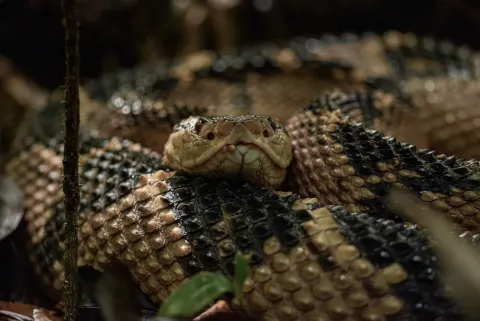
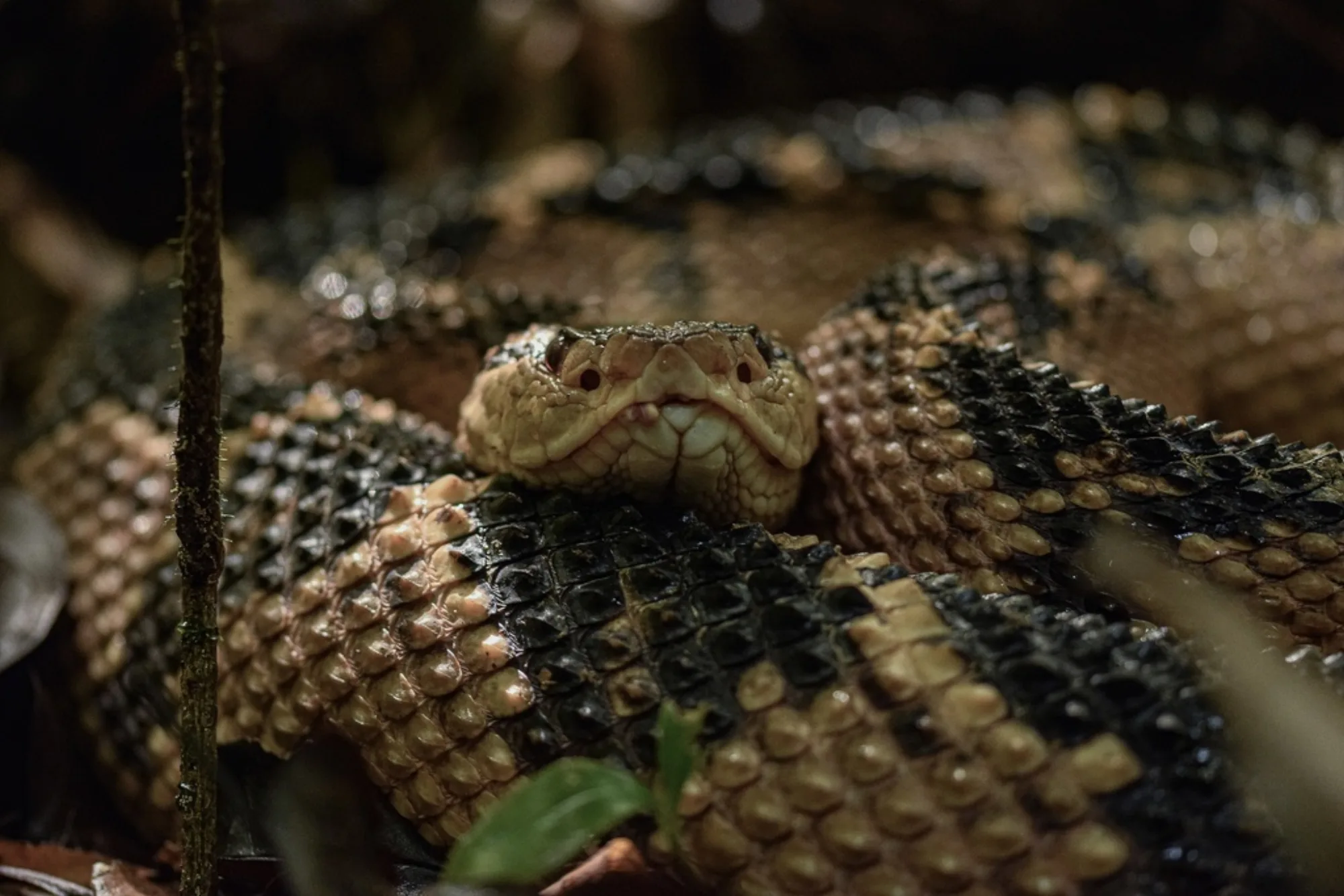
The South American Bushmaster ranges through South America’s equatorial forests, east of the Andes, and also occurs on Trinidad. This venomous pit viper has a broad head set apart from its narrow neck, a rounded snout and a short tail. Its ground colour can be yellowish, reddish or grey-brown, with dark brown or black blotches forming inverted triangles along the sides. These markings can be sharply defined or indistinct, and are normally pale at the centre. Adults average 2 to 2.5 m in length, though a length of 3 m is not unusual. The largest recorded specimen measured 3.65 m, making it the longest of all vipers.
Bushmasters occur in primary and secondary forests, as well as adjacent fields and cleared areas. In Trinidad, they tend to favour hilly and mountainous regions. When alarmed, a bushmaster vibrates its tail vigorously; although it has no rattle, the movement can produce a loud rustling sound in the undergrowth. It also uses this tail vibration defensively in response to potential predators. Rats and mice make up most of its diet, with birds and reptiles eaten occasionally. Its recorded prey also includes agoutis, porcupines, squirrels, opossums, squirrel monkeys and frogs. Spiny rats are favoured in Costa Rica, while rice rats and agoutis are also favoured prey.
The species is badly affected by stress and rarely survives long in captivity. This makes it difficult for researchers to obtain enough venom in good condition for study. Regular venom collection can also reduce the amount obtained from captive snakes.
Written from the English Wikipedia article Lachesis muta (CC BY-SA 4.0).
- Records
- 12
- Countries
- 6
- Atlas places
- 2
These are open occurrence records, so they show where people looked for and recorded the South American Bushmaster as much as where it lives. Cells are up to 25 km across, and every location is generalised to its cell.
Generalised encounter areas, not exact locations. Each shape is a grid cell coloured by how likely the species is there.
- Very likelyPeru25 km zone · medium confidence · 7 records · updated 80 days ago
- Very likelyTrinidad & Tobago25 km zone · medium confidence · 2 records · updated 80 days ago
- LikelyBrazil25 km zone · medium confidence · 1 record · updated 80 days ago
- LikelyColombia25 km zone · medium confidence · 1 record · updated 80 days ago
- PossibleFrench Guiana25 km zone · medium confidence · 1 record · updated 80 days ago
- PossibleEcuador25 km zone · low confidence · 0 records · updated 80 days ago
Conservation status not assessed here yet, so every location is generalised to its grid cell.