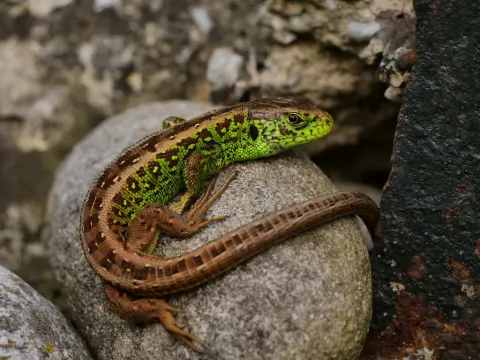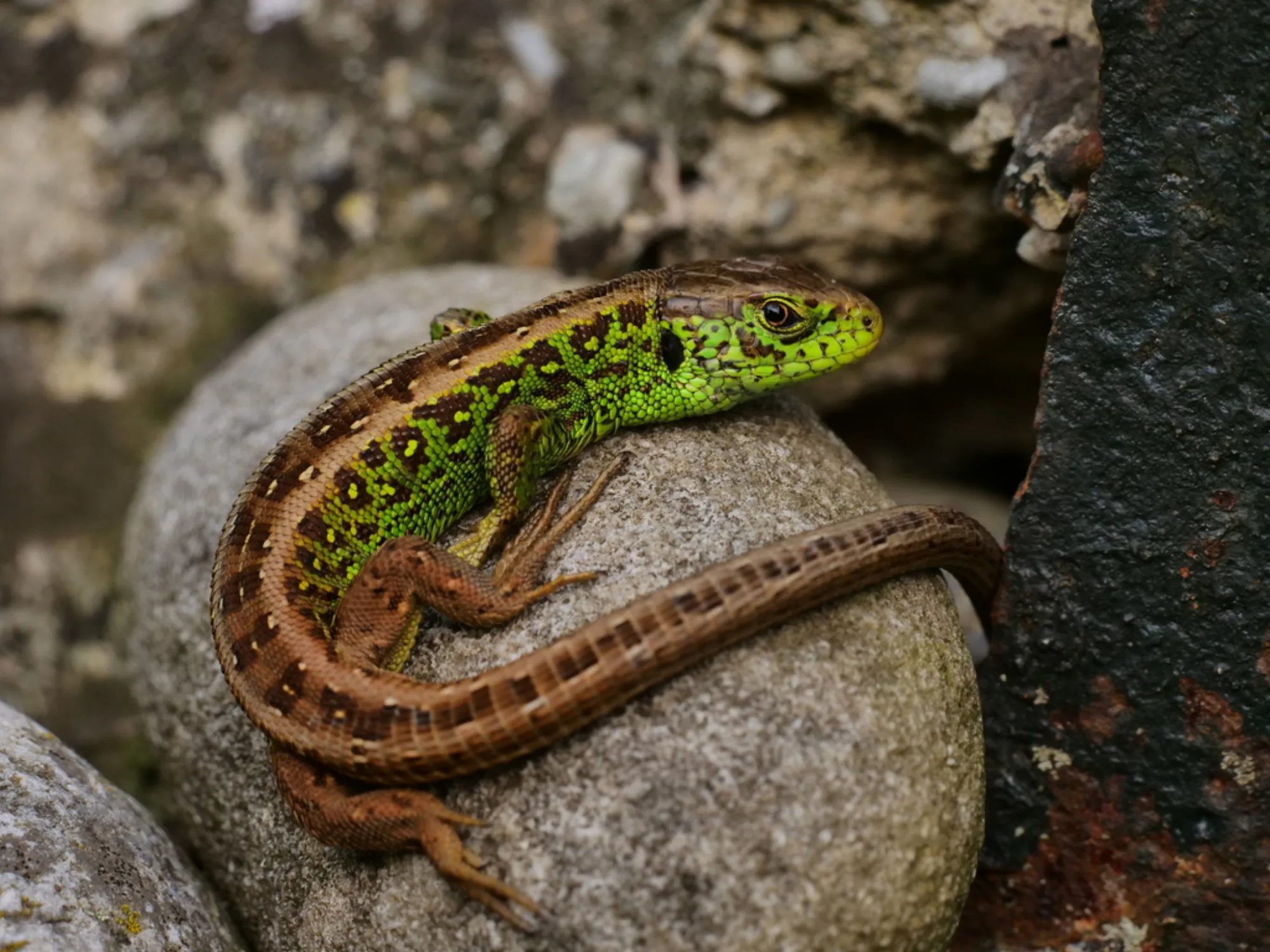
Sand Lizard
Lacerta agilis
Across much of Europe and east to Lake Baikal in Russia, the Sand Lizard has a wide but often patchy distribution. It is absent from European Turkey, and at the northern edge of its range it survives on seaside heathland warmed by the sun. In northwest Europe, look for rows of dark, eye-shaped markings with pale centres along its back and sides. Colour varies across its range: males develop bright green flanks in spring, while females are grey to brown. Some eastern males can be entirely green even outside the breeding season.
Sand lizards favour dry places, including fields, rocky outcrops, heathland, beaches and dunes, and are especially active where the habitat has a variety of structures. In colder Great Britain, they are confined to coastal habitats because their eggs need the warmth of sand. They spend long periods basking, often on logs, with breaks to forage, and also spend time concealed beneath vegetation. In poor weather they emerge later and bask less often. Usually solitary outside the short mating season, males compete over territory and females; females may share burrows or basking areas. A female usually lays one clutch a year, placing six to 15 eggs in loose sand at a sunny spot, where warmth from the ground incubates them.
Foxes, badgers, birds of prey and snakes hunt sand lizards, while cats and other domestic animals also prey on them. A lizard can shed its tail to escape a predator, though the replacement does not reach its original length. Across the range, habitat destruction, degradation and fragmentation threaten the species, along with climate change and inadequate or inappropriate habitat management. In Sweden, populations are highly fragmented, a situation thought to have increased inbreeding and reduced genetic diversity.
Written from the English Wikipedia article Sand lizard (CC BY-SA 4.0).
- Records
- 16,585
- Countries
- 17
No atlas park has a record of the Sand Lizard in or around it yet.
These are open occurrence records, so they show where people looked for and recorded the Sand Lizard as much as where it lives. Cells are up to 25 km across, and every location is generalised to its cell.
Generalised encounter areas, not exact locations. Each shape is a grid cell coloured by how likely the species is there.
- Very likelyFrance25 km zone · high confidence · 5276 records · updated 80 days ago
- Very likelyDenmark25 km zone · medium confidence · 4233 records · updated 80 days ago
- Very likelyGermany25 km zone · high confidence · 3086 records · updated 80 days ago
- Very likelyAustria25 km zone · high confidence · 1228 records · updated 80 days ago
- Very likelyNetherlands25 km zone · high confidence · 1049 records · updated 80 days ago
- Very likelyPoland25 km zone · high confidence · 323 records · updated 80 days ago
- Very likelyUkraine25 km zone · high confidence · 317 records · updated 80 days ago
- Very likelyLuxembourg25 km zone · medium confidence · 273 records · updated 80 days ago
- Very likelyUnited Kingdom25 km zone · medium confidence · 258 records · updated 80 days ago
- Very likelyItaly25 km zone · high confidence · 199 records · updated 80 days ago
Conservation status not assessed here yet, so every location is generalised to its grid cell.