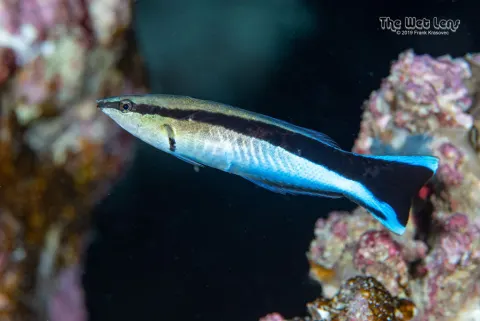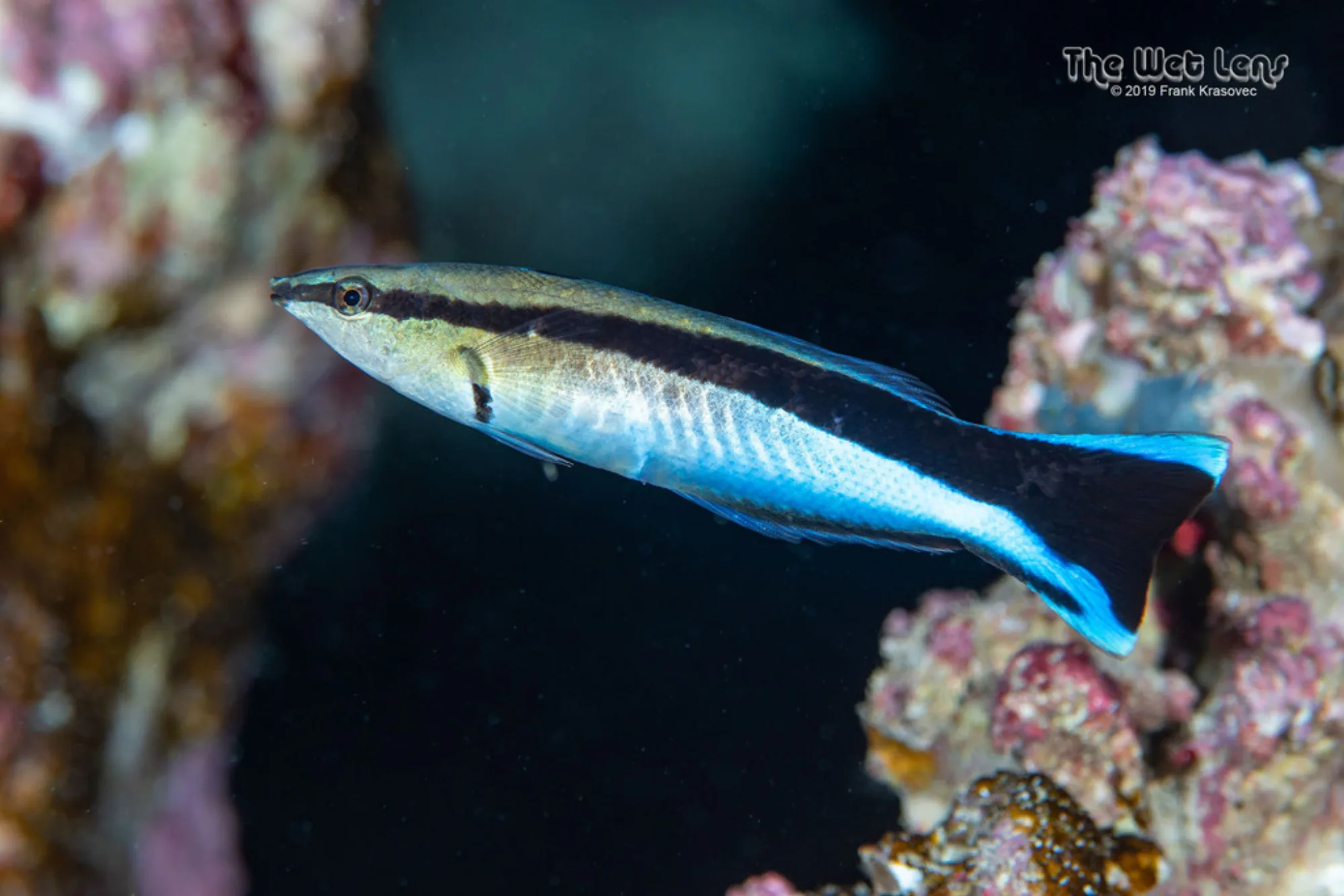
Bluestreak Cleaner Wrasse
Labroides dimidiatus
Look for a dark stripe running through the eye and along the side of the Bluestreak Cleaner Wrasse, widening towards the tail. Its back and belly are white, sometimes tinged with yellow, while the white changes to bright blue at the front. Young fish look different, with black bodies and an electric-blue line. The wrasse averages 10 cm in length and can reach 14 cm. Its tropical coral reef range stretches across the Indian Ocean, between the Red Sea and the western Pacific, with populations around Japan, Fiji, Papua New Guinea and French Polynesia. It has also been recorded north of New Zealand, within the Kermadec Islands Marine Reserve.
Cleaner wrasses gather at cleaning stations, where they may live as a pair of adults, a group of young fish or females accompanied by a dominant male. They greet visiting fish with a dance-like movement, raising and lowering their rear. A visitor seeking attention adopts a pose that lets the cleaner reach its body, gills and sometimes its mouth. The wrasse eats parasites and dead tissue from larger fish, gaining food and protection while its clients benefit too. Its dependence on parasites varies by region: on tidal parts of the Great Barrier Reef, it feeds more on corals than on visiting fish. Young cleaners there bite their clients more often than adults do.
Males defend territories containing females from other males. If the dominant male disappears, one of the larger females can change sex and take over the territory. Some fish imitate cleaner wrasses: one blenny uses similar behaviour to take pieces of flesh or skin from larger fish.
Written from the English Wikipedia article Bluestreak cleaner wrasse (CC BY-SA 4.0).
- Records
- 13,887
- Countries
- 22
- Atlas places
- 2
These are open occurrence records, so they show where people looked for and recorded the Bluestreak Cleaner Wrasse as much as where it lives. Cells are up to 25 km across, and every location is generalised to its cell.
Generalised encounter areas, not exact locations. Each shape is a grid cell coloured by how likely the species is there.
- Very likelyAustralia25 km zone · medium confidence · 4713 records · updated 80 days ago
- Very likelyNorthern Mariana Islands25 km zone · high confidence · 2389 records · updated 80 days ago
- Very likelyU.S. Outlying Islands25 km zone · high confidence · 2285 records · updated 80 days ago
- Very likelyAmerican Samoa25 km zone · high confidence · 2141 records · updated 80 days ago
- Very likelyGuam25 km zone · high confidence · 820 records · updated 80 days ago
- Very likelyTonga25 km zone · high confidence · 557 records · updated 80 days ago
- Very likelyFrench Polynesia25 km zone · high confidence · 393 records · updated 80 days ago
- Very likelySolomon Islands25 km zone · medium confidence · 125 records · updated 80 days ago
- Very likelyRéunion25 km zone · medium confidence · 84 records · updated 80 days ago
- Very likelySouth Africa25 km zone · medium confidence · 76 records · updated 80 days ago
Conservation status not assessed here yet, so every location is generalised to its grid cell.