Dwarf Sperm Whale
Kogia sima
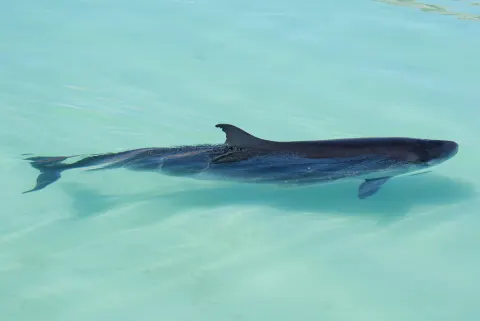
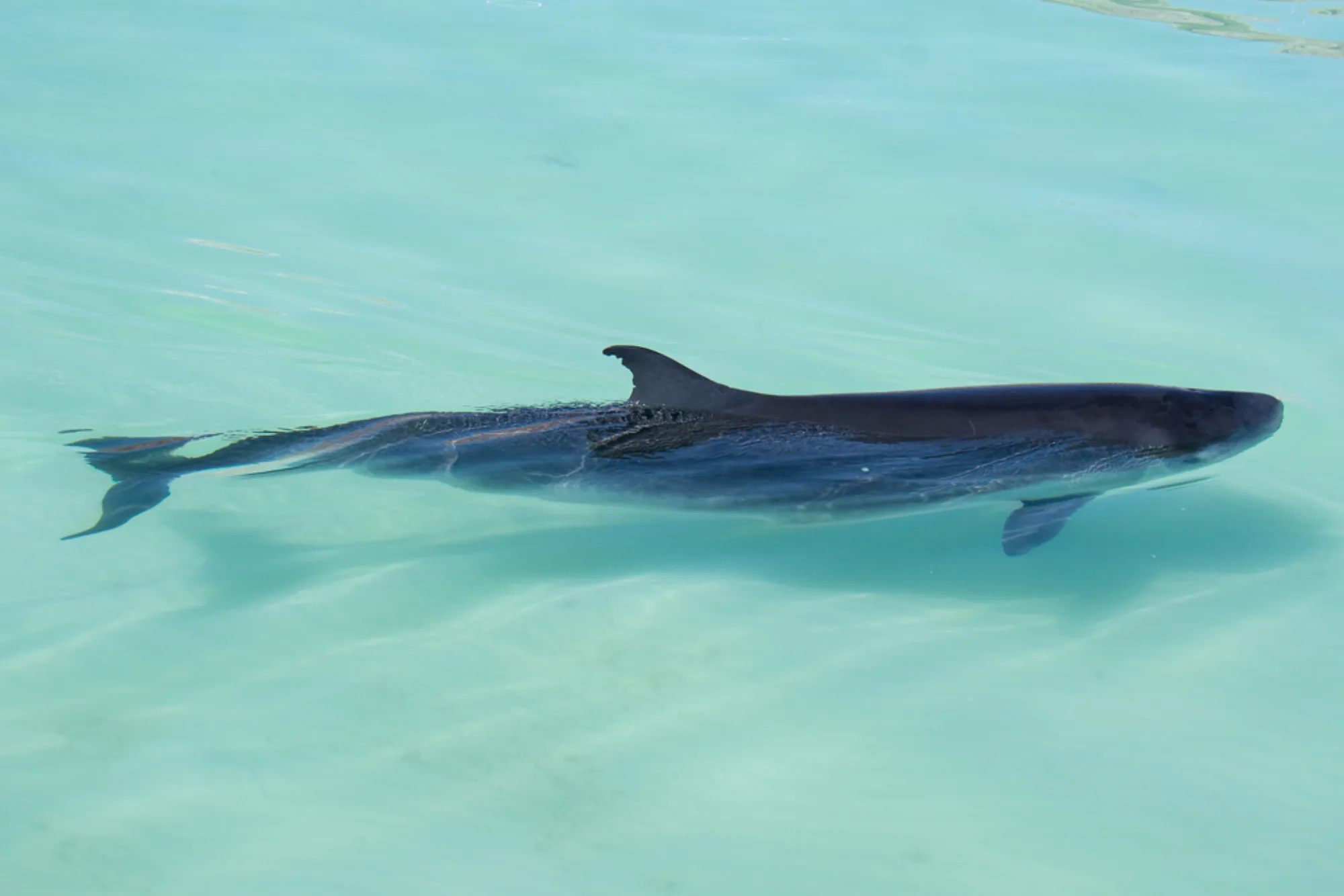
A square head, small jaw and sturdy body give the Dwarf Sperm Whale a distinctive profile, although it can be difficult to distinguish from the pygmy sperm whale. Its skin is dark grey or blue grey, with a lighter underside and a pale crescent between the eye and flipper. The tall dorsal fin sits around the middle of the back, closer to the head than in its pygmy relative. Adults range from 2 to 2.7 m long and weigh 136 to 272 kg.
This small sperm whale lives in tropical and temperate oceans worldwide, especially over continental shelves and slopes. Sightings at sea are rare, and much of what is known comes from stranded animals. It is thought to move slowly, sometimes floating with only the back of its neck and dorsal fin showing. Rather than raising its tail for a dive, it sinks vertically beneath the surface. Groups usually contain one to four whales, although as many as ten may gather. A deep-diving predator, it uses suction to feed mainly on squid, also taking deep-sea fish and crustaceans. When startled, it can release a cloud of red-brown fluid, probably to distract predators. Gestation probably lasts around 9.5 months, and a newborn is generally about 1 m long. Calves begin eating solid food at around 1.35 m, though they are not fully weaned until about 1.5 m.
Orcas and large sharks prey on dwarf sperm whales. People hunt them in small numbers, and some are accidentally caught in fishing nets. Swallowing marine debris and becoming entangled in fishing gear are considered bigger potential threats, though their severity is unknown.
Written from the English Wikipedia article Dwarf sperm whale (CC BY-SA 4.0).
- Records
- 357
- Countries
- 18
- Atlas places
- 4
These are open occurrence records, so they show where people looked for and recorded the Dwarf Sperm Whale as much as where it lives. Cells are up to 25 km across, and every location is generalised to its cell.
Generalised encounter areas, not exact locations. Each shape is a grid cell coloured by how likely the species is there.
- Very likelyUnnamed area25 km zone · high confidence · 110 records · updated 80 days ago
- Very likelyUnited States25 km zone · medium confidence · 93 records · updated 80 days ago
- Very likelyAustralia25 km zone · medium confidence · 56 records · updated 80 days ago
- Very likelyTaiwan25 km zone · medium confidence · 43 records · updated 80 days ago
- LikelyGuadeloupe25 km zone · medium confidence · 10 records · updated 80 days ago
- LikelyMauritania25 km zone · medium confidence · 8 records · updated 80 days ago
- LikelyMexico25 km zone · medium confidence · 5 records · updated 80 days ago
- LikelyNew Caledonia25 km zone · medium confidence · 5 records · updated 80 days ago
- PossibleFrench Polynesia25 km zone · medium confidence · 8 records · updated 80 days ago
- PossibleFrance25 km zone · medium confidence · 3 records · updated 80 days ago
Conservation status not assessed here yet, so every location is generalised to its grid cell.