Pygmy Sperm Whale
Kogia breviceps
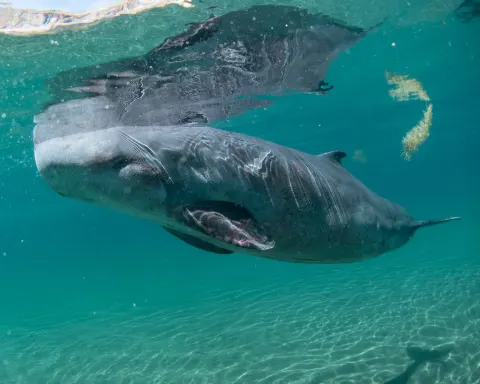
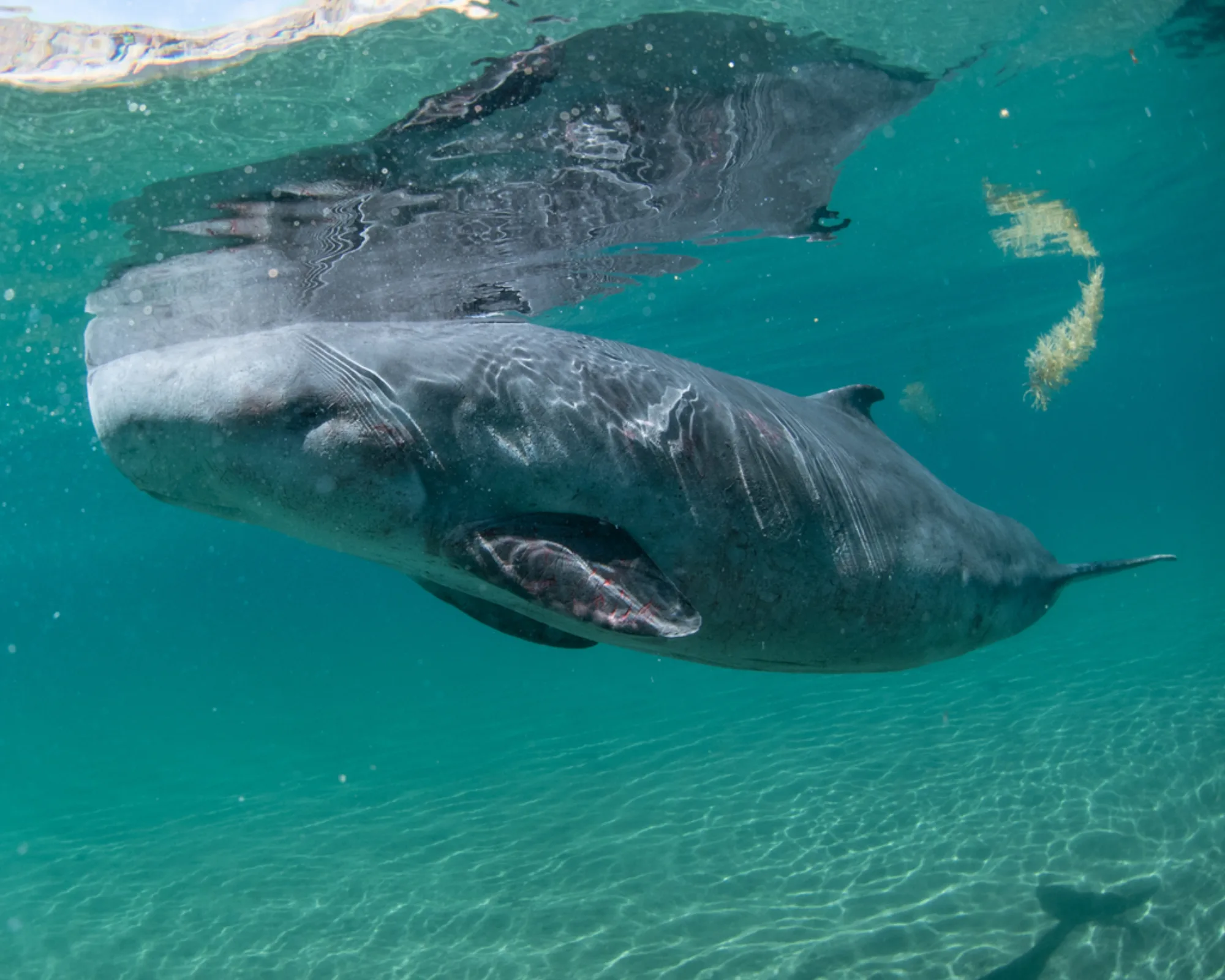
Seldom seen at sea, the Pygmy Sperm Whale is a small sperm whale, not much larger than many dolphins. Adults reach about 3.5 to 3.8 m and weigh about 400 to 450 kg. Look for a large, shark-like head, a small hooked dorsal fin and a whitish mark behind each eye. Its back and sides are bluish grey, while its underside is creamy and sometimes pinkish.
The species lives across the Atlantic, Pacific and Indian Oceans in warm and temperate seas, occasionally reaching colder waters. A 2026 survey also suggests it lives in the Mediterranean Sea. It is believed to favour offshore waters, with sightings most frequent at depths of 400 to 1,000 m, particularly where upwelling concentrates prey. At the surface it moves quietly, rising slowly with little splash or blow, sometimes resting motionless before dropping from view. It tends to back away from boats and is usually alone or in a pair, though groups of up to six have been seen. It hunts by echolocation, feeding mainly on squid and other cephalopods, as well as some deep-sea shrimps and relatively few fish.
After a gestation of 9 to 11 months, a female gives birth to a single calf, which is weaned at around one year old. Great white sharks and killer whales may prey on the species, and a frightened whale can release dark fluid that may help confuse predators. Human pressures include boat strikes, entanglement in fishing nets, plastic swallowed at sea and noise from shipping and military activity. Deep-sea trawling and fishing for cephalopods have also been reported to change its diet and foraging behaviour off Southeast Asia.
Written from the English Wikipedia article Pygmy sperm whale (CC BY-SA 4.0).
- Records
- 890
- Countries
- 11
- Atlas places
- 2
These are open occurrence records, so they show where people looked for and recorded the Pygmy Sperm Whale as much as where it lives. Cells are up to 25 km across, and every location is generalised to its cell.
Generalised encounter areas, not exact locations. Each shape is a grid cell coloured by how likely the species is there.
- Very likelyUnited States25 km zone · medium confidence · 516 records · updated 80 days ago
- Very likelyAustralia25 km zone · medium confidence · 338 records · updated 80 days ago
- LikelyFrance25 km zone · medium confidence · 14 records · updated 80 days ago
- PossibleNew Caledonia25 km zone · medium confidence · 8 records · updated 80 days ago
- PossibleUnnamed area25 km zone · medium confidence · 4 records · updated 80 days ago
- PossibleFrench Polynesia25 km zone · medium confidence · 3 records · updated 80 days ago
- UncommonCanada25 km zone · medium confidence · 3 records · updated 80 days ago
- RarePortugal25 km zone · medium confidence · 2 records · updated 80 days ago
- RareUnited Kingdom25 km zone · medium confidence · 2 records · updated 80 days ago
- RareBahamas25 km zone · low confidence · 0 records · updated 80 days ago
Conservation status not assessed here yet, so every location is generalised to its grid cell.