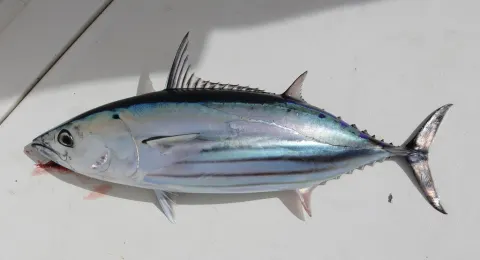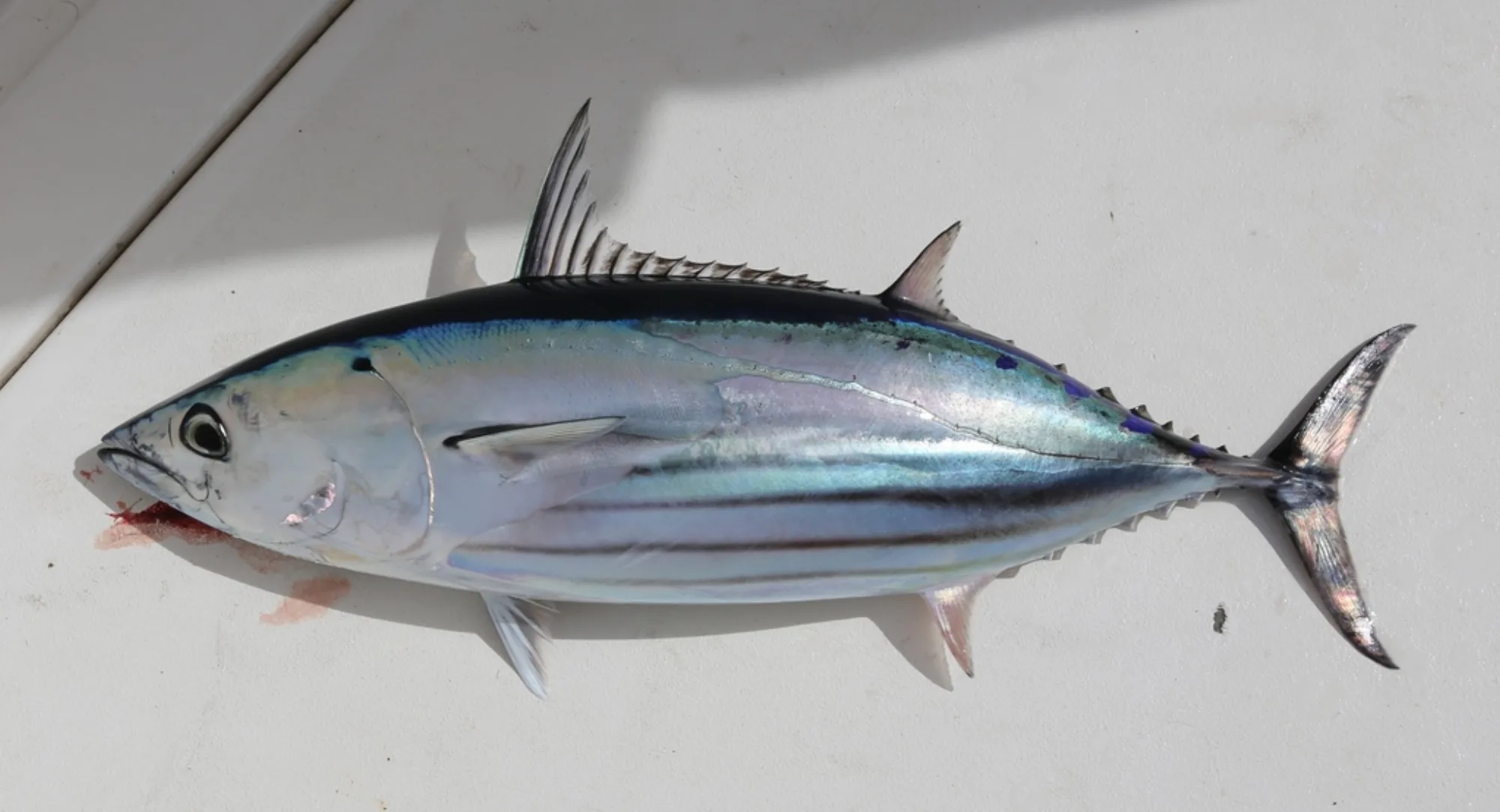
Skipjack Tuna
Katsuwonus pelamis
Built for speed, the Skipjack Tuna is a streamlined fish of tropical and warm-temperate seas around the world. It can grow up to 1.1 m long, though it commonly reaches 80 cm and weighs 8 to 10 kg. Its skin has few scales, with a thick band behind the head and scales along the lateral line. It also has a strong smell.
Skipjack gather near the surface in large shoals that can include other members of the tuna family and reach up to 50,000 fish. They must keep swimming to stay buoyant, and feed on fish, crustaceans, cephalopods and molluscs. Sharks and large fish of the open ocean prey on them. Along a chain of islands, skipjack migrate north in summer and south in autumn, with their fat content changing between the journeys. They spawn in batches throughout the year in equatorial waters, while spawning becomes more seasonal farther from the equator. Their potential lifespan is estimated at 8 to 12 years, although their age is difficult to determine.
Skipjack support a major commercial fishery and are also caught for sport. In 2018, reported landings reached 3.2 million tonnes, placing them third among marine capture fisheries. Their population is considered sustainable against current consumption, but the methods used to catch them remain controversial. Some authorities consider purse seine fishing unsustainable because of excess bycatch, though that bycatch is said to be much lower when fish aggregation devices are not used. Skipjack are sensitive to changes in environmental conditions, and climate change can affect marine ecosystems and the factors that influence their distribution. In global tests, about 90% of skipjack showed contamination by tributyltin, a highly toxic substance that enters the sea from antifouling paint on ship hulls.
Written from the English Wikipedia article Skipjack tuna (CC BY-SA 4.0).
- Records
- 3,423
- Countries
- 24
No atlas park has a record of the Skipjack Tuna in or around it yet.
These are open occurrence records, so they show where people looked for and recorded the Skipjack Tuna as much as where it lives. Cells are up to 25 km across, and every location is generalised to its cell.
Generalised encounter areas, not exact locations. Each shape is a grid cell coloured by how likely the species is there.
- Very likelyUnnamed area25 km zone · medium confidence · 2018 records · updated 80 days ago
- Very likelySeychelles25 km zone · medium confidence · 497 records · updated 80 days ago
- Very likelyUnited States25 km zone · medium confidence · 151 records · updated 80 days ago
- Very likelyBritish Indian Ocean Territory25 km zone · medium confidence · 103 records · updated 80 days ago
- Very likelyMayotte25 km zone · medium confidence · 96 records · updated 80 days ago
- Very likelyLiberia25 km zone · medium confidence · 82 records · updated 80 days ago
- Very likelyAustralia25 km zone · medium confidence · 78 records · updated 80 days ago
- Very likelyFrench Polynesia25 km zone · medium confidence · 51 records · updated 80 days ago
- Very likelyGhana25 km zone · medium confidence · 46 records · updated 80 days ago
- Very likelyFaroe Islands25 km zone · medium confidence · 37 records · updated 80 days ago
Conservation status not assessed here yet, so every location is generalised to its grid cell.