Dark-eyed Junco
Junco hyemalis
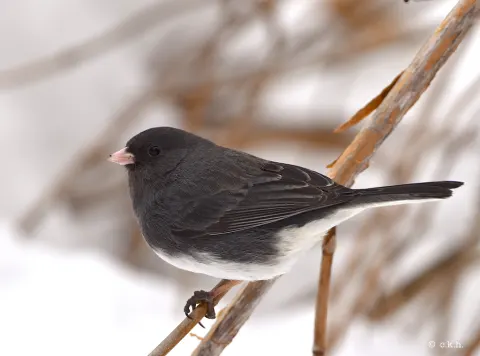
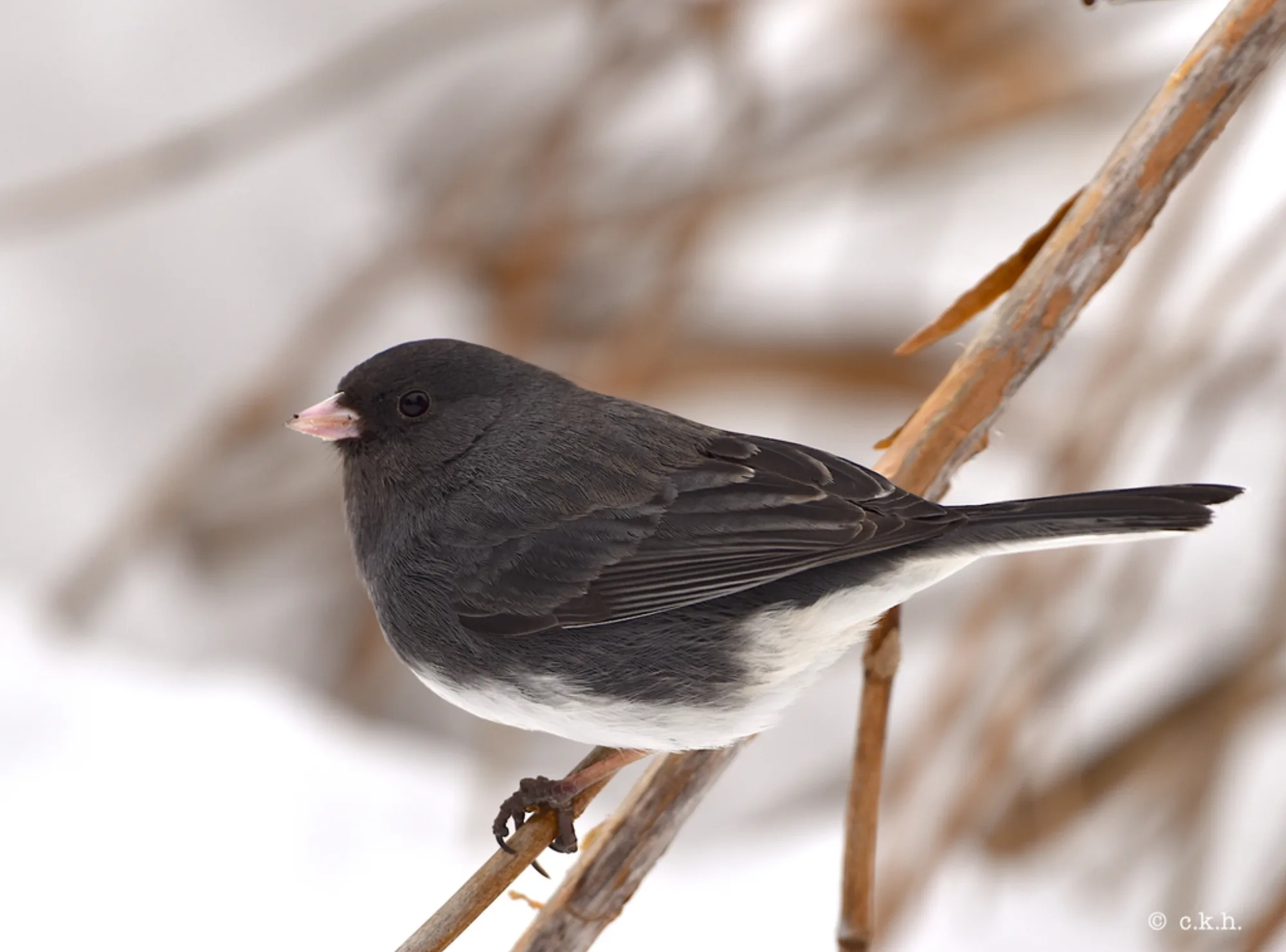
A small sparrow with a pale pinkish bill and a flash of white in its tail, the Dark-eyed Junco can look quite different from place to place. Adults generally have grey heads and breasts, grey or brown backs and wings, and white bellies. Look for the white outer tail feathers as a bird flies or hops across the ground. Males tend to be more boldly marked than females, while young birds often have pale streaks underneath. Listen, too, for a trilling song or calls that include ticks and high, tinkling chips.
Common across much of temperate North America, this junco reaches far into the Arctic in summer. It breeds in coniferous and mixed forests, although it also uses other habitats where conditions are suitable. Northern birds migrate south for winter, while some populations stay in the same area year-round or move between elevations. Around towns in winter, travellers may find them visiting feeders or foraging on the ground, often in flocks. Seeds and insects make up most of their food, with seeds accounting for three quarters of the diet across the year. During breeding, insects become more prominent in the adults' diet and are the main food of the young.
A nest is usually a cup-shaped hollow on the ground, concealed by vegetation or other material and lined with fine grasses and hair. Two clutches of four eggs are normally laid in a breeding season; the female incubates them for 12 to 13 days, and the young leave the nest 11 to 14 days after hatching. Heavy metal poisoning is a documented problem for urban birds, and blood parasites have been found in urban and non-urban junco populations in California.
Written from the English Wikipedia article Dark-eyed junco (CC BY-SA 4.0).
- Records
- 4,951,509
- Countries
- 13
- Atlas places
- 4
These are open occurrence records, so they show where people looked for and recorded the Dark-eyed Junco as much as where it lives. Cells are up to 25 km across, and every location is generalised to its cell.
Generalised encounter areas, not exact locations. Each shape is a grid cell coloured by how likely the species is there.
- Very likelyUnited States25 km zone · high confidence · 3948401 records · updated 86 days ago
- Very likelyCanada25 km zone · high confidence · 998768 records · updated 86 days ago
- Very likelySt. Pierre & Miquelon25 km zone · high confidence · 1525 records · updated today
- LikelyMexico25 km zone · high confidence · 2001 records · updated today
- LikelyBelgium25 km zone · high confidence · 268 records · updated today
- PossibleUnited Kingdom25 km zone · high confidence · 223 records · updated today
- PossibleBermuda25 km zone · high confidence · 175 records · updated today
- PossibleNorway25 km zone · high confidence · 109 records · updated today
- PossibleNetherlands25 km zone · medium confidence · 24 records · updated today
- UncommonFinland25 km zone · medium confidence · 10 records · updated today
Conservation status not assessed here yet, so every location is generalised to its grid cell.