Longfin Mako
Isurus paucus
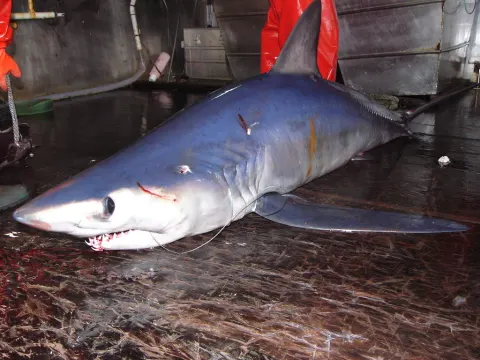
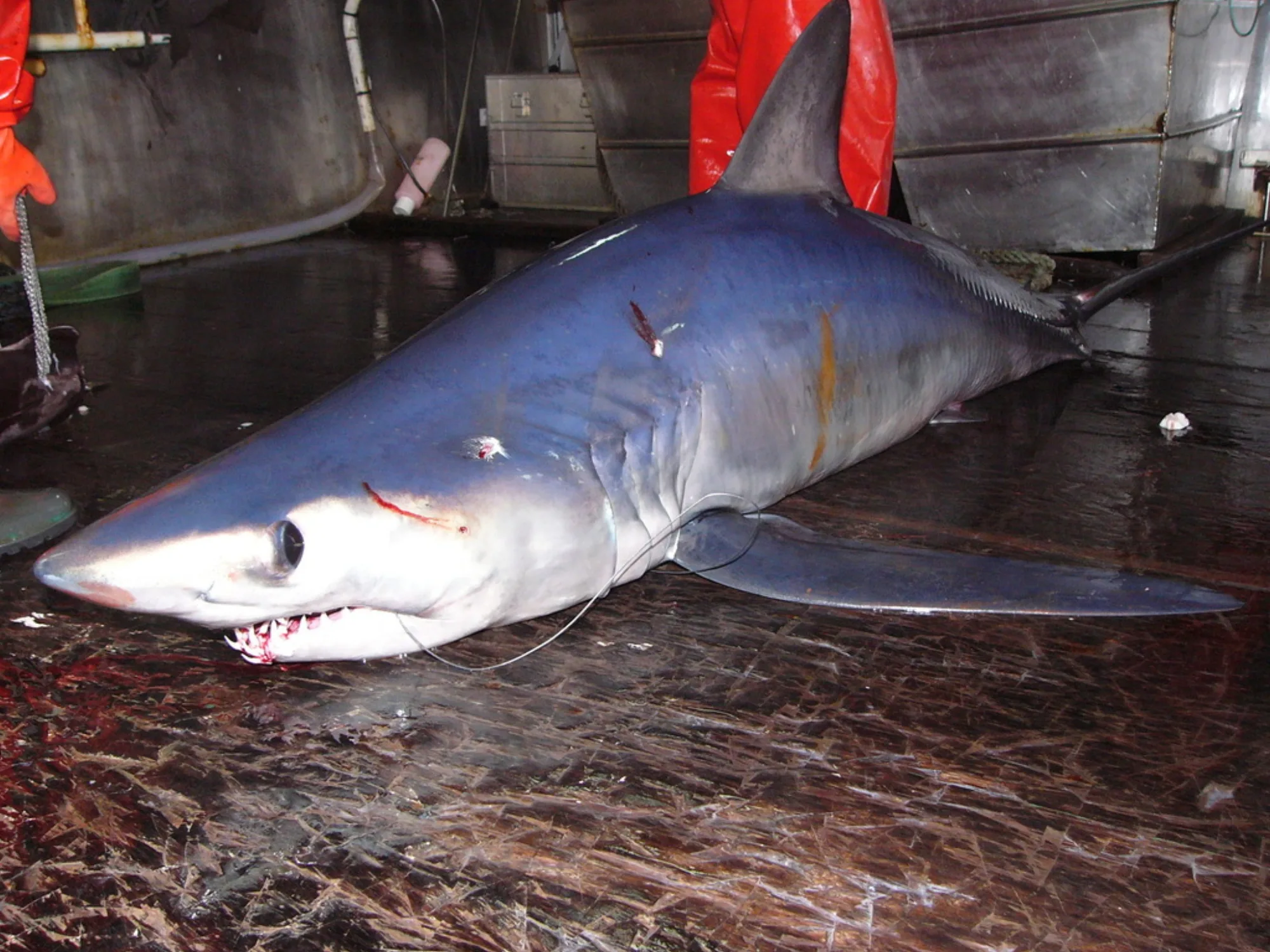
Slim and dark-backed, the Longfin Mako is an uncommon mackerel shark with a pointed snout, large eyes and long, broad fins behind its head. Its upper body ranges from dark blue to greyish black, while its underside is white. The largest reported individual was a female measuring 4.3 m, and females grow larger than males.
Scattered records suggest that this shark ranges across tropical and warm-temperate oceans worldwide, although confusion with the shortfin mako makes its range difficult to establish. It has been recorded in the Caribbean, off southern Brazil, in the Mozambique Channel and off Japan, Taiwan and northeastern Australia. An open-ocean shark, it generally spends the day in deeper water and rises nearer the surface at night. Most catches off Cuba are at depths of 110 to 220 m, compared with 50 to 190 m off New South Wales.
Its slender build and long fins suggest a less active swimmer than the shortfin mako. Large eyes and an attraction to chemical lights suggest that it hunts by sight, feeding mainly on small schooling fish and squid. Mothers usually give birth to two pups, although a pregnant female carrying eight developed embryos has been recorded. Before birth, the developing young feed on unfertilised eggs supplied by their mother. Records off Florida suggest that females enter shallow coastal waters in winter to give birth. Young sharks may be eaten by larger sharks, while adults have no natural predators. Fishing poses a threat: longfin makos are caught unintentionally on longlines, as well as by anchored nets and hook-and-line fishing, and their rarity and low reproductive rate add to concern about continuing deaths as bycatch.
Written from the English Wikipedia article Longfin mako shark (CC BY-SA 4.0).
- Records
- 29
- Countries
- 4
No atlas park has a record of the Longfin Mako in or around it yet.
These are open occurrence records, so they show where people looked for and recorded the Longfin Mako as much as where it lives. Cells are up to 25 km across, and every location is generalised to its cell.
Generalised encounter areas, not exact locations. Each shape is a grid cell coloured by how likely the species is there.
- Very likelyUnited Kingdom25 km zone · medium confidence · 12 records · updated 80 days ago
- Very likelyPortugal25 km zone · medium confidence · 5 records · updated 80 days ago
- PossibleSouth Africa25 km zone · medium confidence · 6 records · updated 80 days ago
- PossibleUnnamed area25 km zone · medium confidence · 3 records · updated 80 days ago
- UncommonAustralia25 km zone · medium confidence · 3 records · updated 80 days ago
Conservation status not assessed here yet, so every location is generalised to its grid cell.