Black Marlin
Istiompax indica
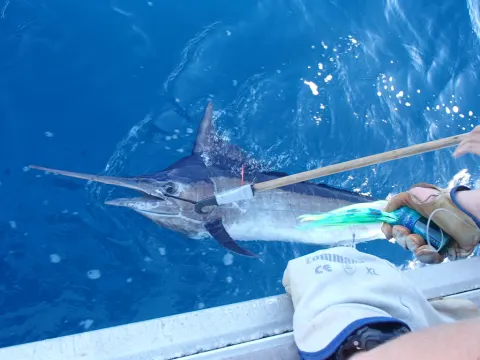
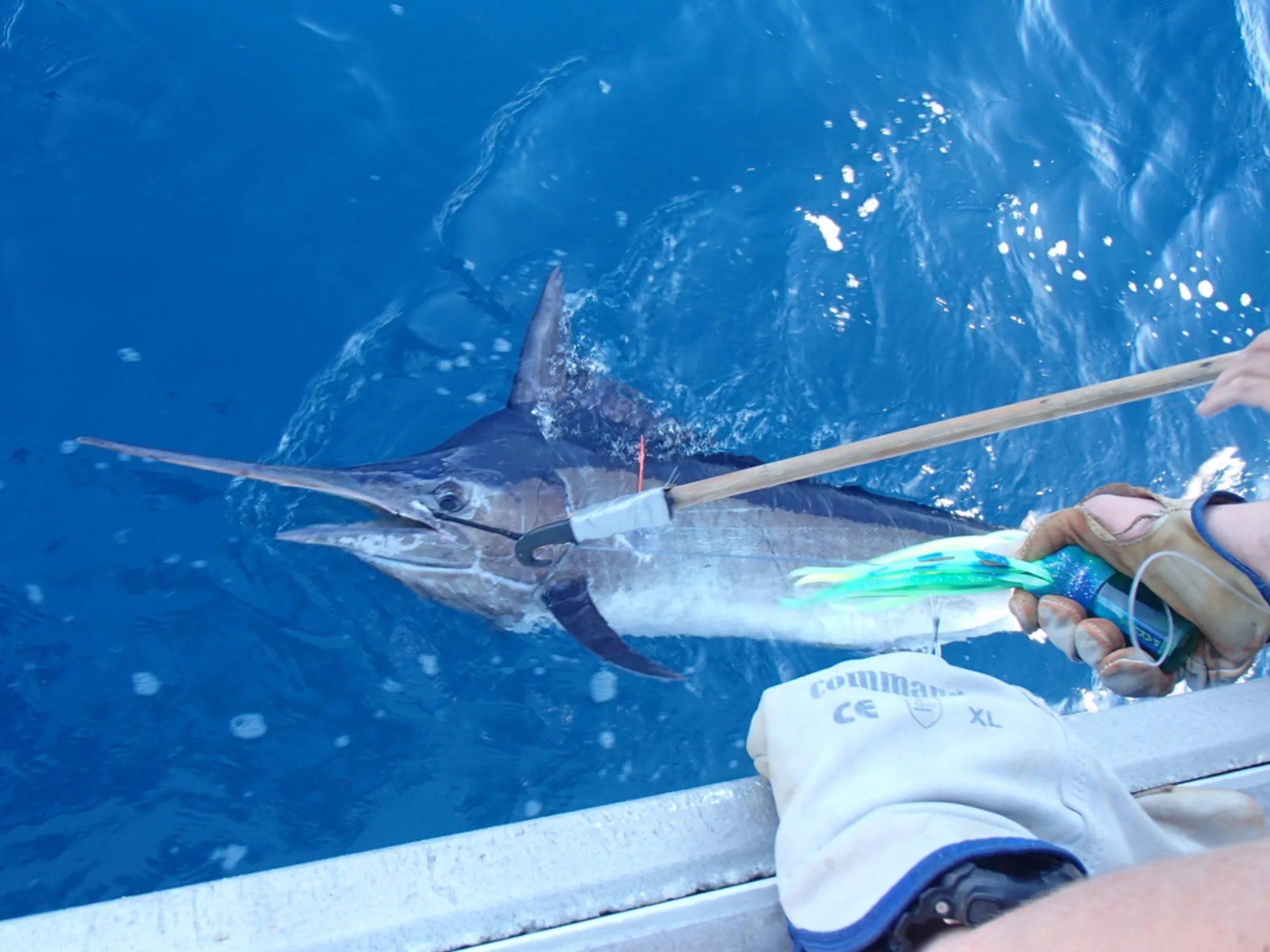
Built for the open water, the Black Marlin is one of the largest marlins and among the largest bony fish. It can exceed 4.5 m in length, and females can weigh more than 700 kg. Its body is deep and solid, with a short, heavy bill and a rounded, low dorsal fin. The back is dark blue-black, the underside is silvery, and a yellowish stripe often separates the two colours. Its stiff side fins cannot be pressed flat against the body, particularly in larger fish.
Black marlin roam tropical and subtropical waters of the Indian and Pacific Oceans, occasionally entering temperate seas. They range from the surface to about 500 metres deep and spend more time near the surface than most other billfish. In one population, fish spent more of their time in the upper 30 metres at night than during the day. Young black marlin gather seasonally in Australia's Great Barrier Reef lagoon, where abundant resources help them grow.
Their diet consists mainly of fish and cephalopods, with mackerel scad a favoured prey. Squid, octopus, crustaceans and even young sharks have also been found in their diet. Slashes on prey recovered from stomachs suggest that black marlin use their bills when hunting among schools of fish. Spawning takes place at different times across their range, with observations around southern Asia in May and June and around Australia between October and December. Black marlin are caught commercially and sought after by recreational anglers off South America, southern Asia and Australia. Their migratory habits, frequent confusion with other large billfish and limited research make it difficult to assess their populations.
Written from the English Wikipedia article Black marlin (CC BY-SA 4.0).
- Records
- 68
- Countries
- 8
- Atlas places
- 1
These are open occurrence records, so they show where people looked for and recorded the Black Marlin as much as where it lives. Cells are up to 25 km across, and every location is generalised to its cell.
Generalised encounter areas, not exact locations. Each shape is a grid cell coloured by how likely the species is there.
- Very likelyAustralia25 km zone · medium confidence · 31 records · updated 80 days ago
- Very likelyUnnamed area25 km zone · medium confidence · 10 records · updated 80 days ago
- Very likelyCôte d’Ivoire25 km zone · medium confidence · 7 records · updated 80 days ago
- Very likelyMozambique25 km zone · medium confidence · 7 records · updated 80 days ago
- Very likelySouth Africa25 km zone · medium confidence · 4 records · updated 80 days ago
- LikelyMauritania25 km zone · medium confidence · 3 records · updated 80 days ago
- LikelyNew Zealand25 km zone · medium confidence · 3 records · updated 80 days ago
- LikelyUnited Kingdom25 km zone · medium confidence · 3 records · updated 80 days ago
- LikelyChile25 km zone · low confidence · 0 records · updated 80 days ago
Conservation status not assessed here yet, so every location is generalised to its grid cell.