Cookiecutter Shark
Isistius brasiliensis
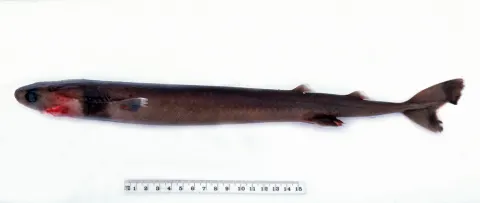
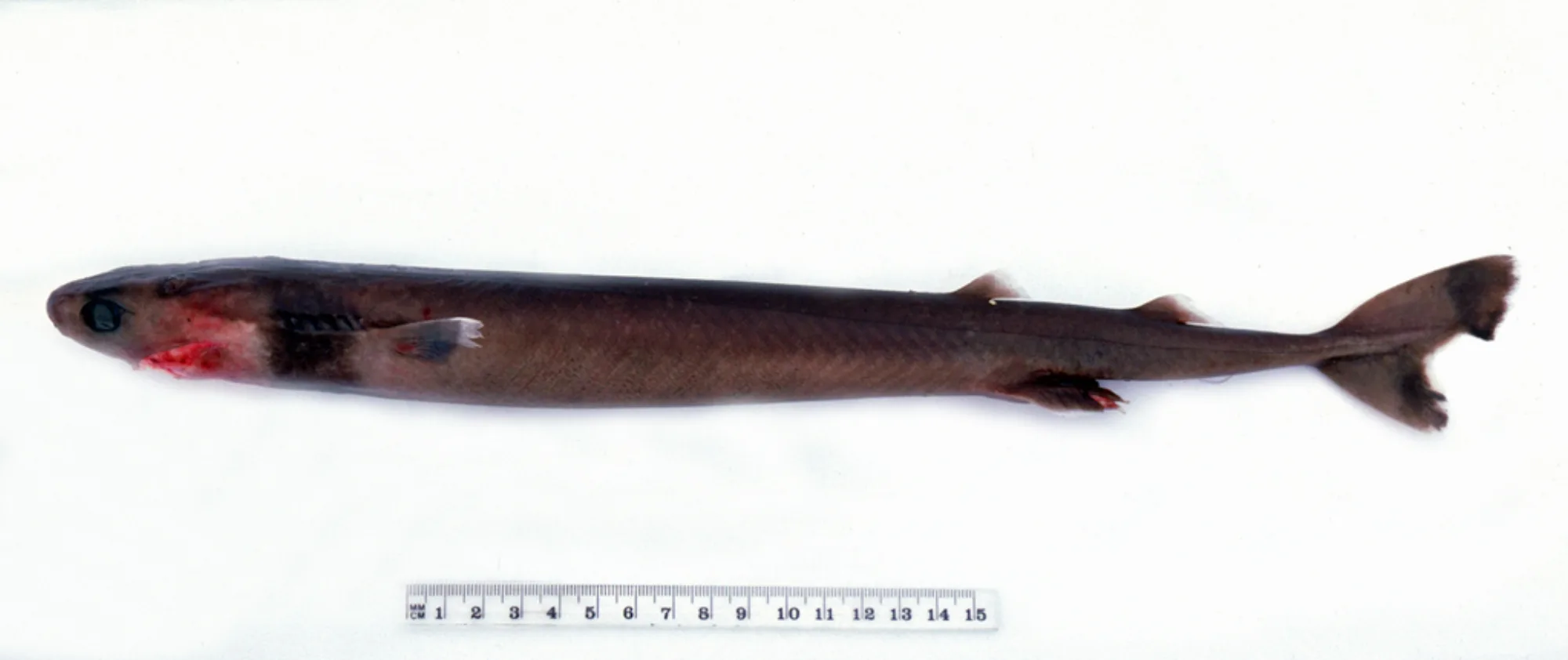
Small, dark and cigar-shaped, the Cookiecutter Shark (Isistius brasiliensis) has a blunt snout, large green eyes and two tiny fins on its back. Males reach a recorded maximum of 42 cm and females 56 cm. Its underside glows green, apart from a dark collar around the throat and gills.
This oceanic shark lives in tropical and warm-temperate seas around the world, often near islands. Records range from the Bahamas and southern Brazil to waters off Japan, Australia and New Zealand, as well as the Hawaiian and Galápagos Islands. It is rarely encountered by people, spending daylight hours 1 to 3.7 km deep. At night it rises through the water, usually staying below 85 m and only rarely reaching the surface. Its daily movement between depths can cover up to 3 km in each direction.
The shark can hover in the water and has been known to travel in schools. Its glowing underside helps conceal its outline from below, while the dark collar may resemble a small fish and lure prey closer. When larger, faster prey comes close, the shark can dart forward to seize it. It bites round plugs of flesh from larger animals, including whales, dolphins, tuna and other sharks. It also swallows smaller prey whole, including squid. The young develop on yolk before birth, and a female produces 6 to 12 pups at a time. Fishing gear occasionally catches the shark, including plankton nets, midwater trawls and longlines set in the open ocean, though no significant population threats are reported.
Written from the English Wikipedia article Cookiecutter shark (CC BY-SA 4.0).
- Records
- 74
- Countries
- 3
No atlas park has a record of the Cookiecutter Shark in or around it yet.
These are open occurrence records, so they show where people looked for and recorded the Cookiecutter Shark as much as where it lives. Cells are up to 25 km across, and every location is generalised to its cell.
Generalised encounter areas, not exact locations. Each shape is a grid cell coloured by how likely the species is there.
- Very likelyUnnamed area25 km zone · high confidence · 63 records · updated 80 days ago
- Very likelyChina25 km zone · medium confidence · 4 records · updated 80 days ago
- LikelyAustralia25 km zone · medium confidence · 7 records · updated 80 days ago
- PossibleUnited States25 km zone · low confidence · 0 records · updated 80 days ago
Conservation status not assessed here yet, so every location is generalised to its grid cell.