Eastern Water Dragon
Intellagama lesueurii
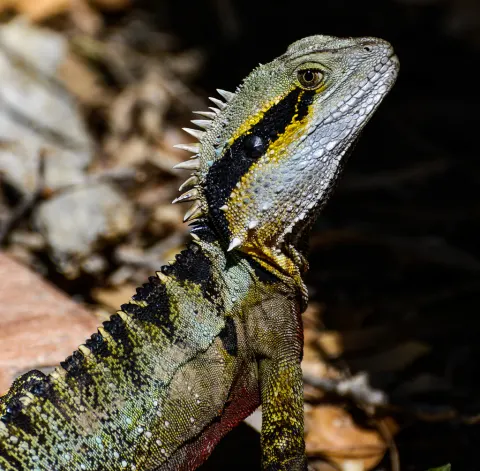
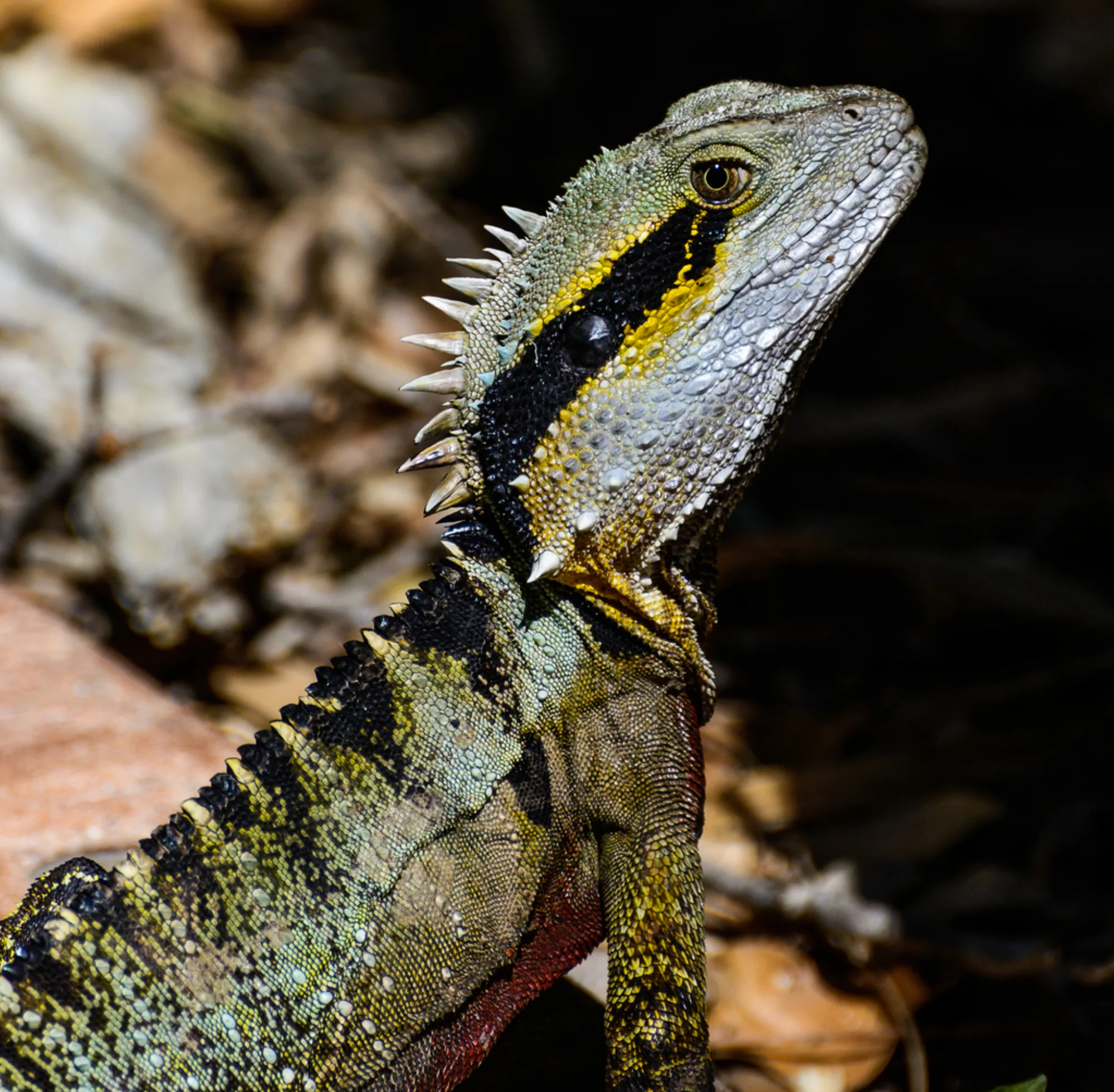
A dark stripe behind the eye helps distinguish the Eastern Water Dragon from its Gippsland relative. This semi-aquatic lizard has a pale, usually unmarked throat, and mature males often have a bright to deep red chest and belly. Both subspecies are generally light greenish grey, with darker bands across the back, tail and legs. A row of spikes runs from behind the head down the spine, becoming smaller towards the tail. Adult females reach about 60 cm in total length, while males may exceed one metre.
Native to eastern Australia, Australian water dragons occur from Victoria north to Queensland, close to creeks, rivers, lakes and other water bodies. Look for places with branches or rocks where they can bask in open or filtered sun. They are shy in the wild, though they readily adapt to people in suburban parks and gardens. Strong climbers and fast runners, they may escape danger by hiding in thick vegetation or dropping from a branch into water. They can remain submerged on the bottom of a shallow creek or lake for up to 90 minutes. Males defend territories, sometimes chasing or fighting other males.
Young dragons eat spiders and small insects, while adults take a wider range of prey, including frogs, fish and small rodents, although insects remain their most common food. They also eat fruit and flowers. In spring, females lay 6 to 18 eggs in a burrow, usually in sunny, sandy or soft soil. Birds, snakes, cats, dogs and foxes prey on water dragons, and young animals are especially vulnerable to carnivorous birds. Roads pose another danger when dragons are drawn to warm bitumen and concrete for basking.
Written from the English Wikipedia article Australian water dragon (CC BY-SA 4.0).
- Records
- 13,663
- Countries
- 1
- Atlas places
- 5
These are open occurrence records, so they show where people looked for and recorded the Eastern Water Dragon as much as where it lives. Cells are up to 25 km across, and every location is generalised to its cell.
Generalised encounter areas, not exact locations. Each shape is a grid cell coloured by how likely the species is there.
- Very likelyAustralia25 km zone · high confidence · 13663 records · updated 80 days ago
Conservation status not assessed here yet, so every location is generalised to its grid cell.