Amazon River Dolphin
Inia geoffrensis
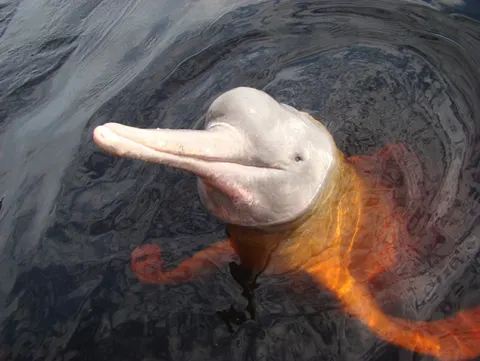
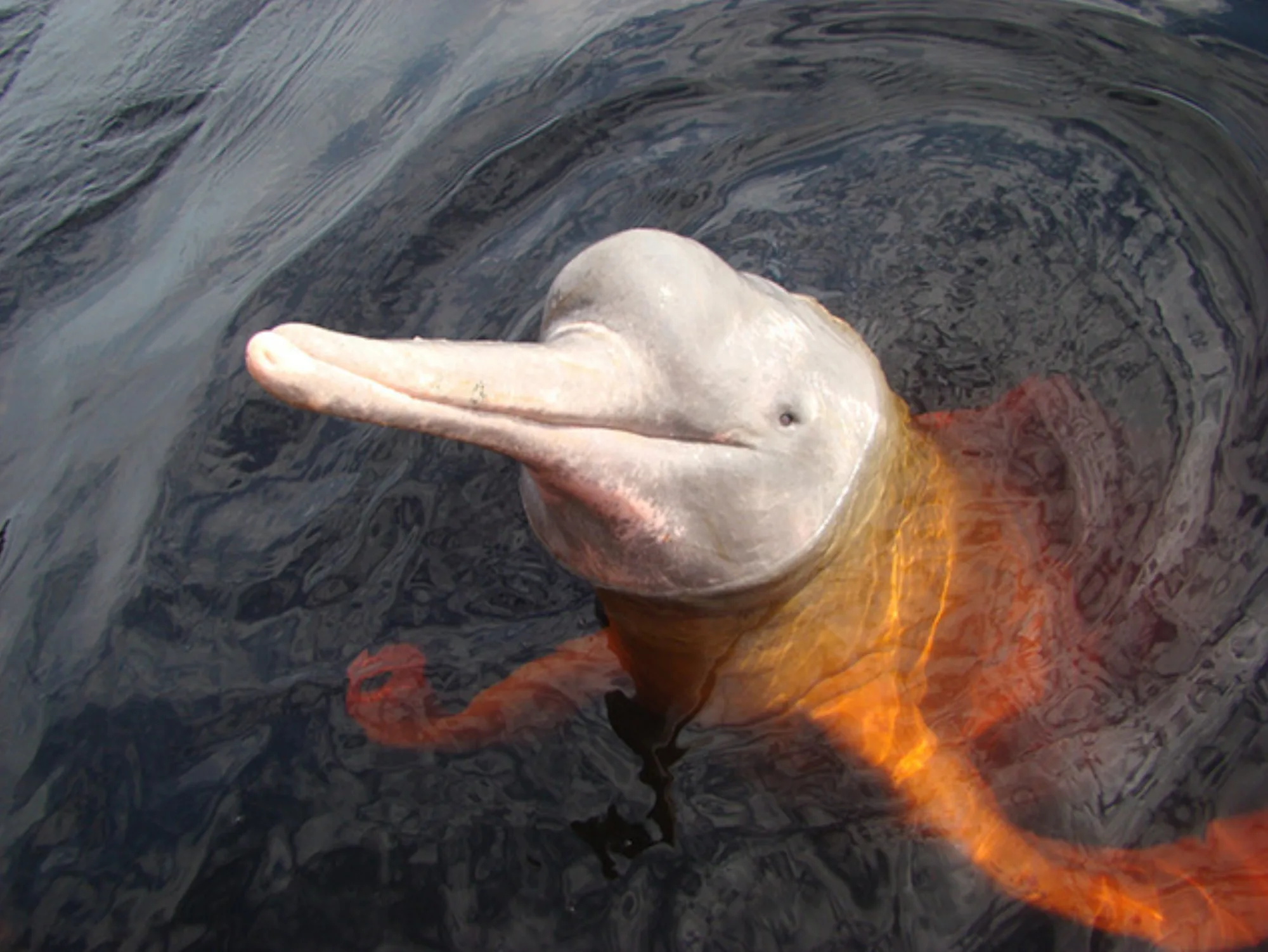
Pink adults and a long, slender snout make the Amazon River Dolphin distinctive among the waterways of South America. Also called the boto, it is a toothed whale and the largest river dolphin, with many adult males reaching 2.5 metres in length and 185 kilograms in weight. Young animals are dark grey, becoming lighter as they grow, while adults can be solid or mottled pink. Its large, paddle-shaped fins help it manoeuvre through flooded forest, although they also reduce its speed.
The dolphin occurs across the Amazon and Orinoco basins, including the upper Madeira River in Bolivia, and is found in rivers, tributaries, lakes and channels. As water levels rise in the rainy season, it moves out of the main channels into smaller tributaries, flooded forests and floodplains. Look for animals alone or in pairs, although larger groups gather where food is plentiful and at river mouths. When surfacing, the tip of the snout and the dorsal fin appear together, while the tail seldom shows before a dive. These dolphins feed during both day and night, taking fish such as catfish and piranhas, as well as river turtles and freshwater crabs. Births take place between May and June, during the flood season, and females and their young remain in flooded areas longer than males.
Fishing brings several dangers: dolphins can become entangled in nets and die, or be deliberately killed, including for use as bait. Dams and pollution also threaten them, while deforestation and other human activities disrupt their habitat.
Written from the English Wikipedia article Amazon river dolphin (CC BY-SA 4.0).
- Records
- 79
- Countries
- 5
- Atlas places
- 4
These are open occurrence records, so they show where people looked for and recorded the Amazon River Dolphin as much as where it lives. Cells are up to 25 km across, and every location is generalised to its cell.
Generalised encounter areas, not exact locations. Each shape is a grid cell coloured by how likely the species is there.
- Very likelyEcuador25 km zone · medium confidence · 41 records · updated 80 days ago
- Very likelyBolivia25 km zone · medium confidence · 14 records · updated 80 days ago
- Very likelyColombia25 km zone · medium confidence · 7 records · updated 80 days ago
- LikelyBrazil25 km zone · medium confidence · 14 records · updated 80 days ago
- LikelyPeru25 km zone · medium confidence · 3 records · updated 80 days ago
Conservation status not assessed here yet, so every location is generalised to its grid cell.