Indri
Indri indri
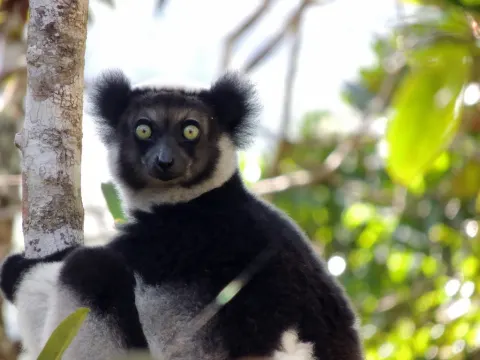
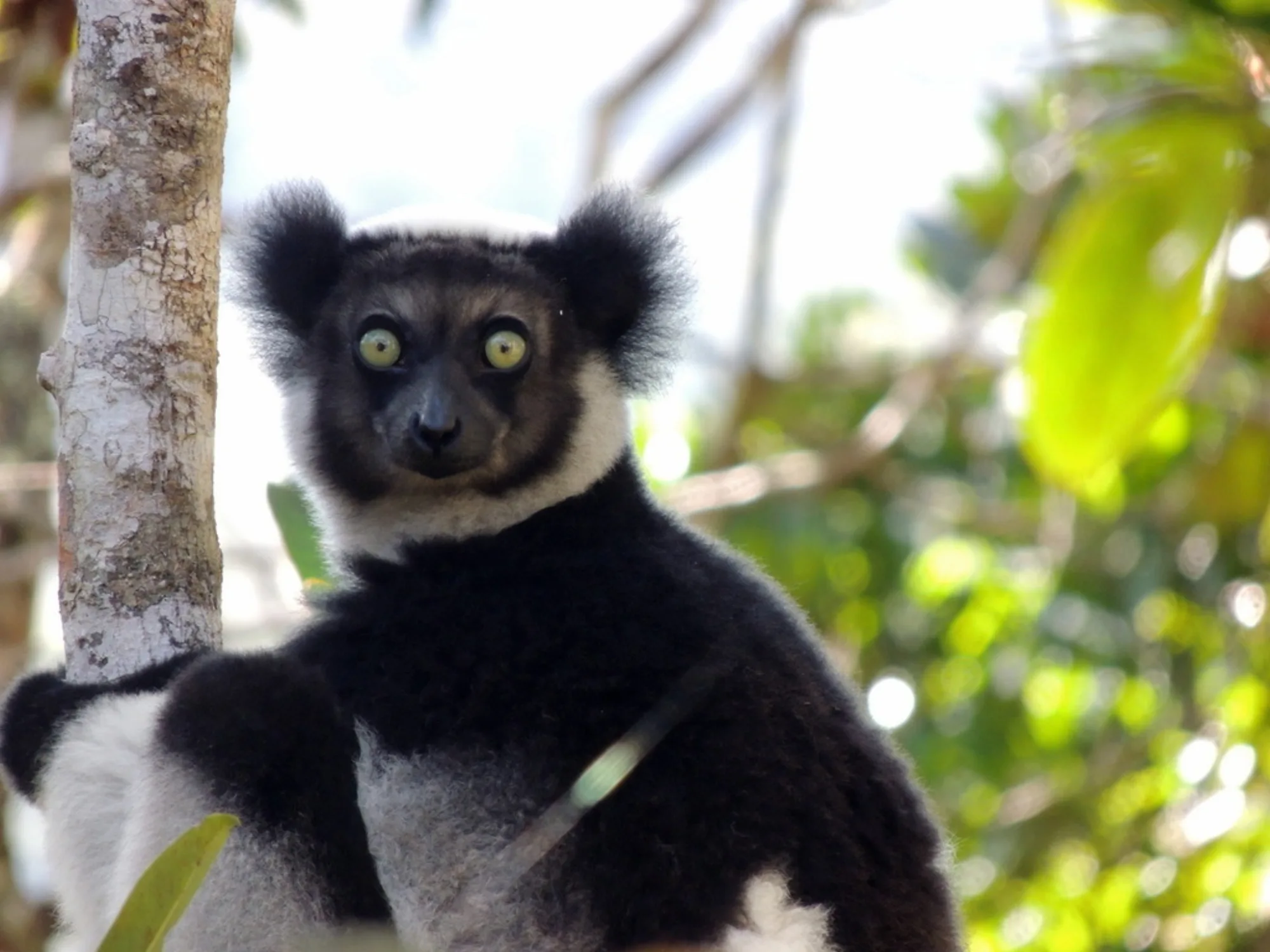
Among the largest living lemurs, the Indri has a black and white coat, a black face, round fuzzy ears and large greenish eyes. Its head and body measure 64 to 72 cm, and it weighs between 6 and 9.5 kg. The tail is very short, while long, muscular legs propel it between tree trunks. Colour varies across its range, and some northern animals are mostly or entirely black.
The Indri lives in lowland and mountain forests along Madagascar's eastern coast, from the Réserve Spéciale d'Anjanaharibe-Sud south to the Mangoro River. Active during the day, it travels through the canopy and holds itself upright when climbing, leaping or resting in branches. Small family groups usually consist of a male and female and their growing offspring, with the female typically leading their travels. Groups often cover 300 to 700 m a day and sleep in trees, alone or in pairs. Their loud songs range in length from 45 seconds to over 3 minutes, and different groups often answer one another. Singing peaks between 7 and 11 am, and before a song the animals move to the treetops. Young leaves are a favourite food, supplemented by seeds, fruit and flowers.
Pairs stay together for the long term, and females give birth every two to three years. Usually, one infant arrives in May or June; its mother provides most of its care, with help from the father. The youngster clings to her belly before moving onto her back and is not fully independent until at least two years old. Forest destruction and fragmentation threaten the Indri as people clear land for agriculture, gather fuelwood and cut timber. It is also hunted, despite traditional taboos that protect it.
Written from the English Wikipedia article Indri (CC BY-SA 4.0).
- Records
- 1,973
- Countries
- 1
No atlas park has a record of the Indri in or around it yet.
These are open occurrence records, so they show where people looked for and recorded the Indri as much as where it lives. Cells are up to 25 km across, and every location is generalised to its cell.
Generalised encounter areas, not exact locations. Each shape is a grid cell coloured by how likely the species is there.
- Very likelyMadagascar25 km zone · high confidence · 1973 records · updated 80 days ago
Conservation status not assessed here yet, so every location is generalised to its grid cell.