Brahminy Blindsnake
Indotyphlops braminus
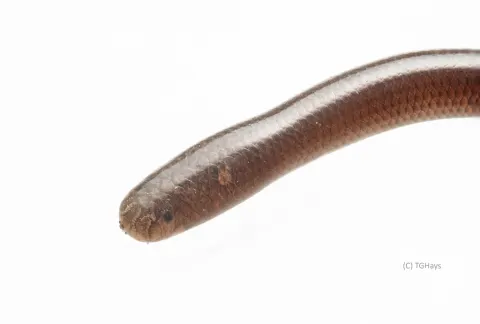
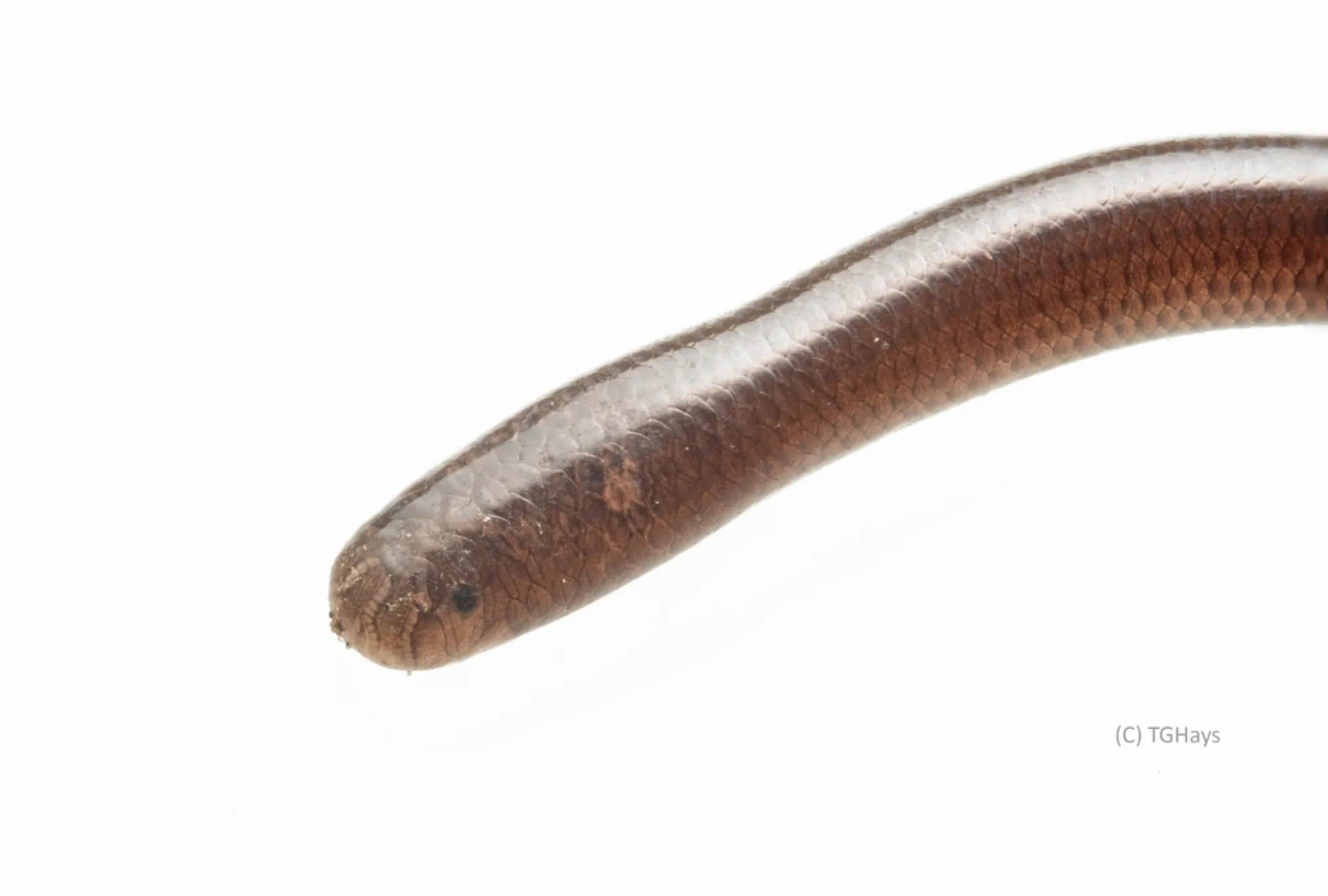
Easy to mistake for an earthworm, the Brahminy Blindsnake is a small, non-venomous reptile that spends its life burrowing. Its tiny eyes and scales distinguish it from a worm, whose body has ring-like segments. Adults usually measure 5.1 to 10.2 cm long, although some reach 15 cm. The head and tail look much alike, and the eyes are barely visible as small dots. Its colour ranges from charcoal grey and silver-grey to light yellow-beige or purplish, with a paler underside; albino individuals are uncommon. Young snakes have similar colouring to adults.
Most records are from Africa and Asia, though introductions have carried the snake as far as Australia, Oceania and the Americas. It occurs in urban and agricultural areas, as well as wet forest and dry jungle. It lives underground in ant and termite nests, and can also be found beneath logs, moist leaves, stones and humus, including in abandoned buildings and city gardens. Soil moisture and temperature influence where this group of blind snakes can live and survive. In Sri Lanka it occurs from sea level to 1,200 metres, and in Guatemala it reaches 1,500 metres.
Almost entirely blind, the snake can detect light intensity but cannot form images. It may be lethargic in suitable habitat, but can move energetically and quickly seek shelter in soil or leaf litter to avoid light. It eats the eggs, larvae and pupae of ants and termites. Every collected specimen has been female, and reproduction occurs without fertilisation. The snake lays eggs or may give birth to live young, producing up to eight offspring, all female and genetically identical.
Written from the English Wikipedia article Indotyphlops braminus (CC BY-SA 4.0).
- Records
- 1,062
- Countries
- 37
- Atlas places
- 4
These are open occurrence records, so they show where people looked for and recorded the Brahminy Blindsnake as much as where it lives. Cells are up to 25 km across, and every location is generalised to its cell.
Generalised encounter areas, not exact locations. Each shape is a grid cell coloured by how likely the species is there.
- Very likelyUnited States25 km zone · medium confidence · 250 records · updated 80 days ago
- Very likelyPalau25 km zone · high confidence · 146 records · updated 80 days ago
- Very likelyMexico25 km zone · medium confidence · 86 records · updated 80 days ago
- Very likelyAustralia25 km zone · medium confidence · 68 records · updated 80 days ago
- Very likelyIndia25 km zone · medium confidence · 67 records · updated 80 days ago
- Very likelyMadagascar25 km zone · medium confidence · 59 records · updated 80 days ago
- Very likelyTaiwan25 km zone · medium confidence · 50 records · updated 80 days ago
- Very likelyJapan25 km zone · medium confidence · 47 records · updated 80 days ago
- Very likelyNew Caledonia25 km zone · medium confidence · 46 records · updated 80 days ago
- Very likelyHong Kong SAR China25 km zone · medium confidence · 45 records · updated 80 days ago
Conservation status not assessed here yet, so every location is generalised to its grid cell.