Sonoran Desert Toad
Incilius alvarius
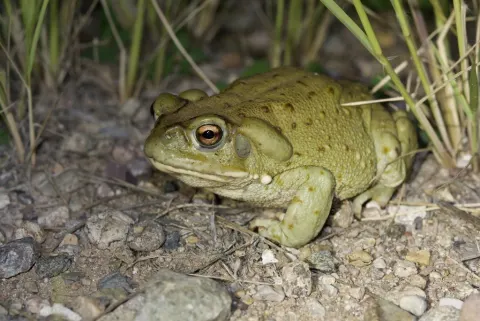
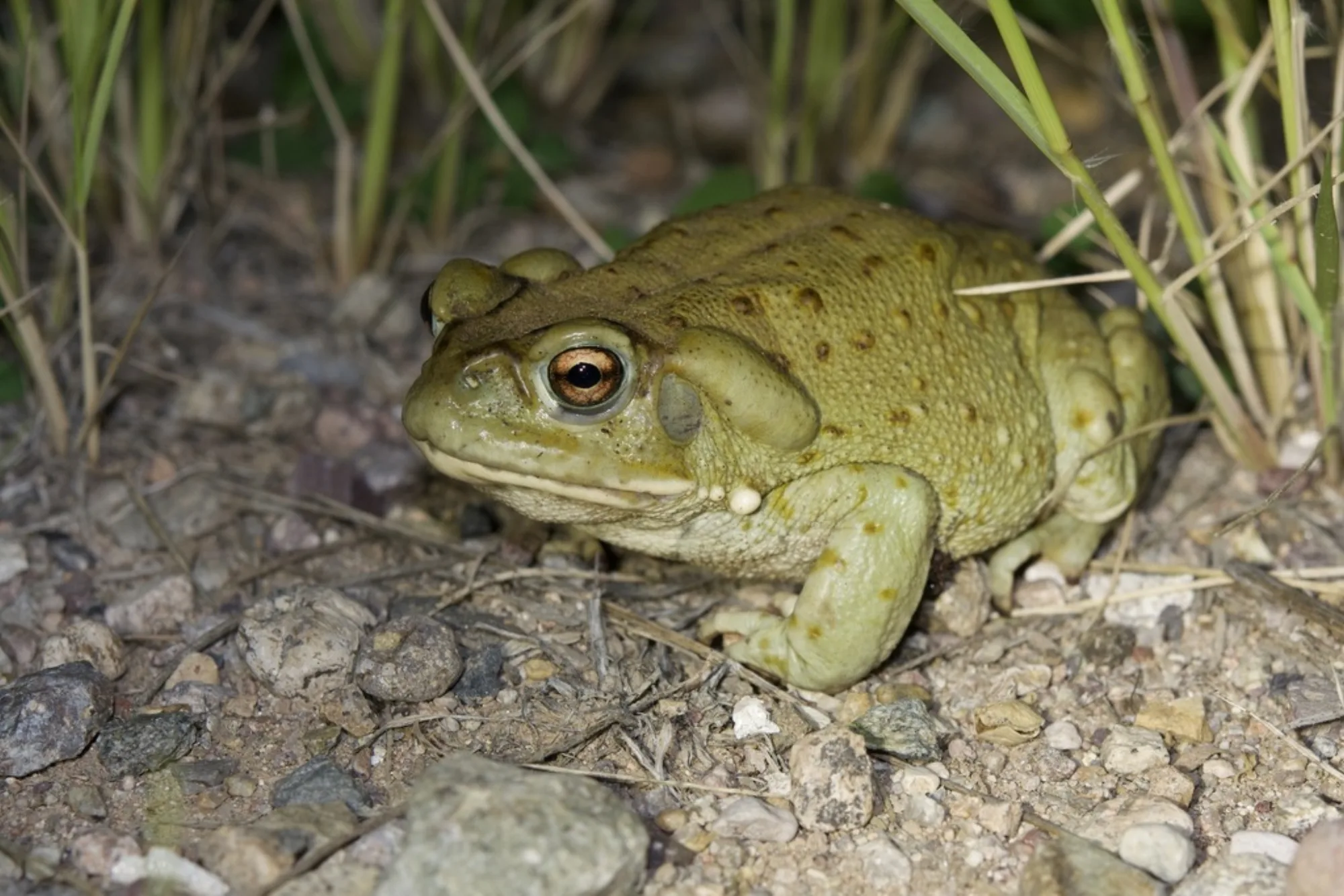
After dark in the desert, the Sonoran Desert Toad may emerge from a rodent burrow to forage. Also called the Colorado River toad, Incilius alvarius can reach about 190 millimetres in length. Its smooth, leathery skin is olive green or mottled brown, with a white wart at the corner of the mouth and white glands on the legs. Look for a large golden eye with a horizontal pupil, and listen for a weak, low toot that lasts less than a second. Its glands produce toxic secretions that can kill a dog.
The toad lives in desert and semi-arid country in the southwestern United States and northwestern Mexico. In the United States, its range includes much of southern Arizona, extreme southwestern New Mexico and the lower Colorado and Gila River catchments; it may have disappeared from California. In Mexico, it occurs in Sonora, Sinaloa and Chihuahua. This semiaquatic toad uses waterways and damp places, including streams, springs, canals, drainage ditches and the shelter beneath water troughs. It absorbs water from small pools or wet objects through its skin. An active forager, it eats invertebrates, lizards, small mammals and other amphibians.
Activity is greatest from May to September, when rainfall is higher. Breeding begins with the rains in July and can continue into August, with eggs laid in ponds, slow streams, temporary pools and water held in human-made structures. A female can lay up to 8,000 eggs. Collection puts the toad under pressure and can cause stress, while persistent trapping has decimated several populations in Mexico. Motorists also run over toads, and raccoons prey on them.
Written from the English Wikipedia article Colorado River toad (CC BY-SA 4.0).
- Records
- 661
- Countries
- 2
No atlas park has a record of the Sonoran Desert Toad in or around it yet.
These are open occurrence records, so they show where people looked for and recorded the Sonoran Desert Toad as much as where it lives. Cells are up to 25 km across, and every location is generalised to its cell.
Generalised encounter areas, not exact locations. Each shape is a grid cell coloured by how likely the species is there.
- Very likelyUnited States25 km zone · medium confidence · 610 records · updated 80 days ago
- Very likelyMexico25 km zone · medium confidence · 51 records · updated 80 days ago
Conservation status not assessed here yet, so every location is generalised to its grid cell.