Striped Polecat
Ictonyx striatus
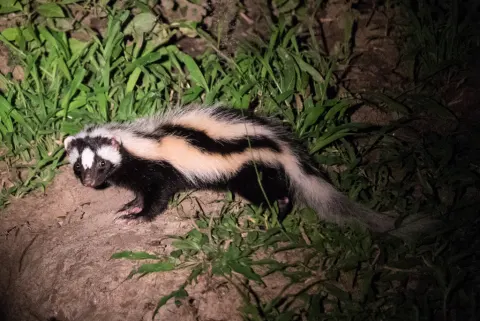
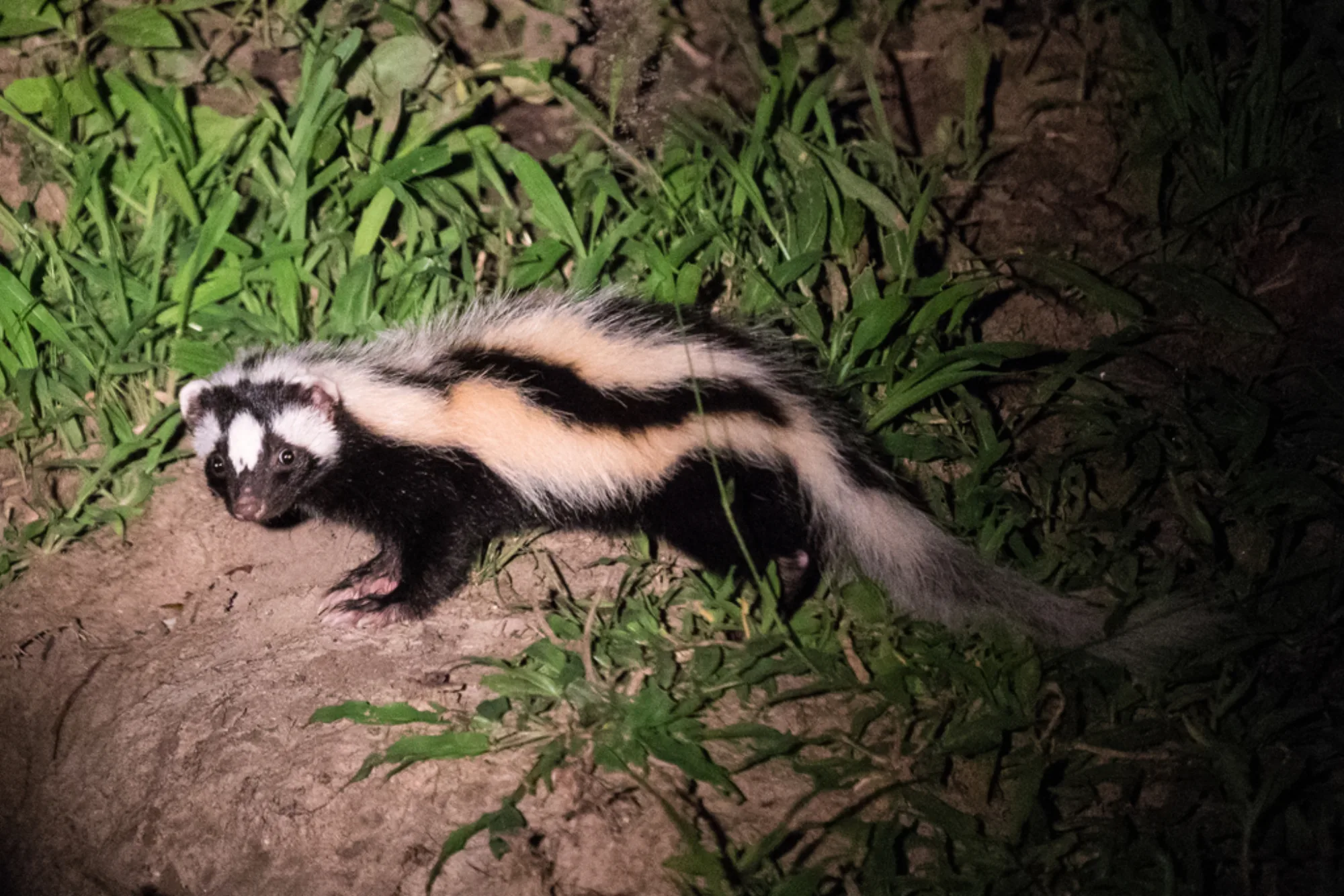
Bold white stripes and a bushy tail make the Striped Polecat a striking sight after dark. This African mammal resembles a skunk, but belongs to the weasel family. Its coat is mostly black, with white markings on the face and tail, although the pattern varies between individuals. The body measures 30 to 38 cm without the tail, and males are larger than females. It ranges across much of sub-Saharan Africa, from Mauritania to southeastern Egypt and south to South Africa, but does not occur in the Congo Basin or West Africa's dense rainforests. Adaptable enough for grasslands, forests, rocky places and deserts, it favours open habitat with relatively few shrubs. It also enters plantations and gardens.
Mostly solitary, the polecat hunts at night and rests by day in places such as burrows, hollow logs or gaps beneath rocks and buildings. It digs with curved front claws, both to make burrows and to find prey in soil or dung. Insects are its most important food across its range, followed by rodents and reptiles, though it also eats birds, eggs and amphibians. When threatened, it often escapes into a burrow; if cornered, it may arch its back and raise its tail before releasing a foul-smelling, irritating spray. Females usually have one litter a year, with two to three young after a gestation of about 36 days. The mother protects them until they can survive independently. Road collisions are a major cause of death, sometimes killing several members of a family group. People also kill polecats for taking poultry, while growing human and free-ranging dog populations may contribute to local declines.
Written from the English Wikipedia article Striped polecat (CC BY-SA 4.0).
- Records
- 13
- Countries
- 4
- Atlas places
- 1
These are open occurrence records, so they show where people looked for and recorded the Striped Polecat as much as where it lives. Cells are up to 25 km across, and every location is generalised to its cell.
Generalised encounter areas, not exact locations. Each shape is a grid cell coloured by how likely the species is there.
- Very likelyMozambique25 km zone · medium confidence · 6 records · updated 80 days ago
- Very likelyBenin25 km zone · medium confidence · 4 records · updated 80 days ago
- LikelySouth Africa25 km zone · medium confidence · 3 records · updated 80 days ago
- RareMalawi25 km zone · low confidence · 0 records · updated 80 days ago
Conservation status not assessed here yet, so every location is generalised to its grid cell.