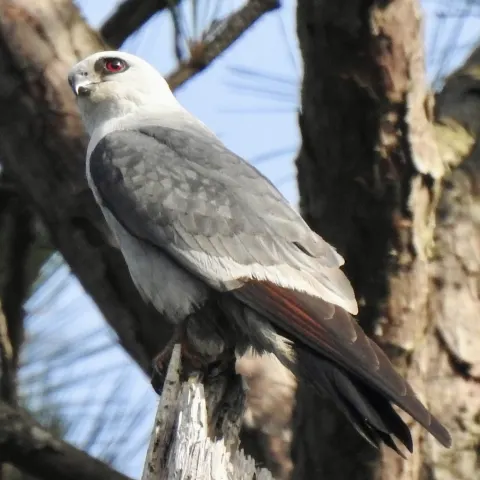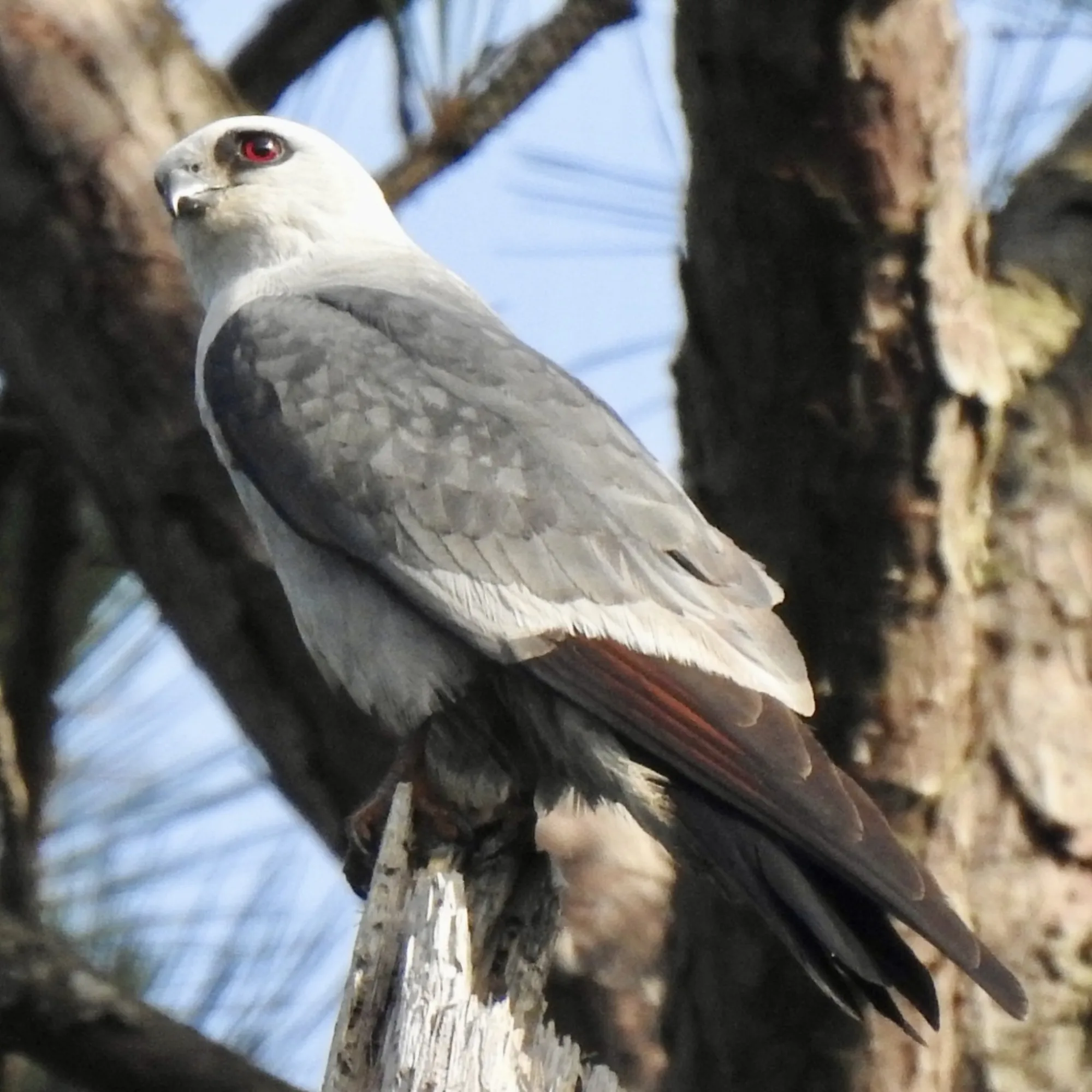
Mississippi Kite
Ictinia mississippiensis
With narrow, pointed wings and an apparently effortless flight, the Mississippi Kite can seem to float overhead. Several may circle together, offering a chance to compare their shapes in the air. This small bird of prey measures about 30 to 37 cm long, with a wingspan of roughly 90 cm. Adults have greyish-blue plumage, a very light grey head, a pale underside and bright red eyes.
The kite breeds in the central and southern United States, with a stronghold in the southern Great Plains. Its range has spread west as shelterbelts planted in grasslands have supplied shelter and food for birds. It also nests in urban areas of the western south-central states, having adapted from open forest and savanna to use hedgerows and shelterbelts. For winter, it migrates to subtropical and temperate South America, mainly northern Argentina and southern Brazil. Migration usually takes place in groups of 20 to 30 birds, although much larger mixed flocks occur.
Mississippi Kites eat mostly large invertebrates and insects, including cicadas, crickets, grasshoppers and locusts caught in flight. They may hunt from a low perch or patrol around livestock for insects disturbed from the ground, eating their catch on the wing. Small birds, amphibians, reptiles and mammals are also taken. The birds nest in colonies, usually near water, building twig nests in deciduous trees and typically laying two white eggs. Both parents incubate the eggs and tend the young, which leave the nest 30 to 34 days after hatching. Eggs and chicks face high winds, storms and predators, including raccoons and owls; only about 50 percent of broods succeed.
Written from the English Wikipedia article Mississippi kite (CC BY-SA 4.0).
- Records
- 271,911
- Countries
- 6
- Atlas places
- 1
These are open occurrence records, so they show where people looked for and recorded the Mississippi Kite as much as where it lives. Cells are up to 25 km across, and every location is generalised to its cell.
Generalised encounter areas, not exact locations. Each shape is a grid cell coloured by how likely the species is there.
- Very likelyUnited States25 km zone · high confidence · 256918 records · updated 80 days ago
- Very likelyMexico25 km zone · high confidence · 9628 records · updated 80 days ago
- Very likelyBelize25 km zone · high confidence · 1882 records · updated 80 days ago
- Very likelyCosta Rica25 km zone · high confidence · 1569 records · updated 80 days ago
- Very likelyPanama25 km zone · high confidence · 1364 records · updated 80 days ago
- Very likelyCanada25 km zone · high confidence · 550 records · updated 80 days ago
Conservation status not assessed here yet, so every location is generalised to its grid cell.