Ictinaetus malaiensis
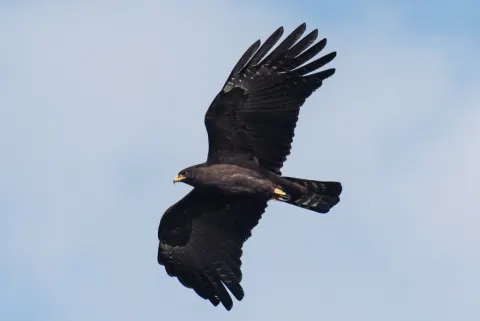
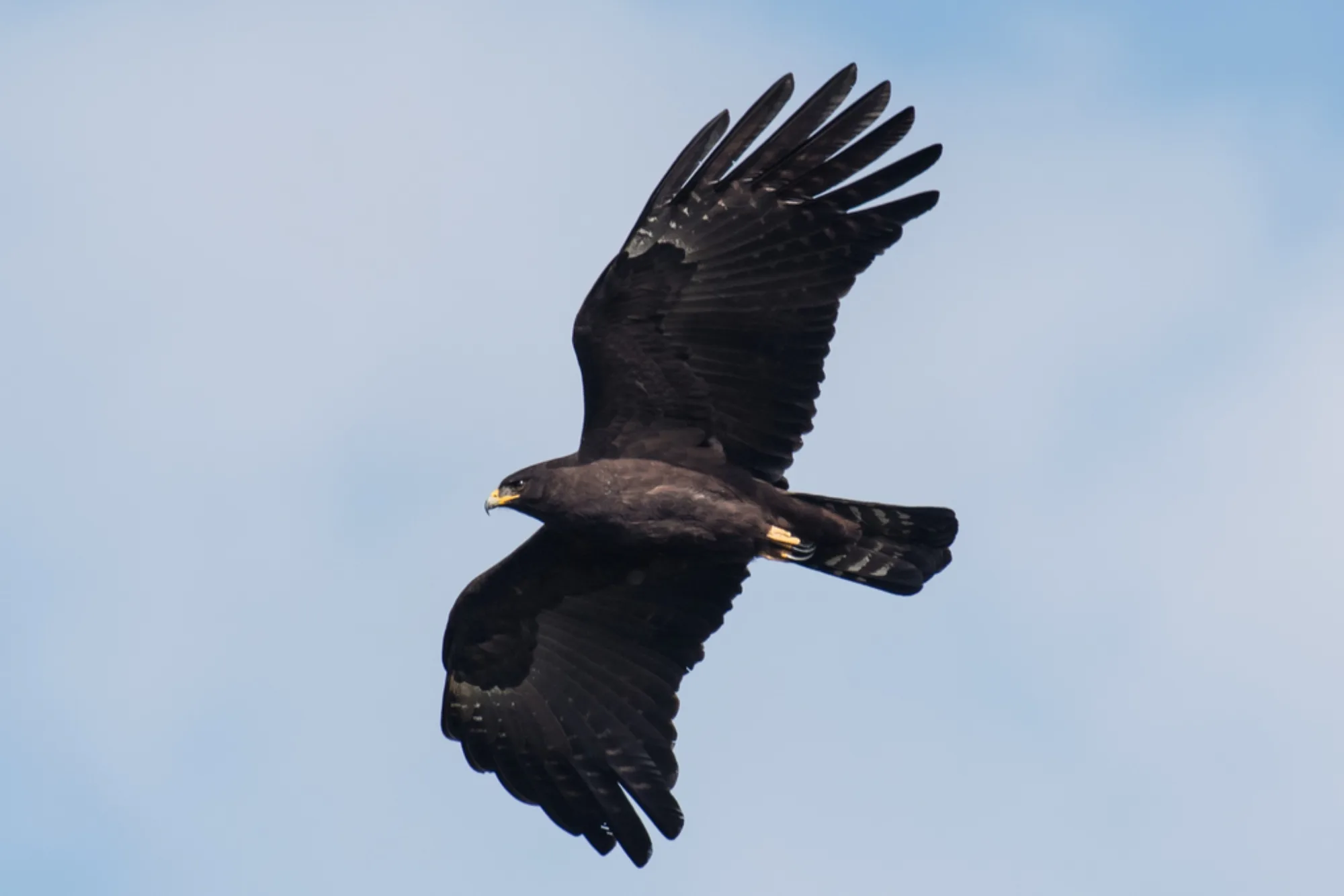
Slow flight above the treetops can give away a black eagle, Ictinaetus malaiensis, as it searches for nests. This large, slender bird of prey has long wings with widely spread, finger-like tips and holds them in a shallow V when flying. Adults are black, with yellow feet and a yellow base to the bill. Young birds have a buff head and buff underparts, while males and females look alike. The eagle measures about 75 cm long, with a wingspan of 148 to 182 cm.
Black eagles soar over wooded hills across South and Southeast Asia, from tropical areas into the subtropics, and in southeastern China. Their range includes the Himalayan foothills, the Eastern and Western Ghats, Sri Lanka, Myanmar, Bangladesh, southern China and Taiwan. They generally stay in the same area throughout the year, and no migration has been observed. A study in southern India found that they favoured well-covered forest and were absent where forest cover fell below 50%.
The eagle hunts mammals, birds and eggs, often searching slowly just above the canopy. Its prey includes squirrels and bats, and it can take swiftlets from caves. It may take a whole nest, including the young birds inside, away to a perch where it feeds. During courtship, the eagle makes steep dives and swoops upwards. It builds a platform nest in a tall tree overlooking a steep valley and may reuse the site year after year. Between January and April, it may lay one or two white eggs marked with brown and mauve. The eagle is uncommon across large parts of its range, which has contracted as large-scale extraction has reduced forested areas.
Written from the English Wikipedia article Black eagle (CC BY-SA 4.0).
- Records
- 50,896
- Countries
- 12
- Atlas places
- 14
- Bandipur National Park· India
- Eravikulam National Park· India
- Periyar National Park· India
- Nagarhole National Park· India
- Danum Valley Conservation Area· Malaysia
- Kerinci Seblat National Park· Indonesia
- Udawalawe National Park· Sri Lanka
- Annapurna Conservation Area· Nepal
- Kanha National Park· India
- Kinabalu Park· Malaysia
- Langtang National Park· Nepal
- Lore Lindu National Park· Indonesia
- Manas National Park· India
- Tabin Wildlife Reserve· Malaysia
These are open occurrence records, so they show where people looked for and recorded the Ictinaetus malaiensis as much as where it lives. Cells are up to 25 km across, and every location is generalised to its cell.
Generalised encounter areas, not exact locations. Each shape is a grid cell coloured by how likely the species is there.
- Very likelyIndia25 km zone · high confidence · 24029 records · updated 80 days ago
- Very likelyTaiwan25 km zone · high confidence · 15050 records · updated 80 days ago
- Very likelySri Lanka25 km zone · high confidence · 2479 records · updated 80 days ago
- Very likelyMalaysia25 km zone · high confidence · 1861 records · updated 80 days ago
- Very likelyBhutan25 km zone · high confidence · 1644 records · updated 80 days ago
- Very likelyIndonesia25 km zone · high confidence · 1483 records · updated 80 days ago
- Very likelyNepal25 km zone · high confidence · 1210 records · updated 80 days ago
- Very likelyChina25 km zone · high confidence · 1172 records · updated 80 days ago
- Very likelyThailand25 km zone · high confidence · 934 records · updated 80 days ago
- Very likelyVietnam25 km zone · high confidence · 706 records · updated 80 days ago
Conservation status not assessed here yet, so every location is generalised to its grid cell.