Blue Catfish
Ictalurus furcatus
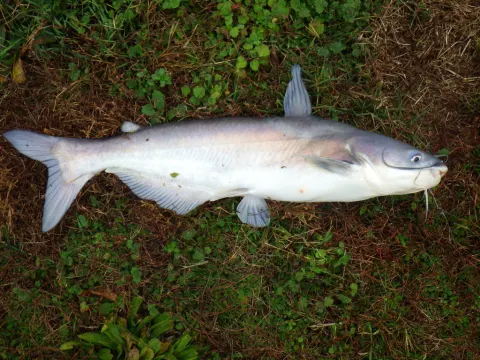
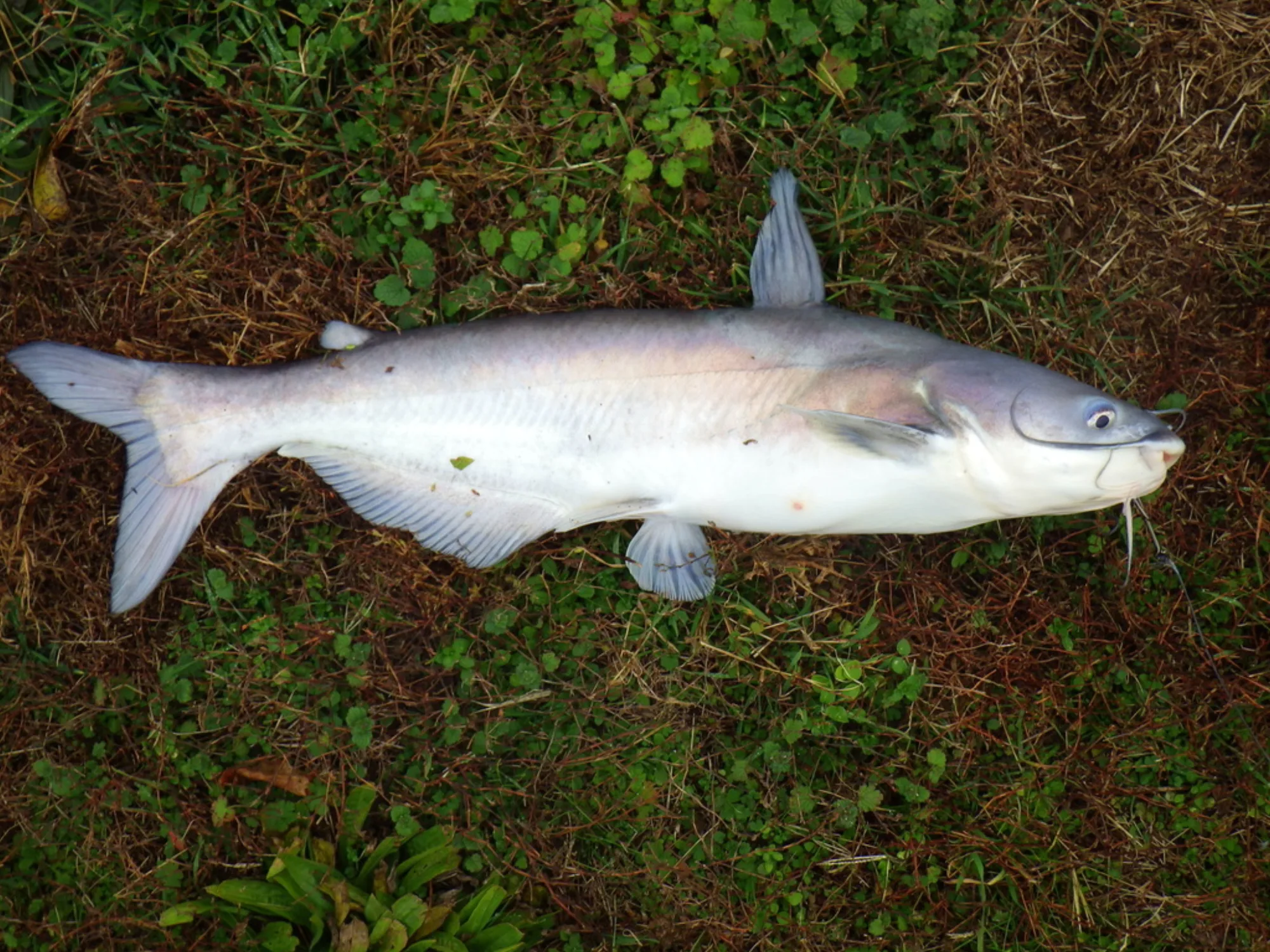
Heavy-bodied and blueish grey, the Blue Catfish is North America's largest catfish. A hump rises behind its head, and it has barbels, a deeply forked tail and an upper jaw that projects forward. It can reach 170 cm and 65 kg, although a typical fish measures 64 to 117 cm and weighs 14 to 32 kg. It can live for 20 years.
Its native range centres on the Mississippi and Louisiana drainage systems, with populations in rivers including the Arkansas, Tennessee, Ohio, Missouri and Rio Grande, and along the Gulf Coast as far south as Belize and Guatemala. It has also been introduced to reservoirs and rivers, including South Carolina's Lake Marion and Lake Moultrie and Virginia's James River, and occurs in some Florida lakes. Able to tolerate brackish water, it can spread through inland waterways in coastal regions. In Virginia, it occupies rivers, lakes, tributaries and Chesapeake Bay, where it is considered a problematic invasive species.
Blue Catfish feed opportunistically, taking fish they can catch as well as insects, crawfish, crabs, mussels, clams, worms and frogs. In reservoirs, they pick up injured fish beneath schools of striped bass and eat wounded baitfish carried through dam spillways or power-generation turbines. They can also eat adult Asian carp in the Mississippi River basin. Virginia Tech researchers found that their diet in Chesapeake Bay consisted largely of Hydrilla and Asian clams, both invasive there, with blue crab also eaten regularly. They spawn once a year, from May to June. The species has expanded rapidly in Virginia since its introduction there in the 1970s.
Written from the English Wikipedia article Blue catfish (CC BY-SA 4.0).
- Records
- 112,510
- Countries
- 2
- Atlas places
- 1
These are open occurrence records, so they show where people looked for and recorded the Blue Catfish as much as where it lives. Cells are up to 25 km across, and every location is generalised to its cell.
Generalised encounter areas, not exact locations. Each shape is a grid cell coloured by how likely the species is there.
- Very likelyUnited States25 km zone · high confidence · 112421 records · updated 80 days ago
- Very likelyMexico25 km zone · medium confidence · 89 records · updated 80 days ago
Conservation status not assessed here yet, so every location is generalised to its grid cell.