Indian Crested Porcupine
Hystrix indica
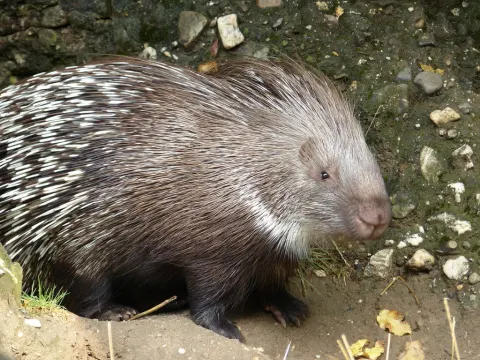
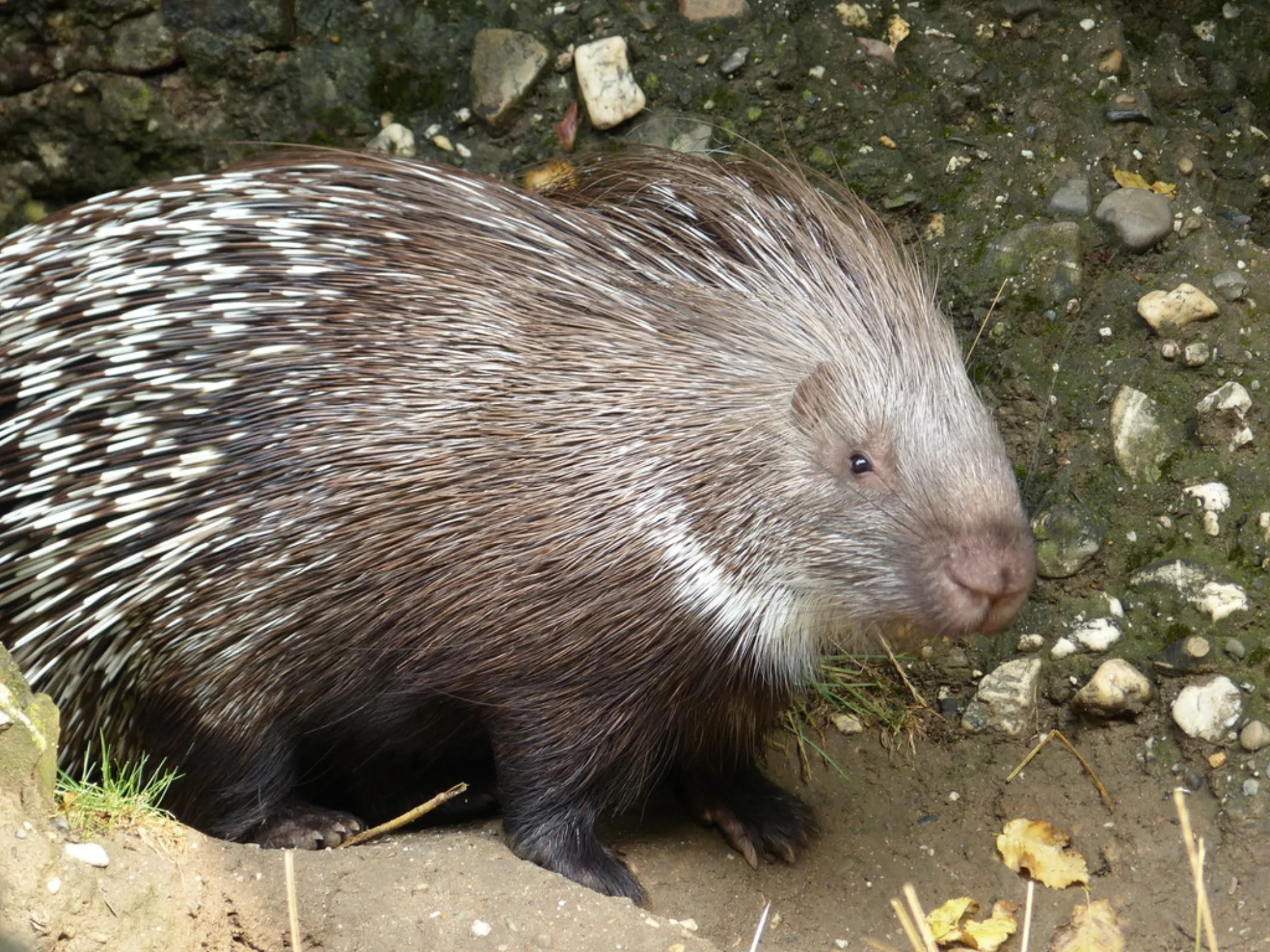
A stocky rodent with a coat of striking quills, the Indian Crested Porcupine weighs 11 to 18 kg and measures 70 to 90 cm from nose to tail base. Its brown or black quills have alternating black and white bands, and the longest form a skirt around its neck and shoulders. When alarmed, it can raise its quills, rattle the hollow ones at its tail, stamp its feet or charge backwards.
Native to West and South Asia, it occurs across a wide area that includes India, Iran, Nepal, Pakistan and Sri Lanka. Rocky hillsides are a favourite, though it also lives in grasslands, forests, shrublands, plantations and gardens. Mostly active at night, it shelters by day in a natural cave or a burrow, occasionally coming out to bask on winter days. Adults and weaned young spend an average of 7 hours foraging each night. In winter it tends to avoid moonlight, while in summer it stays closer to its den.
Its varied diet is mostly plant material, from roots and bulbs to fruit, grains and tubers, though it also eats insects and small vertebrates. It chews bones for minerals that help its quills grow. Females produce one brood a year, with two to four young whose soft quills harden within hours. The young stay in the den with their parents and siblings until they reach sexual maturity at around 2 years. Habitat is declining as cities and infrastructure expand and pesticides are used. The porcupine is also widely hunted because it damages gardens and crops, and it is traded for food and medicinal use.
Written from the English Wikipedia article Indian crested porcupine (CC BY-SA 4.0).
- Records
- 1,142
- Countries
- 14
- Atlas places
- 3
These are open occurrence records, so they show where people looked for and recorded the Indian Crested Porcupine as much as where it lives. Cells are up to 25 km across, and every location is generalised to its cell.
Generalised encounter areas, not exact locations. Each shape is a grid cell coloured by how likely the species is there.
- Very likelyIsrael25 km zone · medium confidence · 675 records · updated 80 days ago
- Very likelyPalestinian Territories25 km zone · medium confidence · 284 records · updated 80 days ago
- Very likelyIndia25 km zone · medium confidence · 77 records · updated 80 days ago
- Very likelyLebanon25 km zone · high confidence · 61 records · updated 80 days ago
- Very likelyAfghanistan25 km zone · medium confidence · 28 records · updated 80 days ago
- Very likelyArmenia25 km zone · medium confidence · 9 records · updated 80 days ago
- LikelyKazakhstan25 km zone · medium confidence · 4 records · updated 80 days ago
- LikelySyria25 km zone · medium confidence · 1 record · updated 80 days ago
- PossibleSri Lanka25 km zone · medium confidence · 2 records · updated 80 days ago
- PossibleTajikistan25 km zone · medium confidence · 1 record · updated 80 days ago
Conservation status not assessed here yet, so every location is generalised to its grid cell.