Hammer-headed Fruit Bat
Hypsignathus monstrosus
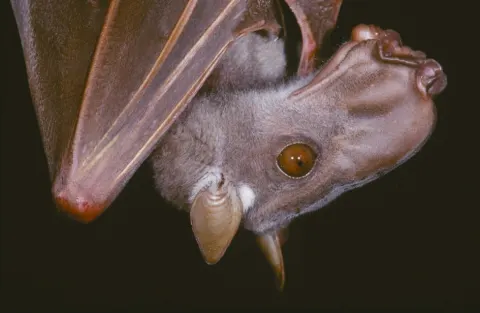
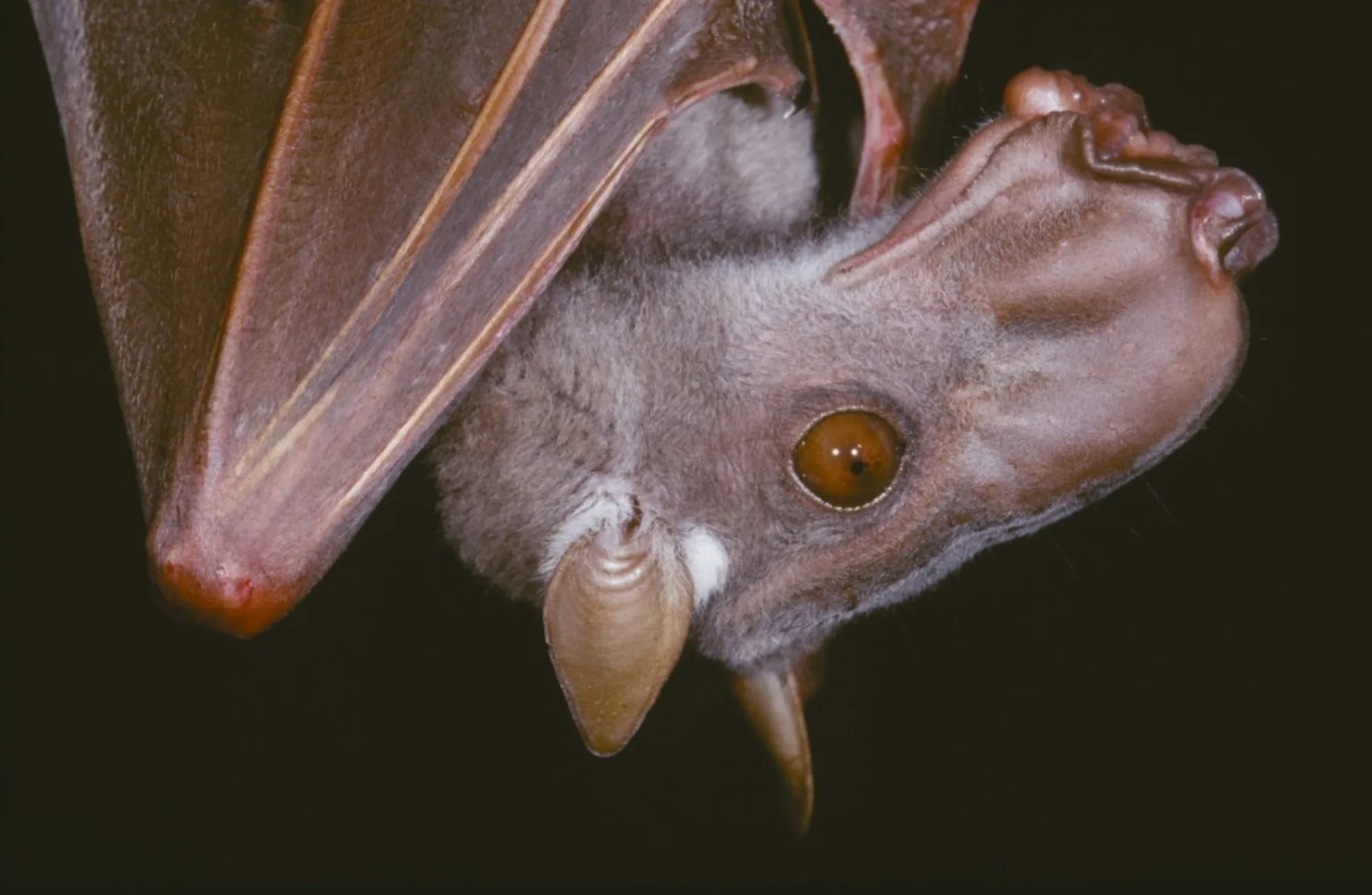
With a wingspan approaching 1 m, the Hammer-headed Fruit Bat is the largest bat in continental Africa. Males have boxy heads and enormous lips, while females have narrower, fox-like faces. Both have dark brown fur, paler colouring around the neck and very large eyes. White markings near the ears are sometimes indistinct.
This lowland bat ranges widely across West and Central Africa, always below 1,800 m. Most records come from rainforest, including swamp and riverside forests, as well as mosaics of forest and grassland. By day it sleeps in trees, often high in the canopy, either alone or in small groups. Males and females may share a roost, and individuals cover their noses with their wings as they sleep. At sunset they groom themselves before setting off independently to feed.
Figs make up much of the diet, alongside fruit such as mangoes, bananas and guavas. Females follow established routes between reliable food sources, while males search more widely for good fruit. A bat may eat at the tree or carry fruit elsewhere, swallowing the juice and soft pulp and spitting out the rest. During breeding seasons, males can gather along streams or riverbeds and make loud honking calls. Some West African populations instead have a harem system. After five or six months, females usually give birth to one young, though twins have been reported. People hunt the bats for food in Nigeria and at certain times of year in the Democratic Republic of the Congo; some also regard them as pests because they eat fruit crops and call loudly at night.
Written from the English Wikipedia article Hammer-headed bat (CC BY-SA 4.0).
- Records
- 58
- Countries
- 9
- Atlas places
- 1
These are open occurrence records, so they show where people looked for and recorded the Hammer-headed Fruit Bat as much as where it lives. Cells are up to 25 km across, and every location is generalised to its cell.
Generalised encounter areas, not exact locations. Each shape is a grid cell coloured by how likely the species is there.
- Very likelyCongo - Kinshasa25 km zone · medium confidence · 20 records · updated 80 days ago
- Very likelyCôte d’Ivoire25 km zone · medium confidence · 16 records · updated 80 days ago
- Very likelyKenya25 km zone · medium confidence · 8 records · updated 80 days ago
- LikelyCentral African Republic25 km zone · medium confidence · 4 records · updated 80 days ago
- LikelyGhana25 km zone · medium confidence · 3 records · updated 80 days ago
- PossibleUganda25 km zone · medium confidence · 4 records · updated 80 days ago
- PossibleCameroon25 km zone · medium confidence · 3 records · updated 80 days ago
- UncommonCongo - Brazzaville25 km zone · low confidence · 0 records · updated 80 days ago
- UncommonZambia25 km zone · low confidence · 0 records · updated 80 days ago
Conservation status not assessed here yet, so every location is generalised to its grid cell.