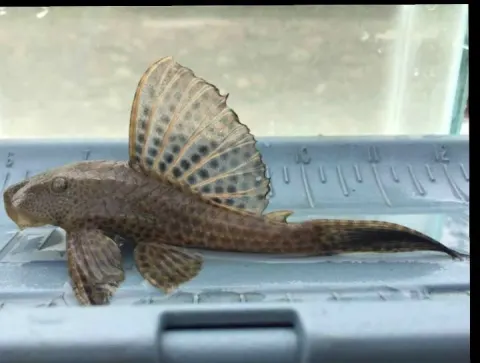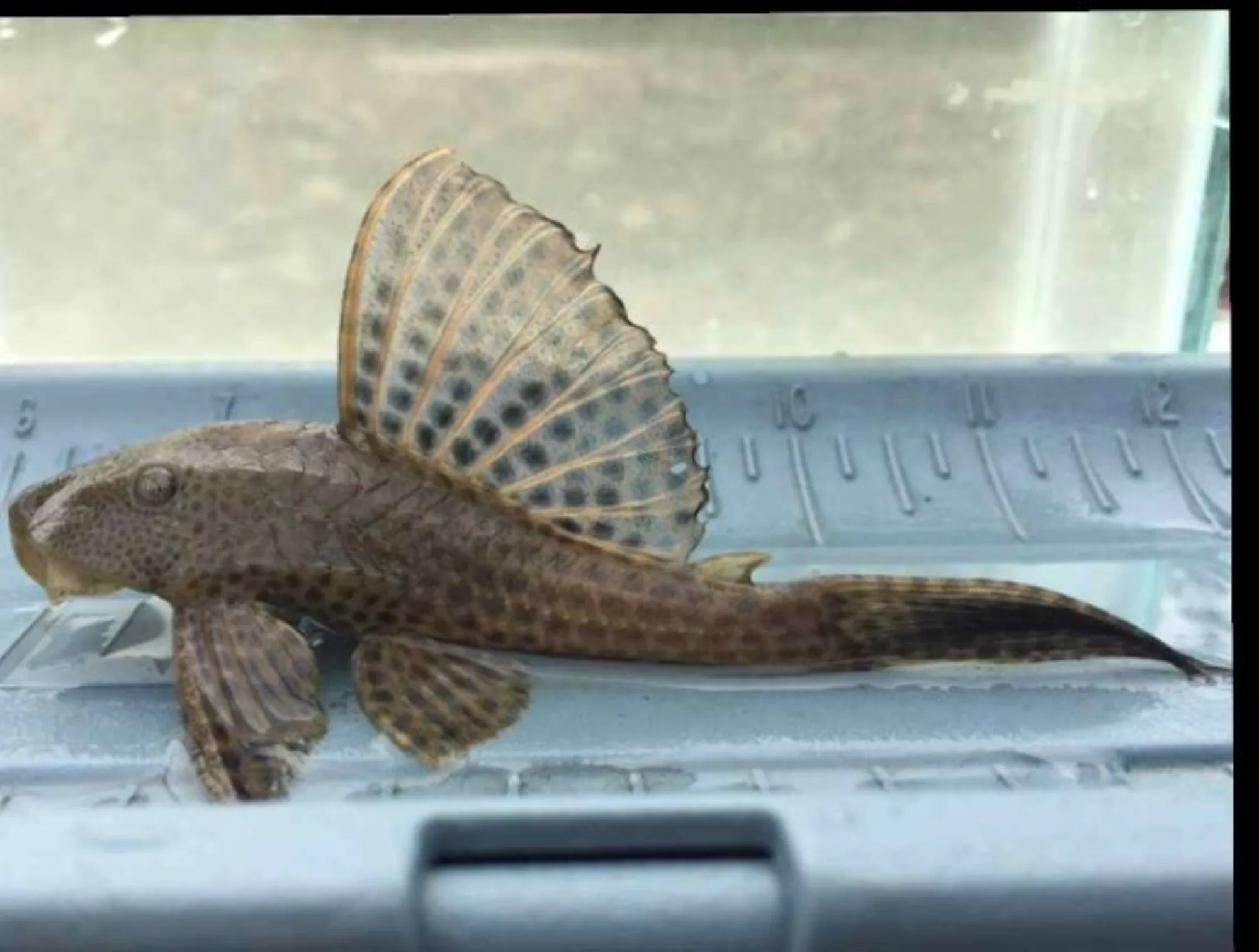
Suckermouth Catfish
Hypostomus plecostomus
Dark in colour and covered along its head and upper body with rows of armour-like plates, the Suckermouth Catfish is a tropical freshwater fish that can grow up to 50 cm long in the wild. Its sucker-like mouth grips surfaces and helps it rasp food, while its thick armour makes it difficult for other fish to harass. It is also known as the spotted pleco, though several common names are shared with similar catfish, making identification confusing.
Its native range lies in tropical northeastern South America, from the Guianas and northeastern Brazil to Trinidad and Tobago. It favours water at 22 to 30 °C and a pH of 6.5 to 7.5. A bottom-feeder active at night, it eats algae and aquatic plants as well as small crustaceans and young snails. It normally breathes through its gills, but can also breathe air, surfacing more often as oxygen levels in the water fall. Air retained in its stomach can increase its buoyancy, which may help it feed on vegetation.
In the wild, it lives for 7 to 8 years, while captive fish can live for 10 to 15 years. There is demand for the fish as an aquarium bottom cleaner, and it is occasionally eaten within its native range. In Bangladesh, it has become invasive, and the government is moving to restrict its farming, breeding and trade. The fish has prompted serious concern in Sri Lanka, Indonesia, Malaysia and India, though similar catfish have sometimes been reported under its name.
Written from the English Wikipedia article Hypostomus plecostomus (CC BY-SA 4.0).
- Records
- 43
- Countries
- 4
No atlas park has a record of the Suckermouth Catfish in or around it yet.
These are open occurrence records, so they show where people looked for and recorded the Suckermouth Catfish as much as where it lives. Cells are up to 25 km across, and every location is generalised to its cell.
Generalised encounter areas, not exact locations. Each shape is a grid cell coloured by how likely the species is there.
- Very likelyUnited States25 km zone · medium confidence · 26 records · updated 80 days ago
- Very likelySuriname25 km zone · medium confidence · 6 records · updated 80 days ago
- LikelyBrazil25 km zone · medium confidence · 11 records · updated 80 days ago
- PossibleColombia25 km zone · low confidence · 0 records · updated 80 days ago
Conservation status not assessed here yet, so every location is generalised to its grid cell.