Bighead Carp
Hypophthalmichthys nobilis
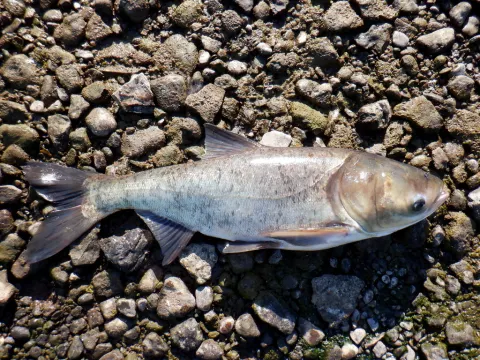
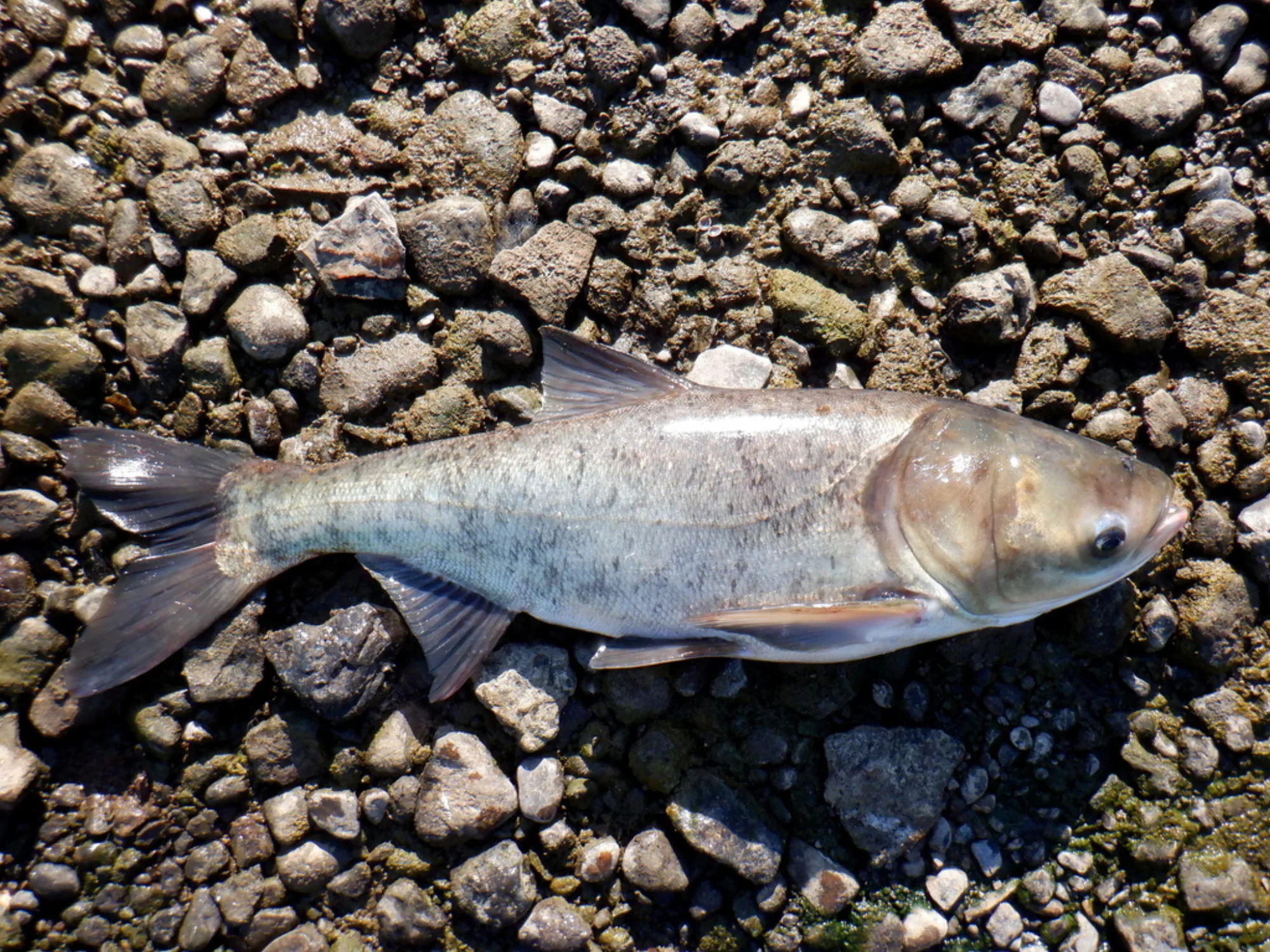
A large freshwater fish with a broad, scaleless head, the Bighead Carp has a wide mouth and eyes set low on its head. Adults are usually mottled silver-grey, and a typical fish measures 60 cm, though the largest observed reached 146 cm and 40 kg. It grows very quickly and is widely farmed for food.
Its native waters are the large rivers and floodplain lakes of eastern Asia, spanning an area between southern China and the Amur River system, which borders Russia and China. Introduced well beyond its native range, it now lives wild across parts of Europe and both South and North America. It also occurs in the Nile in North Africa and in parts of the Volga River basin, including reservoirs and the delta. In the Mississippi River basin, escaped fish have become firmly established. Bighead Carp often feed close to the surface, but unlike silver carp they do not leap from the water when startled by moving boats. They are omnivores and filter feeders, eating algae and zooplankton. Evidence of natural reproduction has been found in the lower Volga River Delta, where very young fish have been recorded.
Fishing and farming both bring the species into close contact with people. Bighead Carp are popular targets for bowfishers when they feed near the surface, although their filter-feeding habits make them difficult to catch with a rod and reel. They are intensively exploited in fish farming, and are also stocked in some waters to support commercial fisheries. Outside their native range, escaped or released fish can compete with native species; in the United States, they are considered highly destructive invaders.
Written from the English Wikipedia article Bighead carp (CC BY-SA 4.0).
- Records
- 2,681
- Countries
- 12
No atlas park has a record of the Bighead Carp in or around it yet.
These are open occurrence records, so they show where people looked for and recorded the Bighead Carp as much as where it lives. Cells are up to 25 km across, and every location is generalised to its cell.
Generalised encounter areas, not exact locations. Each shape is a grid cell coloured by how likely the species is there.
- Very likelyUnited States25 km zone · medium confidence · 2647 records · updated 80 days ago
- PossibleNetherlands25 km zone · medium confidence · 11 records · updated 80 days ago
- PossiblePhilippines25 km zone · medium confidence · 4 records · updated 80 days ago
- UncommonBrazil25 km zone · medium confidence · 3 records · updated 80 days ago
- UncommonChina25 km zone · medium confidence · 3 records · updated 80 days ago
- UncommonSerbia25 km zone · medium confidence · 3 records · updated 80 days ago
- UncommonSwitzerland25 km zone · medium confidence · 3 records · updated 80 days ago
- RareHong Kong SAR China25 km zone · medium confidence · 3 records · updated 80 days ago
- RareMexico25 km zone · medium confidence · 2 records · updated 80 days ago
- RareAustria25 km zone · medium confidence · 1 record · updated 80 days ago
Conservation status not assessed here yet, so every location is generalised to its grid cell.