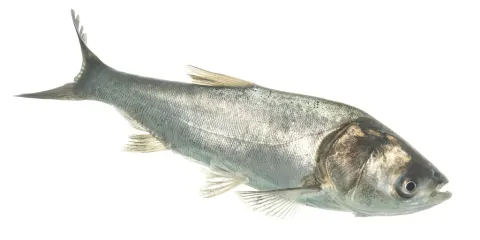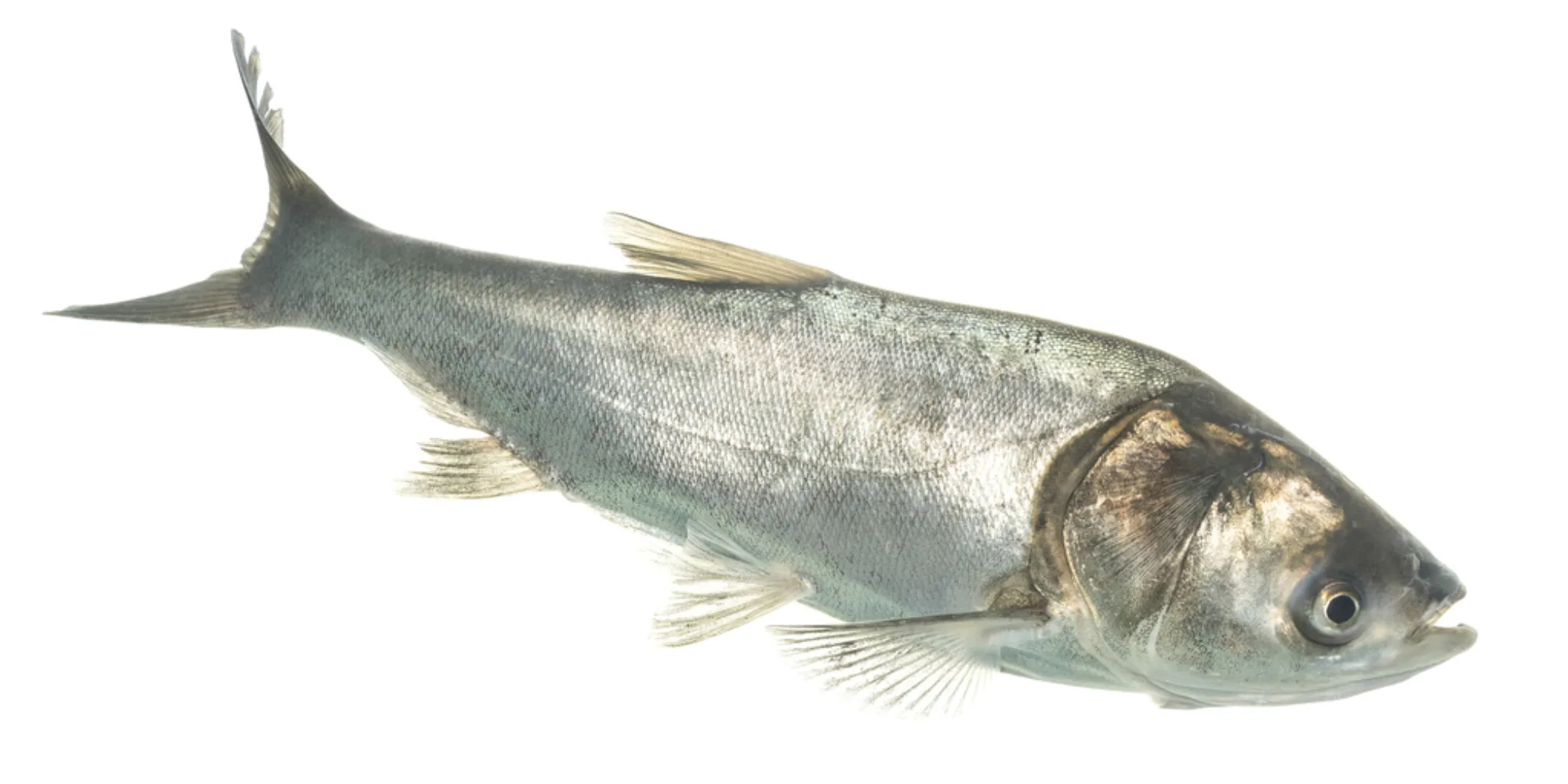
Silver Carp
Hypophthalmichthys molitrix
A flash above the water can betray a Silver Carp: when startled, this freshwater fish may leap as high as 3.0 m. Such extreme jumping appears to be largely a North American trait; fish in its native Asian range and elsewhere are less prone to it. Silver Carp usually measure 60 to 100 cm, though they can reach 140 cm and weigh 50 kg. Its natural range spans eastern Siberia and China, stretching south from the Amur drainage to the Xi Jiang drainage. Introductions and connected waterways have carried them to at least 88 countries, and in some places they are considered invasive. In the Volga basin, they live mainly in the Lower Volga reservoirs, the unregulated stretch of river and the delta. In the United States, they are abundant across much of the Mississippi catchment.
Silver Carp filter food from the water and are thought to feed almost constantly. They eat mainly phytoplankton, along with zooplankton and detritus. Young fish begin on zooplankton, switching to phytoplankton as they grow. In their natural range, adults migrate upstream to spawn; eggs and larvae drift downstream, and the young hatch in the floodplain zone. The fish are somewhat sensitive to low oxygen conditions. Dams, pollution and overfishing threaten them in their original range by affecting their habitat and reproduction, with particularly marked declines reported in the Chinese parts of their range. Elsewhere, their numbers can become very high, and they are thought to compete with native fish that also feed on plankton. Although they are sometimes used to control algae, their presence can also make some blue-green algal blooms worse.
Written from the English Wikipedia article Silver carp (CC BY-SA 4.0).
- Records
- 10,649
- Countries
- 12
No atlas park has a record of the Silver Carp in or around it yet.
These are open occurrence records, so they show where people looked for and recorded the Silver Carp as much as where it lives. Cells are up to 25 km across, and every location is generalised to its cell.
Generalised encounter areas, not exact locations. Each shape is a grid cell coloured by how likely the species is there.
- Very likelyUnited States25 km zone · high confidence · 10351 records · updated 80 days ago
- LikelyFrance25 km zone · medium confidence · 201 records · updated 80 days ago
- LikelyUkraine25 km zone · medium confidence · 26 records · updated 80 days ago
- LikelyBelgium25 km zone · medium confidence · 15 records · updated 80 days ago
- LikelySouth Africa25 km zone · medium confidence · 8 records · updated 80 days ago
- PossibleChina25 km zone · medium confidence · 16 records · updated 80 days ago
- PossibleGermany25 km zone · medium confidence · 10 records · updated 80 days ago
- PossibleSerbia25 km zone · medium confidence · 7 records · updated 80 days ago
- PossibleMexico25 km zone · medium confidence · 4 records · updated 80 days ago
- PossibleNetherlands25 km zone · medium confidence · 4 records · updated 80 days ago
Conservation status not assessed here yet, so every location is generalised to its grid cell.