Northern Bottlenose Whale
Hyperoodon ampullatus
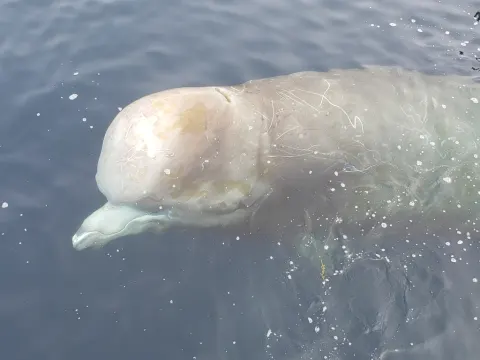
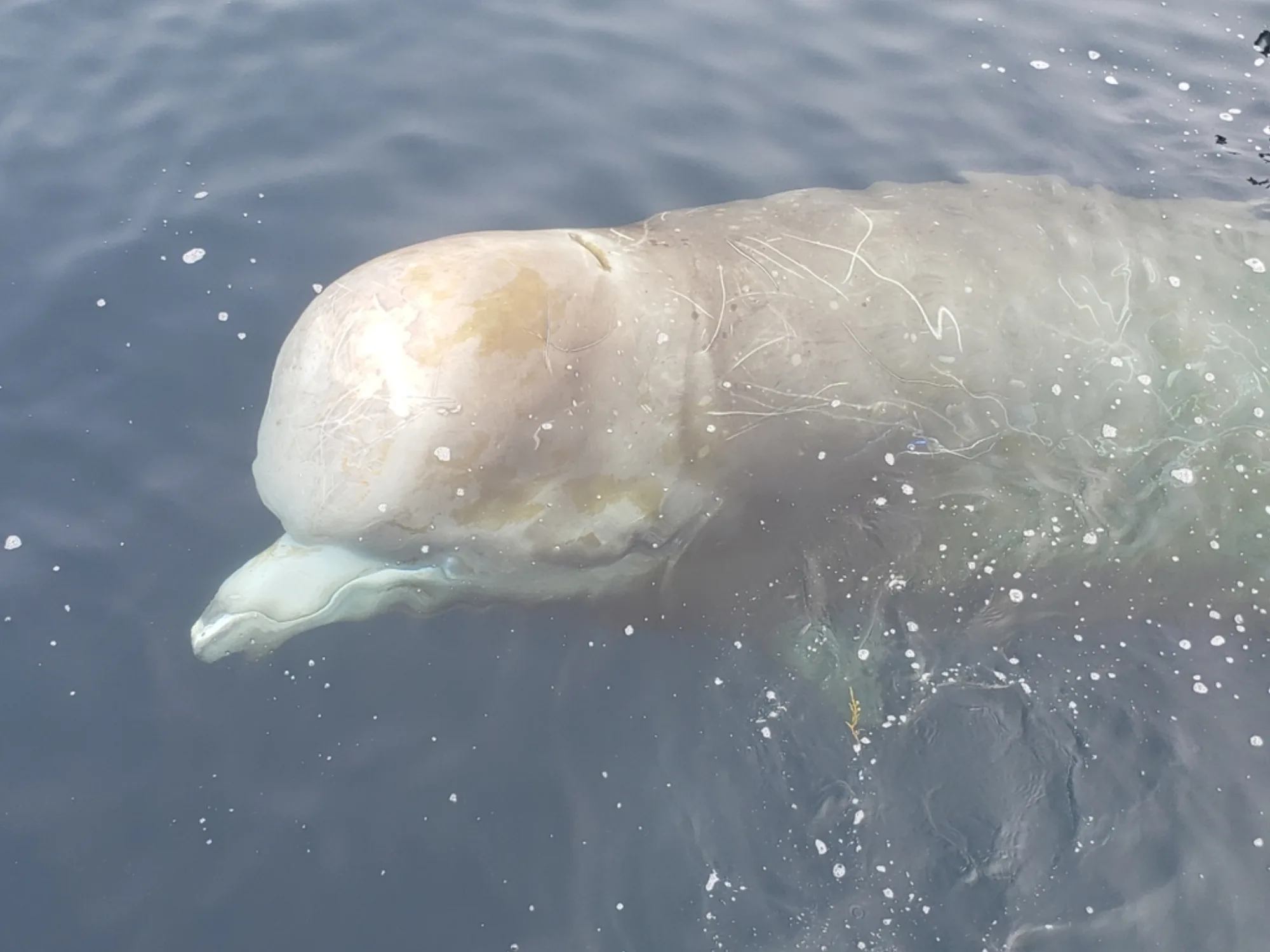
A rounded forehead and short beak give the Northern Bottlenose Whale a distinctive profile. This North Atlantic beaked whale can grow to 9.8 metres, with a mid-to-dark grey back, a lighter underside and a small, sickle-shaped dorsal fin set well back on the body. Mature males have squarer foreheads than females and young whales, and their heads tend to become whiter or buff with age. At the surface, these social whales are typically seen in groups of 4 to 20, and they sometimes approach vessels.
They inhabit cold, deep subarctic waters, including the Davis Strait and the Labrador, Greenland and Barents seas, and range south to Newfoundland and Nova Scotia. The Gully, a submarine canyon east of Nova Scotia, is home to a population on the Scotian Shelf. Northern bottlenose whales feed mainly on deep-water squid and bottom fish, including Greenland halibut. In search of food, they can dive for at least an hour and descend beyond 1000 metres. Calves nurse for a long time, continuing until they are 3 to 4 years old.
Commercial whaling greatly reduced their numbers across the North Atlantic, and killing continues in the Faroe Islands when stranded whales cannot be driven back out. Today, disturbance from offshore oil and gas development and naval sonar adds to pressures from fishing gear entanglement, pollution, plastic ingestion and climate-related ecosystem shifts. The whales have also been observed avoiding certain sounds emitted by naval sonar. Limited genetic diversity and a slow rate of reproduction may leave their populations less able to recover from human pressures and chance events.
Written from the English Wikipedia article Northern bottlenose whale (CC BY-SA 4.0).
- Records
- 2,201
- Countries
- 12
No atlas park has a record of the Northern Bottlenose Whale in or around it yet.
These are open occurrence records, so they show where people looked for and recorded the Northern Bottlenose Whale as much as where it lives. Cells are up to 25 km across, and every location is generalised to its cell.
Generalised encounter areas, not exact locations. Each shape is a grid cell coloured by how likely the species is there.
- Very likelyCanada25 km zone · high confidence · 2067 records · updated 80 days ago
- Very likelyUnnamed area25 km zone · medium confidence · 50 records · updated 80 days ago
- Very likelyIceland25 km zone · medium confidence · 19 records · updated 80 days ago
- Very likelyGreenland25 km zone · medium confidence · 12 records · updated 80 days ago
- LikelySvalbard & Jan Mayen25 km zone · medium confidence · 18 records · updated 80 days ago
- LikelyPortugal25 km zone · medium confidence · 10 records · updated 80 days ago
- LikelyNorway25 km zone · medium confidence · 5 records · updated 80 days ago
- LikelyUnited States25 km zone · medium confidence · 5 records · updated 80 days ago
- PossibleFrance25 km zone · medium confidence · 5 records · updated 80 days ago
- PossibleSt. Pierre & Miquelon25 km zone · medium confidence · 4 records · updated 80 days ago
Conservation status not assessed here yet, so every location is generalised to its grid cell.