Giant Forest Hog
Hylochoerus meinertzhageni
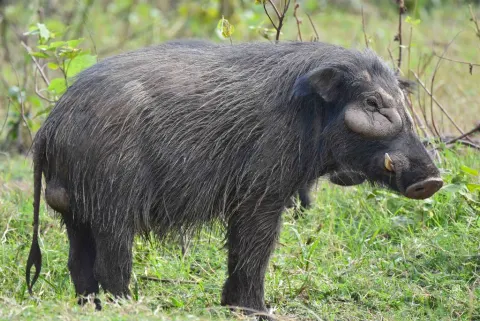
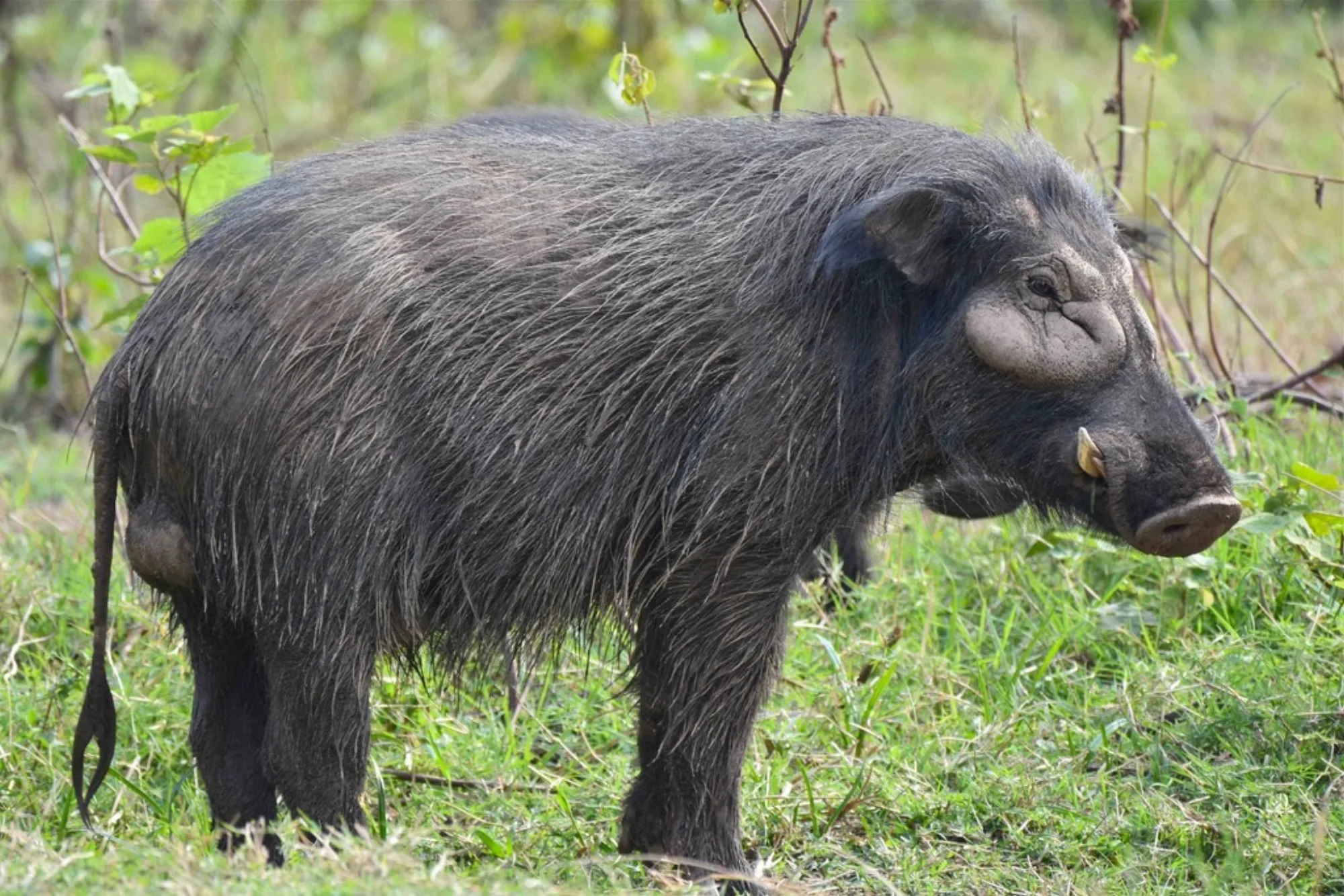
Large, dark and long-haired, the Giant Forest Hog is a wild member of the pig family native to wooded habitats in Africa. On average, it is the largest living pig species, with adults measuring 1.3 to 2.1 m from head to body and weighing 100 to 275 kg. Females are smaller than males. The coat is mostly black on the surface, with deep orange hairs closer to the skin, and becomes less conspicuous with age. Large, pointed ears add to its distinctive appearance. In west and central Africa, the hog is largely confined to the Guinean and Congolese forests. It also occurs locally in the humid highlands of the Rwenzori Mountains and farther east towards Mount Kenya and the Ethiopian Highlands. Look for its habitat in forest-grassland mosaics, wooded savanna and subalpine areas up to 3,800 m. It needs humidity and dense cover and cannot tolerate prolonged exposure to the sun.
Giant forest hogs feed mainly on plants but also scavenge. They are usually considered nocturnal, although they are more often seen in daylight during cold periods and may be active by day where protected from humans. Herds can contain up to 20 animals, typically females and their young with a single older male. A female leaves the herd to give birth and returns with her piglets about a week later. The whole herd helps protect the young, and piglets can nurse from any of the females. Leopards and groups of spotted hyenas prey on the hogs, despite their size and capacity for aggression. Males sometimes attack without warning, possibly in defence of their group, and fights between males can be fatal.
Written from the English Wikipedia article Giant forest hog (CC BY-SA 4.0).
- Records
- 72
- Countries
- 5
- Atlas places
- 2
These are open occurrence records, so they show where people looked for and recorded the Giant Forest Hog as much as where it lives. Cells are up to 25 km across, and every location is generalised to its cell.
Generalised encounter areas, not exact locations. Each shape is a grid cell coloured by how likely the species is there.
- Very likelyUganda25 km zone · medium confidence · 56 records · updated 80 days ago
- Very likelyKenya25 km zone · medium confidence · 16 records · updated 80 days ago
- LikelyCentral African Republic25 km zone · low confidence · 0 records · updated 80 days ago
- LikelyLiberia25 km zone · low confidence · 0 records · updated 80 days ago
Conservation status not assessed here yet, so every location is generalised to its grid cell.