Pelagic Sea Snake
Hydrophis platurus
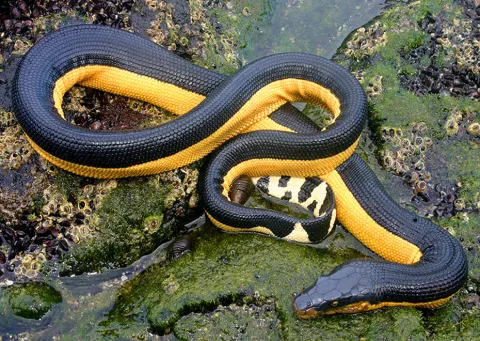
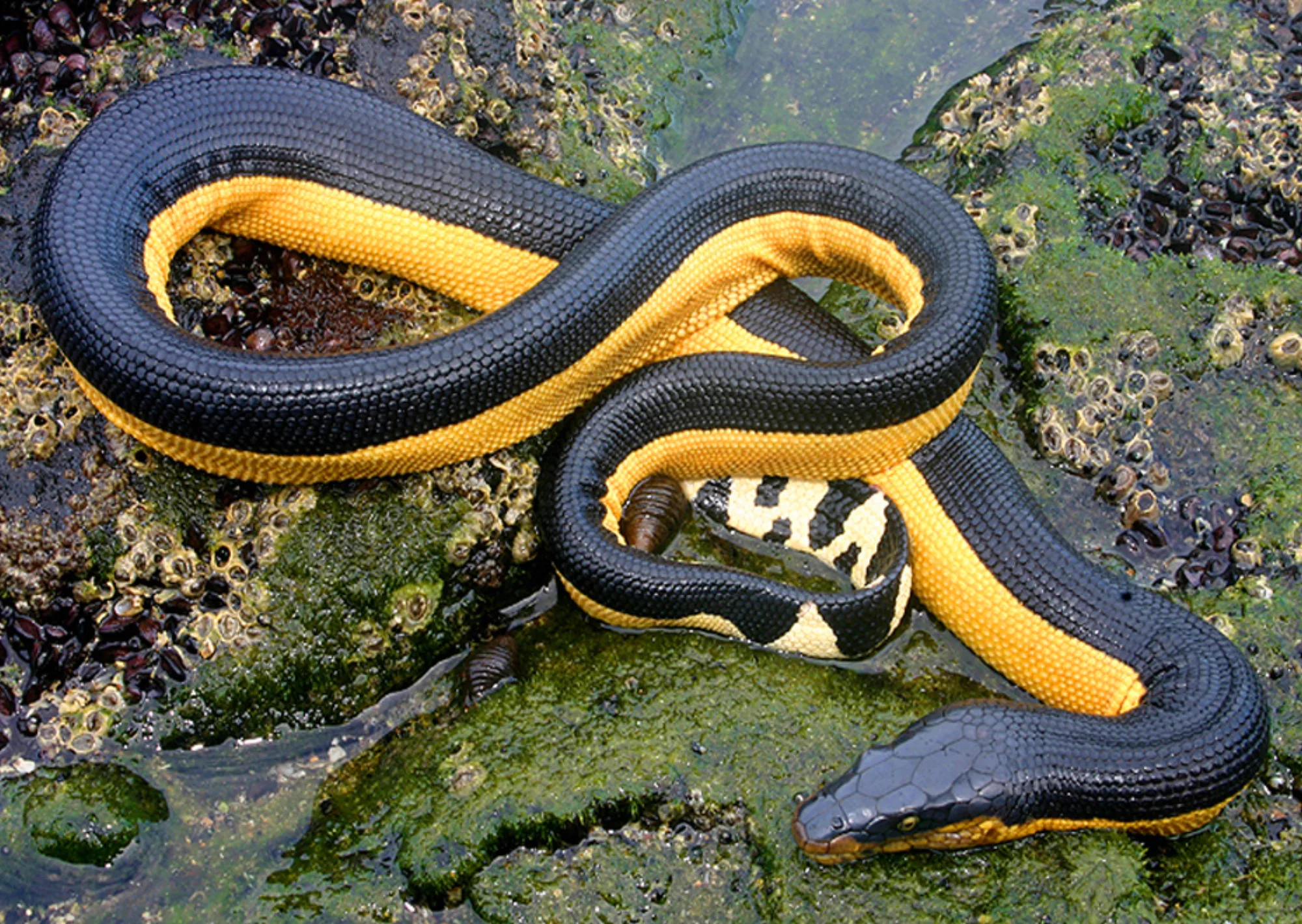
A dark back and a yellow or brown underside can help distinguish the Pelagic Sea Snake (Hydrophis platurus) from other sea snakes, though its colouring varies. Some have dark spots or bars underneath, while others have yellow extending up the sides and a narrow dark stripe along the back. Females can reach 880 mm in total length, while males can reach 720 mm. This extremely venomous snake has a flattened tail that helps it swim, and spends its entire life at sea.
Its range covers the tropical Indo-Pacific, reaching the coasts of southern California, Costa Rica and northern Peru; it has also reached the Hawaiian Islands. Oceanic drift lines are a place to look for it, sometimes in groups of thousands at the surface. Currents and storms carry the snakes across the ocean, and some have turned up in colder waters, including off Tasmania and New Zealand. In the Indian Ocean, free-floating kelp mats are favoured places for hunting and reproduction. The snake floats at the surface to attract fish seeking shelter, then swims backwards and lunges to catch them.
Breeding takes place in warm water, and females give birth to live young after a gestation of around 6 months. Although it lives at sea, the snake needs fresh or brackish water and likely drinks from fresh water gathered at the surface after heavy rain. Seasonal drought can leave it severely dehydrated, though it has been reported to survive in that state for up to 7 months. It is not considered aggressive, but will defend itself when threatened; bites are rare and most often involve fishermen removing snakes from nets.
Written from the English Wikipedia article Yellow-bellied sea snake (CC BY-SA 4.0).
- Records
- 404
- Countries
- 8
- Atlas places
- 2
These are open occurrence records, so they show where people looked for and recorded the Pelagic Sea Snake as much as where it lives. Cells are up to 25 km across, and every location is generalised to its cell.
Generalised encounter areas, not exact locations. Each shape is a grid cell coloured by how likely the species is there.
- Very likelyAustralia25 km zone · medium confidence · 373 records · updated 80 days ago
- LikelyMexico25 km zone · medium confidence · 25 records · updated 80 days ago
- PossibleColombia25 km zone · medium confidence · 2 records · updated 80 days ago
- UncommonNew Zealand25 km zone · medium confidence · 2 records · updated 80 days ago
- UncommonCosta Rica25 km zone · medium confidence · 1 record · updated 80 days ago
- UncommonPanama25 km zone · medium confidence · 1 record · updated 80 days ago
- UncommonGuatemala25 km zone · low confidence · 0 records · updated 80 days ago
- UncommonNicaragua25 km zone · low confidence · 0 records · updated 80 days ago
Conservation status not assessed here yet, so every location is generalised to its grid cell.