Common Water Rat
Hydromys chrysogaster
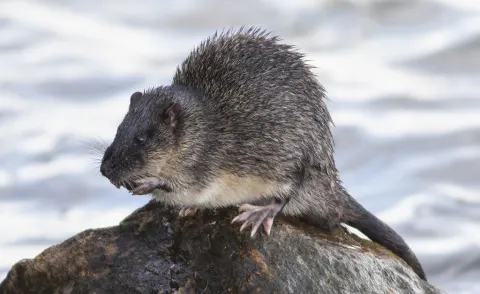
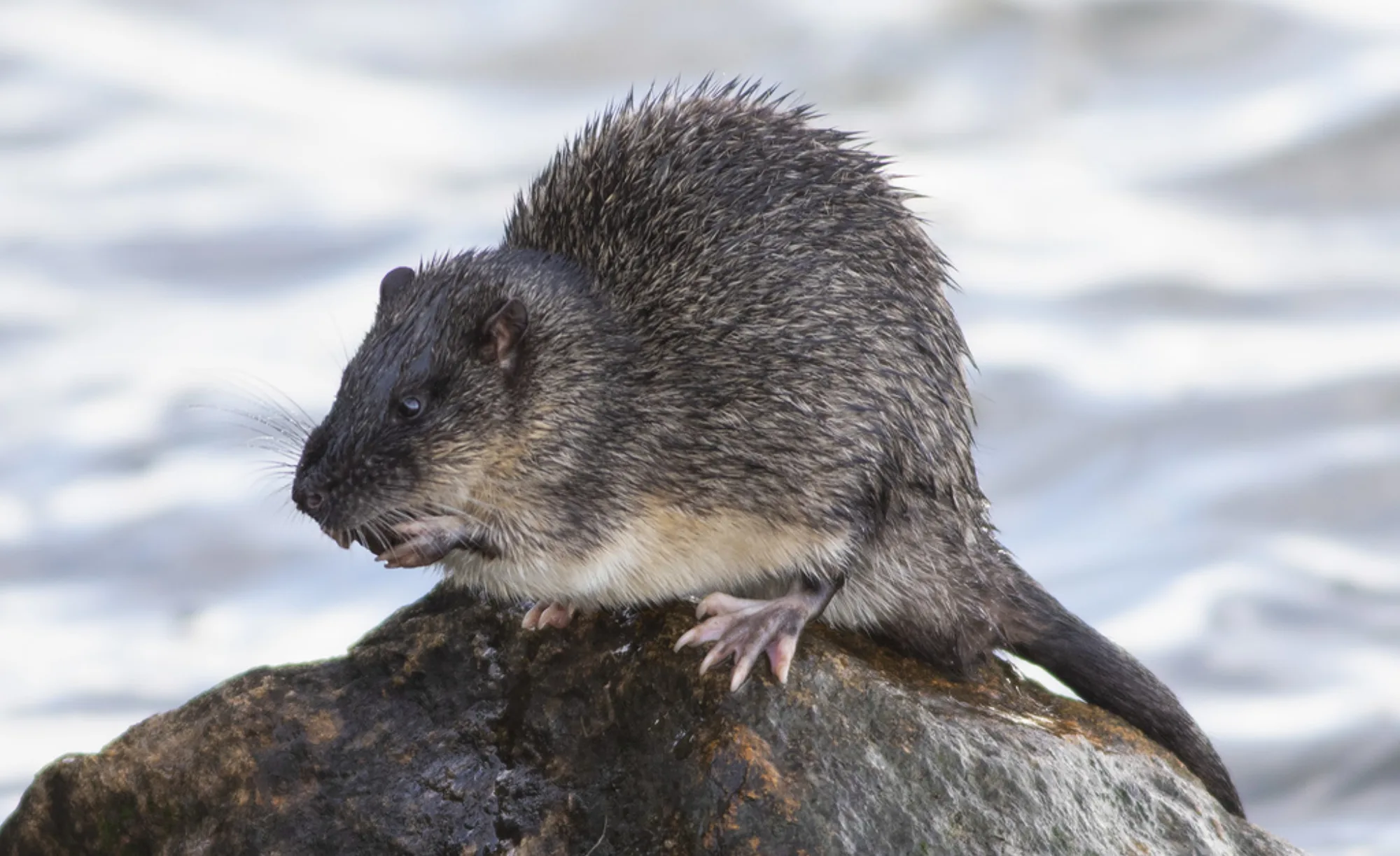
Along the water's edge, the Common Water Rat, or rakali, can be recognised by its dark coat, pale belly and thick, white-tipped tail. This native Australian rodent has a flattened head, long whiskers, small ears and eyes, and partly webbed hind feet. Its waterproof fur ranges from black to brown, with an orange to white belly. The body measures 23 to 37 cm, while the tail is around 24 to 35 cm long.
Rakali live around permanent water in Australia, New Guinea and offshore islands. Their habitats include slow-moving freshwater streams, brackish lakes, wetlands, estuaries, beaches and sheltered marine bays. They favour low banks with flat, densely vegetated edges, where they can find cover and stalk prey. Mostly nocturnal, they look for food at dusk, but may also swim and hunt in the early hours and at evening. They eat fish, crustaceans, mussels, insects, frogs, eggs and small birds, as well as cane toads. In winter, they also eat plants when resources are scarce and spend longer periods in their burrows. Mostly solitary and territorial, they rest in burrows or hollow logs when not foraging.
Breeding depends on seasonal conditions, and several litters may be produced when conditions are good. Litters average four to five young, born from September to February and suckled for four weeks. Rakali were hunted for their fur and killed because they were considered pests. Today, threats to some populations include urbanisation, salinisation, pollution and degradation of waterways. In parts of Victoria, commercial eel-fishing, predation, habitat loss from development and poisoning from baiting programmes have been linked to declines. Young rakali in the water face predators including large fish and snakes; birds of prey, foxes and cats also prey on them.
Written from the English Wikipedia article Rakali (CC BY-SA 4.0).
- Records
- 6,937
- Countries
- 1
- Atlas places
- 5
These are open occurrence records, so they show where people looked for and recorded the Common Water Rat as much as where it lives. Cells are up to 25 km across, and every location is generalised to its cell.
Generalised encounter areas, not exact locations. Each shape is a grid cell coloured by how likely the species is there.
- Very likelyAustralia25 km zone · medium confidence · 6937 records · updated 80 days ago
Conservation status not assessed here yet, so every location is generalised to its grid cell.