False Water Cobra
Hydrodynastes gigas
Across wetlands and tropical rainforests in South America, the False Water Cobra moves through water and vegetation by day. This large, mildly venomous snake occurs from eastern Bolivia to southern Brazil, as well as in Paraguay and Argentina. It favours marshes and other wet or humid places, although it has also been seen in drier areas. Most adults reach about 2 m in length, while some exceed 3 m. Females are much larger than males.
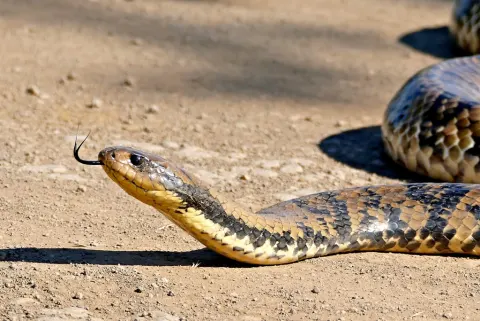
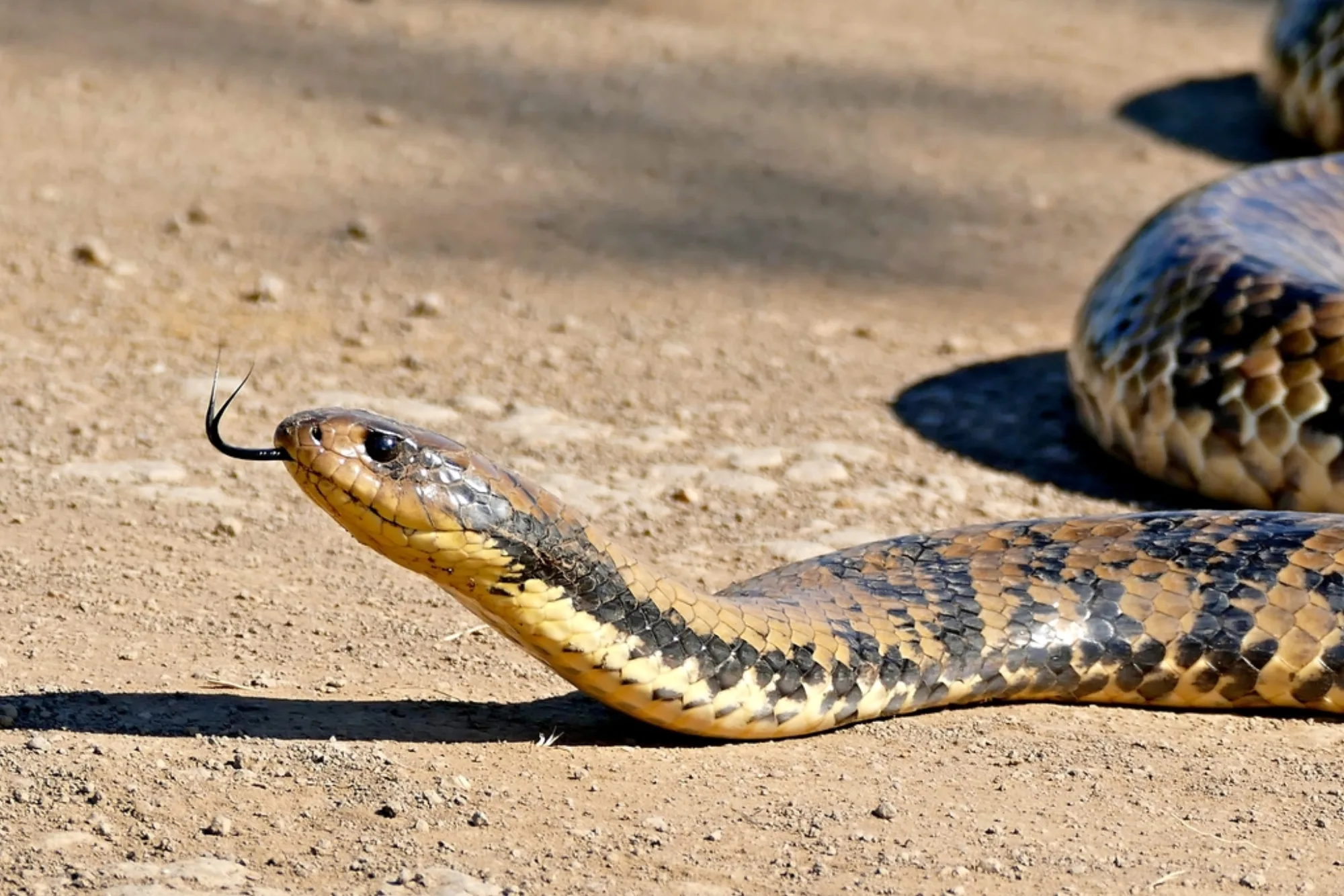
A mature snake has an olive green or brown background colour, marked over much of its body with dark spots and bands. The colour and bands tend to darken towards the tail, and the pattern helps camouflage it in rainforest. Its large eyes have round pupils, and its tongue is black. Young snakes are much darker than adults and lack their typical dark eyes. When threatened, the False Water Cobra flattens its neck into a hood, making itself look larger. It can also flatten the body farther down, and it stays horizontal rather than raising itself like a true cobra.
Active mainly in daylight, it often climbs, burrows or swims. Individual snakes vary in temperament: some are docile, while others are defensive or aggressive. In the wild, fish and amphibians make up much of its diet, but it also eats small mammals, birds and reptiles. Most reported bites cause mild local pain and minor swelling, although significant reactions have been reported. Some captive-bred snakes become tame and trusting.
Written from the English Wikipedia article Hydrodynastes gigas (CC BY-SA 4.0).
- Records
- 19
- Countries
- 4
- Atlas places
- 1
These are open occurrence records, so they show where people looked for and recorded the False Water Cobra as much as where it lives. Cells are up to 25 km across, and every location is generalised to its cell.
Generalised encounter areas, not exact locations. Each shape is a grid cell coloured by how likely the species is there.
- Very likelyArgentina25 km zone · medium confidence · 11 records · updated 80 days ago
- Very likelyBrazil25 km zone · medium confidence · 8 records · updated 80 days ago
- PossibleBolivia25 km zone · low confidence · 0 records · updated 80 days ago
- UncommonFrench Guiana25 km zone · low confidence · 0 records · updated 80 days ago
Conservation status not assessed here yet, so every location is generalised to its grid cell.