Capybara
Hydrochoerus hydrochaeris
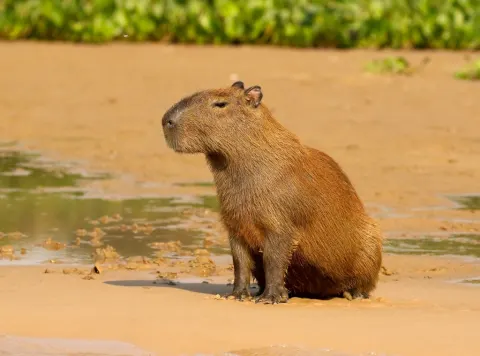
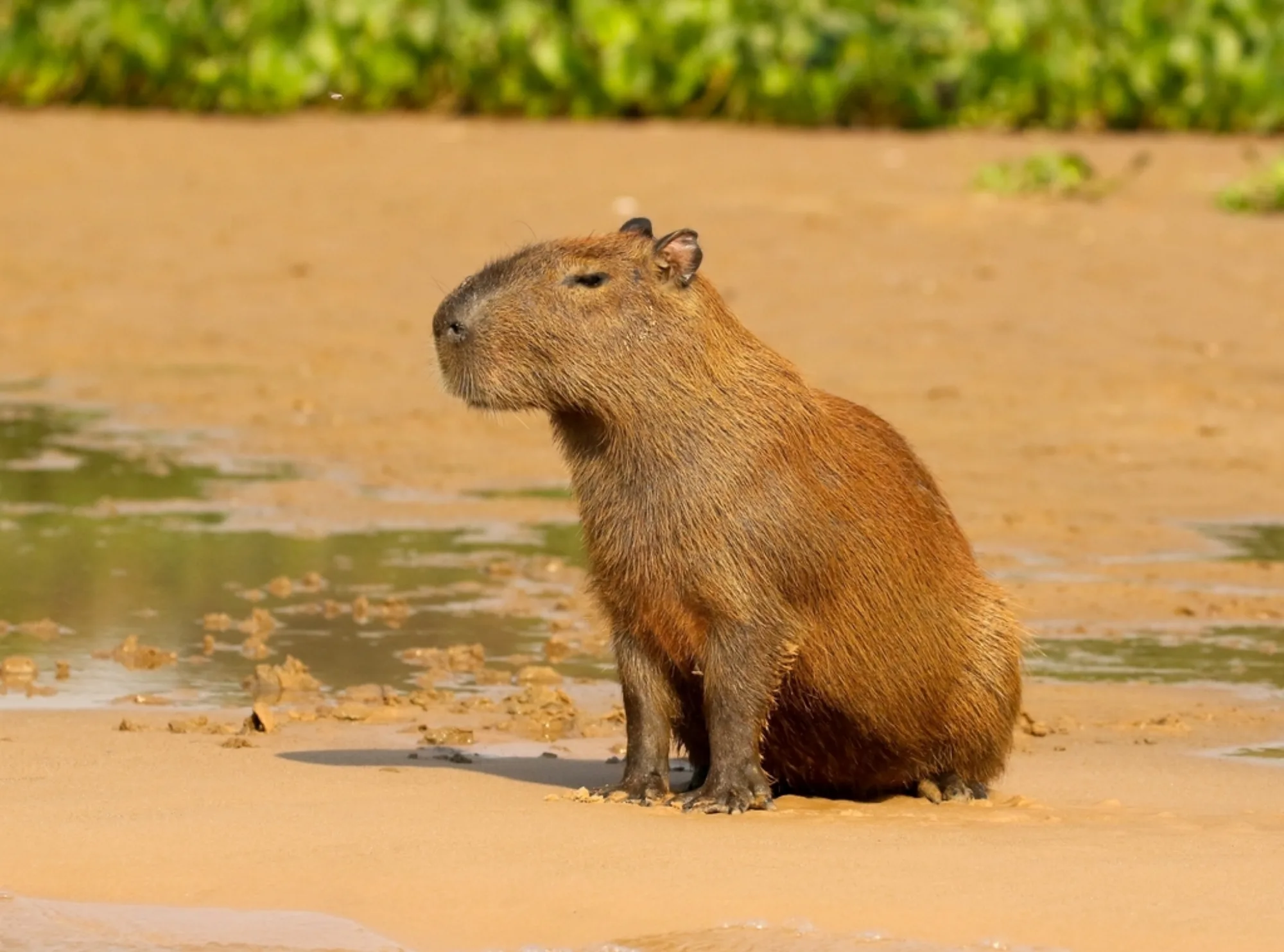
At the water's edge, the Capybara is recognisable by its heavy, barrel-shaped body, broad head and blunt muzzle. The world's largest living rodent has reddish-brown fur above and yellowish-brown fur underneath, with eyes and ears set near the top of its head. Adults measure 106 to 134 cm in length and usually weigh 35 to 66 kg. Slightly webbed feet suit a life spent between land and water. Native to every South American country except Chile, capybaras live mainly in lowlands near freshwater. Look for them around rivers, lakes, ponds and swamps, in places ranging from flooded savannas and wetlands to forests along waterways.
Capybaras usually rest on dry land in the morning, then enter the water during the heat of the early afternoon. They graze from late afternoon through the night, eating mostly grass and water plants, along with fruit and bark. During the dry season, they eat a wider variety of plants and turn to plentiful reeds. They are social animals, usually gathering in groups of 10 to 20, though larger groups can form around water in the dry season. Listen for their barks, chirps, whistles, huffs and purrs. After a gestation of 130 to 150 days, a female gives birth on land to four young on average. The young join the group when they can move, eat grass within a week and suckle until around 16 weeks. Jaguars, caimans and green anacondas are among their predators. People also hunt capybaras for meat and hides, and sometimes kill them because they see their grazing as competition for livestock.
Written from the English Wikipedia article Capybara (CC BY-SA 4.0).
- Records
- 4,394
- Countries
- 10
- Atlas places
- 7
These are open occurrence records, so they show where people looked for and recorded the Capybara as much as where it lives. Cells are up to 25 km across, and every location is generalised to its cell.
Generalised encounter areas, not exact locations. Each shape is a grid cell coloured by how likely the species is there.
- Very likelyBrazil25 km zone · medium confidence · 3188 records · updated 80 days ago
- Very likelyArgentina25 km zone · medium confidence · 743 records · updated 80 days ago
- Very likelyColombia25 km zone · high confidence · 197 records · updated 80 days ago
- Very likelyBolivia25 km zone · medium confidence · 100 records · updated 80 days ago
- Very likelyPeru25 km zone · medium confidence · 55 records · updated 80 days ago
- Very likelyUruguay25 km zone · medium confidence · 46 records · updated 80 days ago
- Very likelyFrench Guiana25 km zone · medium confidence · 30 records · updated 80 days ago
- LikelyUnited States25 km zone · medium confidence · 20 records · updated 80 days ago
- LikelyVenezuela25 km zone · medium confidence · 9 records · updated 80 days ago
- LikelyEcuador25 km zone · medium confidence · 6 records · updated 80 days ago
Conservation status not assessed here yet, so every location is generalised to its grid cell.