Orange Roughy
Hoplostethus atlanticus
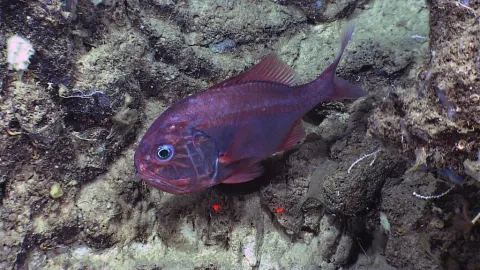
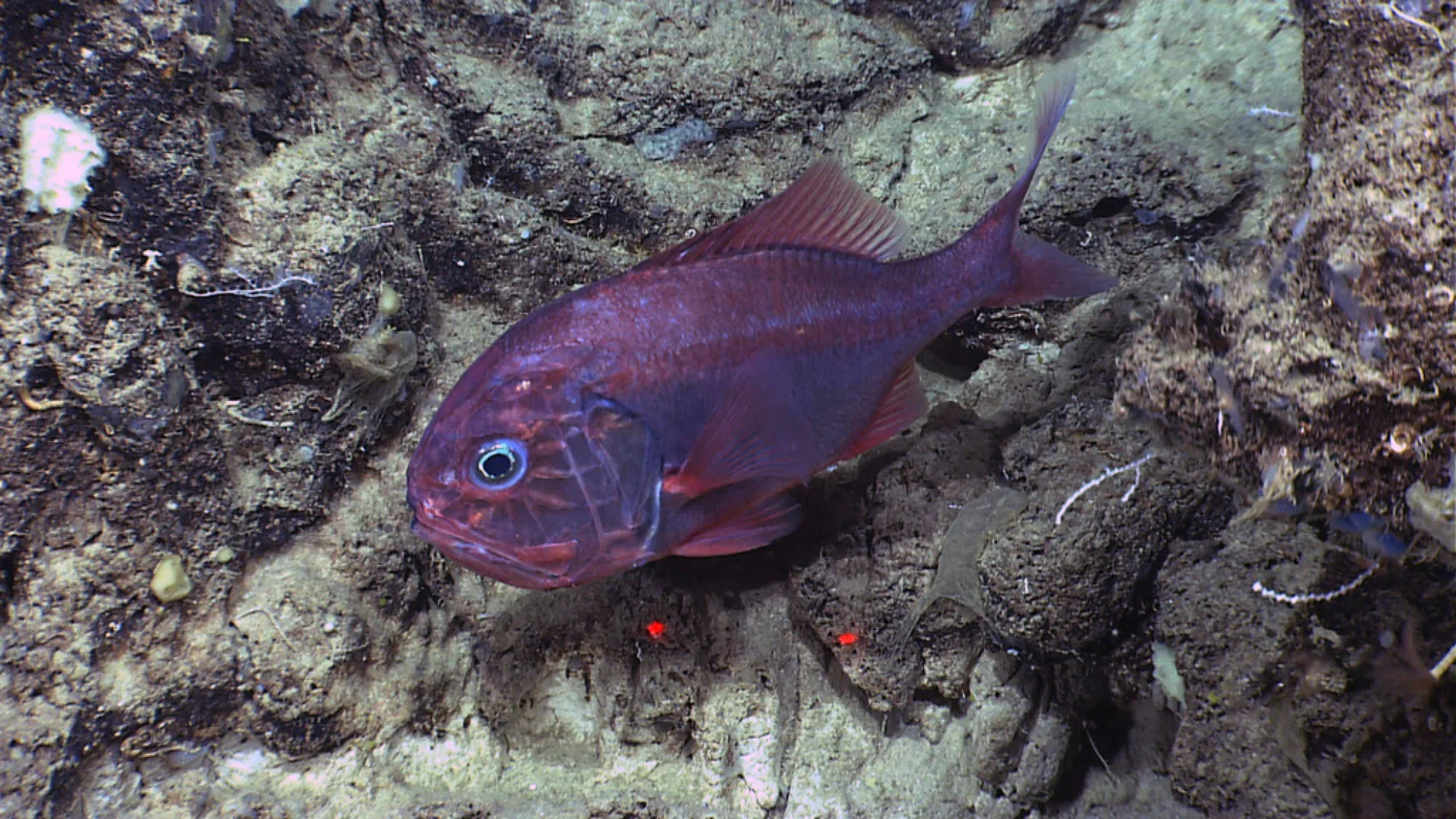
Bright brick-red colouring, a rounded head and large eyes help distinguish the Orange Roughy, a deep-sea fish in the slimehead family. Its body is flattened from side to side, and its tail is forked. It can reach 75 cm in length, excluding the tail fin, and weigh up to 7 kg. After death, its red colour fades to yellowish-orange.
Orange roughy live in cold water at depths of 180 to 1,800 metres, across parts of the Pacific, Atlantic and Indo-Pacific oceans. Their range includes waters off New Zealand, Australia and Chile, as well as the eastern Atlantic from Iceland to Morocco and from Namibia to South Africa. Generally sluggish and living near the seabed, they gather around features such as underwater canyons and seamounts, where moving water concentrates prey. These gatherings are not necessarily for feeding or breeding: the fish are thought to alternate between active and resting phases. During the inactive phase, they lose almost all their colour and can be approached easily. Young fish eat mainly zooplankton, including small crustaceans and fish, while mature adults take smaller fish and squid. Large deep-roving sharks, cutthroat eels, hakes and snake mackerels prey on them.
Each year, orange roughy migrate several hundred kilometres between feeding and spawning areas. Their eggs and larvae rise towards 200 m to develop, and the young descend into deeper water as they mature. These slow-growing fish can live for over 200 years and only begin breeding at age 20 or later. Their late maturity and relatively low egg production make populations slow to recover from fishing. Many stocks were severely depleted by commercial deep-trawl fisheries, although several have since recovered to levels fisheries managers consider sustainable.
Written from the English Wikipedia article Orange roughy (CC BY-SA 4.0).
- Records
- 8,012
- Countries
- 5
No atlas park has a record of the Orange Roughy in or around it yet.
These are open occurrence records, so they show where people looked for and recorded the Orange Roughy as much as where it lives. Cells are up to 25 km across, and every location is generalised to its cell.
Generalised encounter areas, not exact locations. Each shape is a grid cell coloured by how likely the species is there.
- Very likelyNew Zealand25 km zone · high confidence · 7619 records · updated 80 days ago
- Very likelyCanada25 km zone · high confidence · 311 records · updated 80 days ago
- LikelyAustralia25 km zone · medium confidence · 67 records · updated 80 days ago
- LikelyGreenland25 km zone · medium confidence · 9 records · updated 80 days ago
- PossibleIreland25 km zone · medium confidence · 6 records · updated 80 days ago
Conservation status not assessed here yet, so every location is generalised to its grid cell.