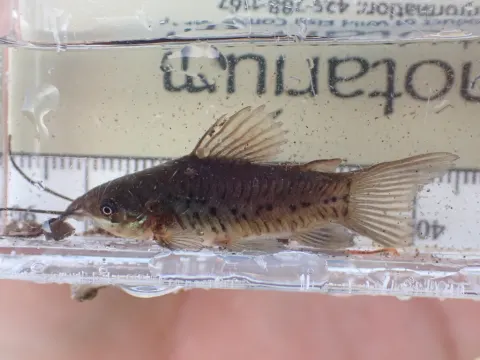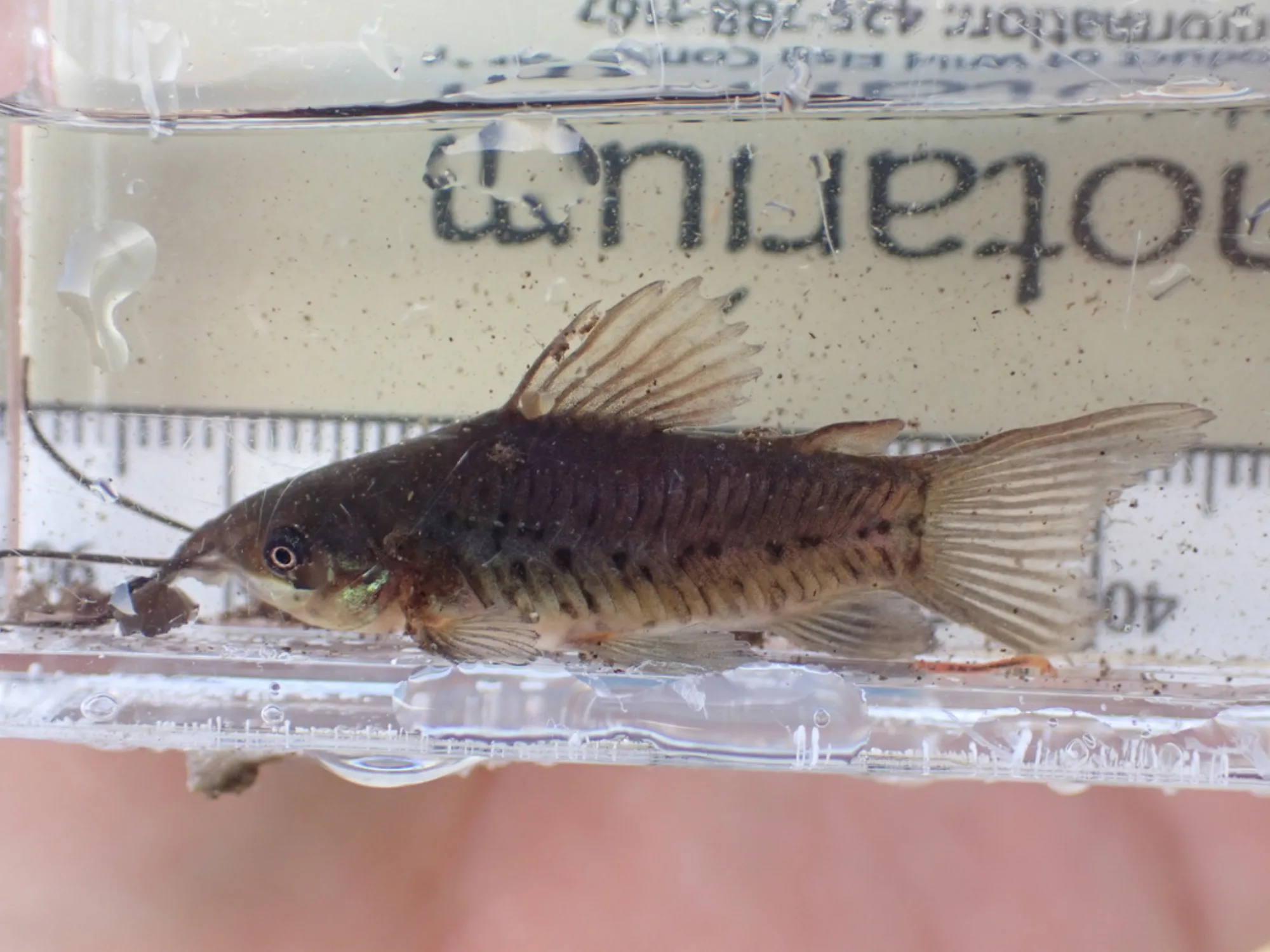
Brown Hoplo
Hoplosternum littorale
Armour plates cover the Brown Hoplo, a freshwater catfish that can grow to 24.0 centimetres long. Its body is flattened from top to bottom, and males grow larger on average than females. During the breeding season, males develop a curved fin spine that often turns reddish.
The fish ranges from Venezuela and the Guianas to Argentina, occupying South America to the east of the Andes and as far south as Buenos Aires. Its range includes the Amazon drainage, the Orinoco, Trinidad and coastal rivers of the Guianas. It has also been introduced to Florida's Indian River Lagoon. Look for it in tropical standing waters and swamps, including newly flooded swamps, and on the floodplains of Amazonian whitewater rivers that begin in the Andes. These habitats have little dissolved oxygen and change markedly with seasonal rainfall. Outside the breeding season, the fish feeds and moves mainly at night. Its food includes bottom-dwelling invertebrates and detritus, with the adult diet changing between dry and wet seasons. Young fish eat mainly small aquatic crustaceans, while both juveniles and adults eat chironomid larvae.
Breeding begins after one year, with spawning prompted by the first rains of the warm, rainy season. The fish builds a dome-shaped bubble nest, often in open water near the edge of a newly flooded swamp. Plant material and foam form the nest, which holds the eggs above the oxygen-poor water. A male guards and maintains the nest day and night, and defends the surrounding territory. Eggs and larvae face intense predation, and the male stops guarding them one or two days after they hatch. People also fish extensively for this valued food fish in the Amazon and Orinoco deltas.
Written from the English Wikipedia article Hoplosternum littorale (CC BY-SA 4.0).
- Records
- 300
- Countries
- 8
- Atlas places
- 2
These are open occurrence records, so they show where people looked for and recorded the Brown Hoplo as much as where it lives. Cells are up to 25 km across, and every location is generalised to its cell.
Generalised encounter areas, not exact locations. Each shape is a grid cell coloured by how likely the species is there.
- Very likelyUnited States25 km zone · medium confidence · 156 records · updated 82 days ago
- Very likelyBrazil25 km zone · medium confidence · 85 records · updated 82 days ago
- Very likelyVenezuela25 km zone · medium confidence · 18 records · updated 82 days ago
- Very likelyArgentina25 km zone · medium confidence · 13 records · updated 82 days ago
- Very likelyPeru25 km zone · medium confidence · 11 records · updated 82 days ago
- LikelyParaguay25 km zone · medium confidence · 14 records · updated 82 days ago
- LikelyBolivia25 km zone · medium confidence · 3 records · updated 82 days ago
- UncommonColombia25 km zone · low confidence · 0 records · updated 82 days ago
Conservation status not assessed here yet, so every location is generalised to its grid cell.