Ribbon Seal
Histriophoca fasciata
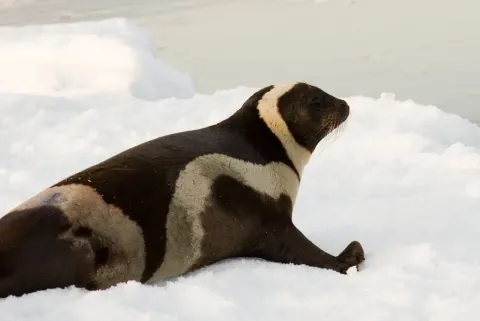
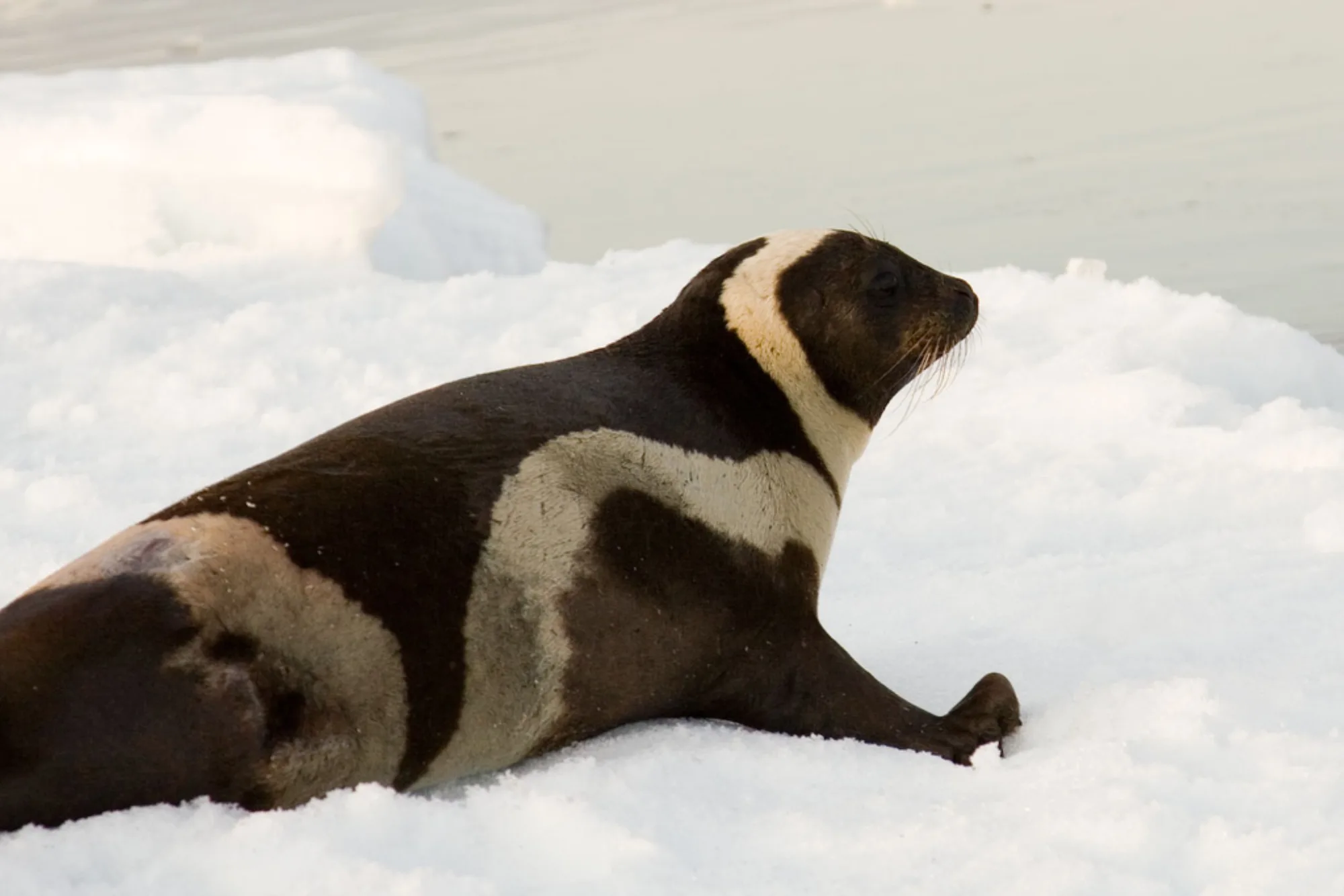
Dark fur crossed by broad white markings makes an adult Ribbon Seal distinctive. One pale band circles the neck, another the tail, and a ring surrounds each front flipper. The contrast is strongest in males and often less conspicuous in females. Newborn pups have white fur, which changes to blue-grey above and silvery below after moulting; the striped pattern appears at four years old. Adults can reach about 1.6 m in length and weigh 95 kg, with males larger than females.
Ribbon Seals live in the Arctic and Subarctic North Pacific, especially around the Bering and Okhotsk seas. In winter and spring, they use pack ice for breeding, moulting and giving birth, and are found at the ice front. They are rarely seen on land or on ice attached to shore. On the ice, they move with a quick, winding motion, gripping with their claws and pulling with alternating flipper strokes. They are solitary and do not form herds, and dive as deep as 200 m to find food. Their diet includes pollock, eelpout, Arctic cod, squid and octopus; young seals also eat crustaceans such as shrimp.
Breeding takes place once a year, usually from late May to June. A female gives birth to one pup, then tends it for about four to six weeks on the pack ice. Pups stay out of the water until they have shed their white birth coat. Great white sharks and orcas are among the seal's main predators. Young seals were once overhunted for their soft, dense fur, causing the population to fall; it recovered after the Soviet Union limited hunting in 1969.
Written from the English Wikipedia article Ribbon seal (CC BY-SA 4.0).
- Records
- 13
- Countries
- 1
No atlas park has a record of the Ribbon Seal in or around it yet.
These are open occurrence records, so they show where people looked for and recorded the Ribbon Seal as much as where it lives. Cells are up to 25 km across, and every location is generalised to its cell.
Generalised encounter areas, not exact locations. Each shape is a grid cell coloured by how likely the species is there.
- Very likelyUnited States25 km zone · medium confidence · 13 records · updated 80 days ago
Conservation status not assessed here yet, so every location is generalised to its grid cell.