Welcome Swallow
Hirundo neoxena
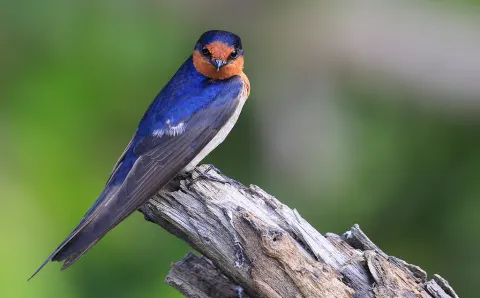
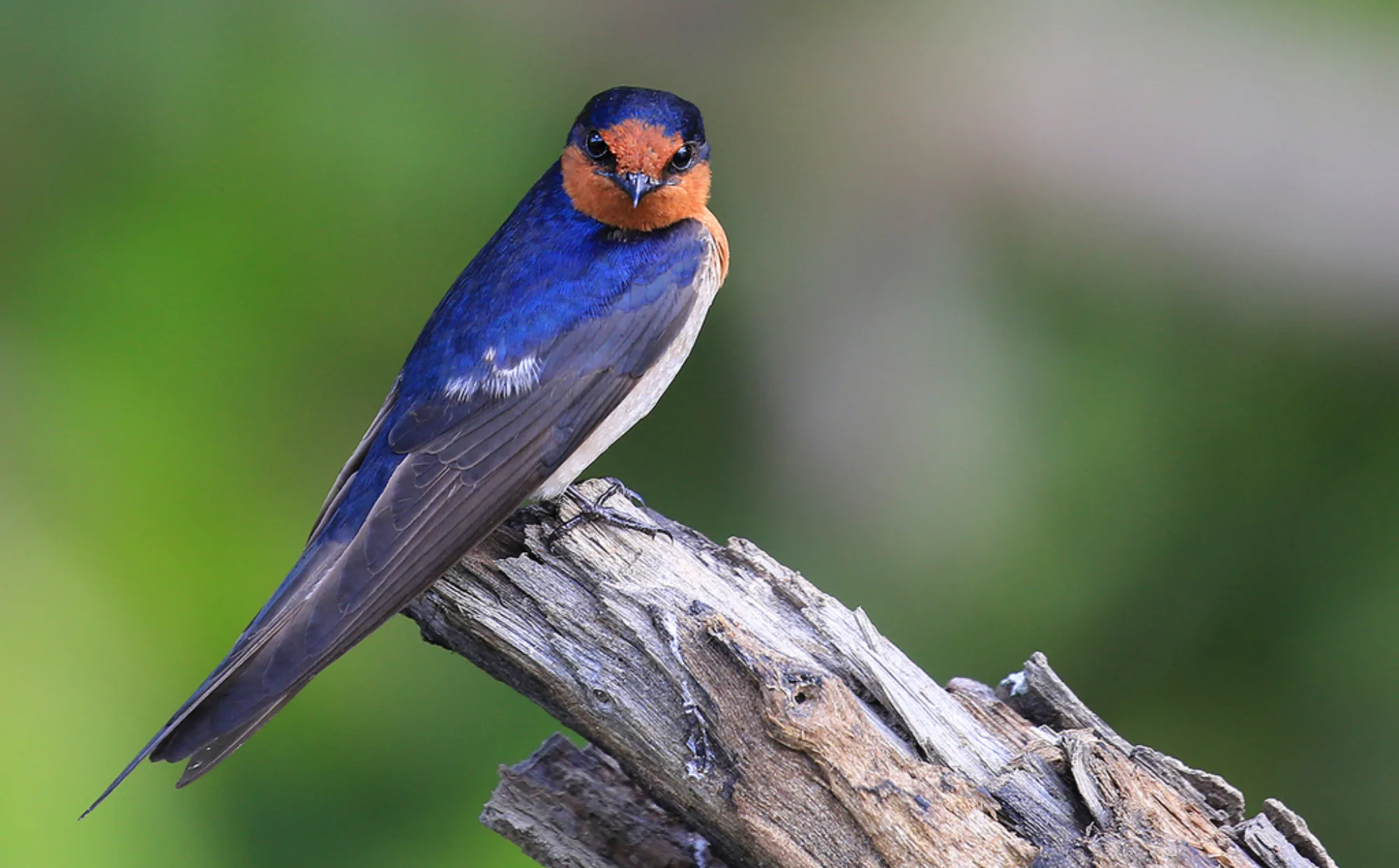
A quick flash of metallic blue-black above, a pale grey belly and a rusty forehead and throat can help identify the Welcome Swallow. About 15 cm long, it has a long forked tail marked with white spots. Its flight follows circles with quick darts, and birds may fly alone, in pairs or in clusters. Listen for quiet twittering and soft warbling, with a sharp whistle when the bird is alarmed.
From its native range in Australia and neighbouring islands, it has spread to New Zealand, where it is found across most of the country but is very rare in Fiordland. It favours coastal and wetland areas, but also uses farmland, grassland, partly cleared woodland, lakeshores and urban areas. Wires and posts are common perches, and it readily breeds near human homes. Eastern Australian birds mostly migrate north for winter, while birds in Western Australia and New Zealand are mainly sedentary. Agile in the air, they catch insects on the wing, often flying low over open fields in circles or figure-eight patterns. They also scoop water from lakes and ponds while flying.
Breeding runs from August to March, when pairs build an open cup of mud and grass on a structure such as a building or rock wall. Feathers and fur line the cup, which typically holds three to five eggs; pairs often raise two broods in a season. Both parents feed the young, which leave the nest two to three weeks after hatching. Hawks, snakes and feral cats prey on these swallows; snakes can reach nests and eat eggs or young birds. Nest disturbance and egg predation have also caused nest failure in a New Zealand study.
Written from the English Wikipedia article Welcome swallow (CC BY-SA 4.0).
- Records
- 912,347
- Countries
- 4
- Atlas places
- 8
- Blue Mountains National Park· Australia
- Daintree National Park· Australia
- Great Sandy National Park (K'gari)· Australia
- Abel Tasman National Park· New Zealand
- Catlins Conservation Park· New Zealand
- Grampians (Gariwerd) National Park· Australia
- Lamington National Park· Australia
- Tongariro National Park· New Zealand
These are open occurrence records, so they show where people looked for and recorded the Welcome Swallow as much as where it lives. Cells are up to 25 km across, and every location is generalised to its cell.
Generalised encounter areas, not exact locations. Each shape is a grid cell coloured by how likely the species is there.
- Very likelyAustralia25 km zone · high confidence · 794336 records · updated 86 days ago
- Very likelyNew Zealand25 km zone · high confidence · 116859 records · updated 86 days ago
- Very likelyNorfolk Island25 km zone · high confidence · 1006 records · updated today
- PossibleNew Caledonia25 km zone · medium confidence · 146 records · updated today
Conservation status not assessed here yet, so every location is generalised to its grid cell.