Common Hippopotamus
Hippopotamus amphibius
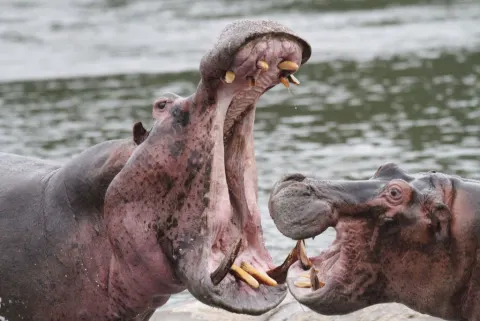
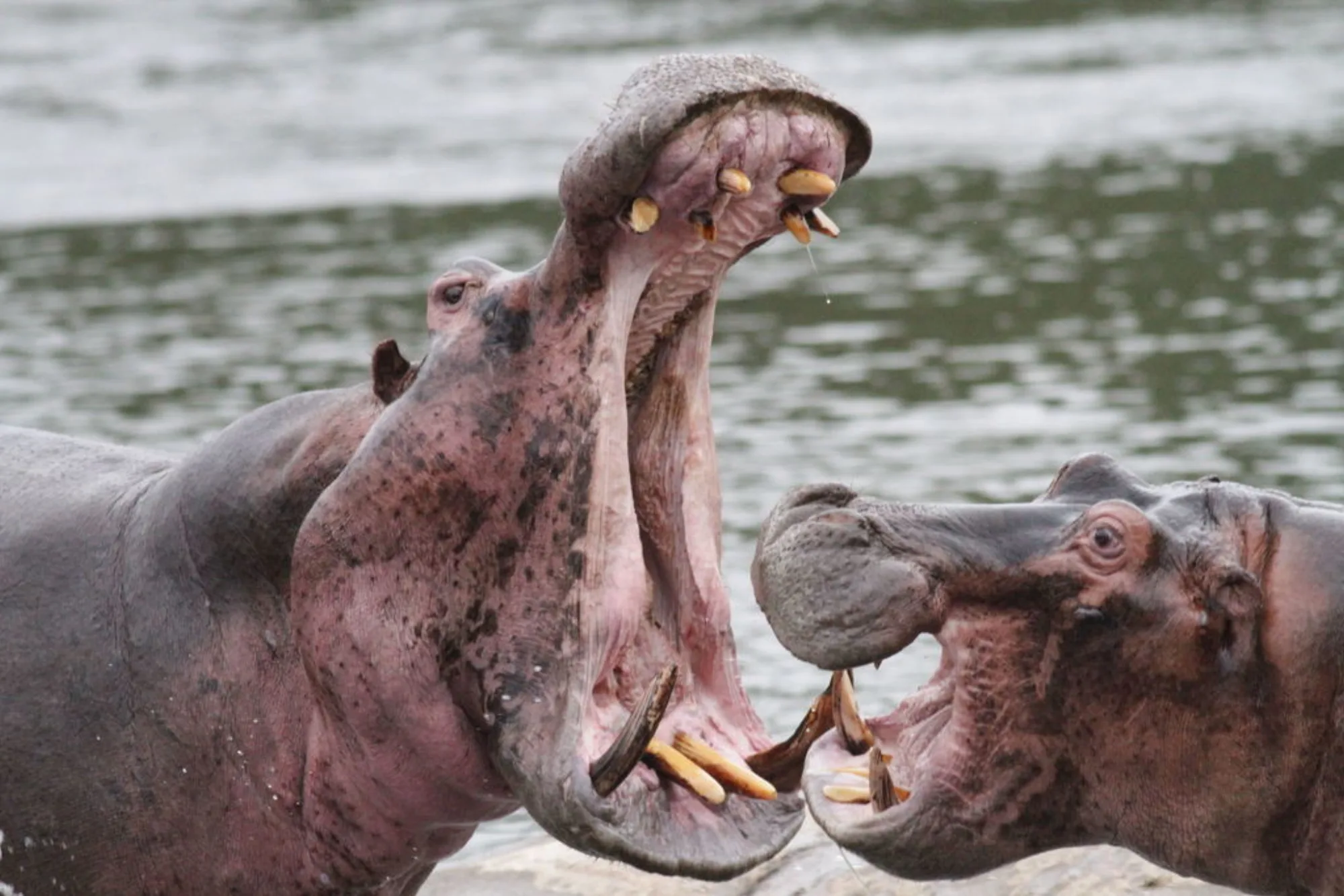
With its barrel-shaped body, short legs and immense mouth, the Common Hippopotamus is hard to mistake for another animal. Its skin is nearly hairless and mostly purplish-grey or blue-black, with brownish-pink around the eyes and ears and on the underside. Eyes, ears and nostrils sit high on the head, allowing a hippo to keep them above water while the rest of its body is submerged. Adult males average 1.5 t and females 1.3 t.
Native to sub-Saharan Africa, hippos live in rivers, lakes and mangrove swamps, with a range extending from The Gambia to South Africa. They need water deep enough to immerse themselves and grass nearby, favouring relatively still water with gently sloping shores. They spend much of the day in water to keep cool, then come ashore around dusk to feed. Grass makes up almost all of their natural diet, and an individual may travel 3 to 5 km in a night while eating around 40 kg of it. Hippos rest close together in the water, sometimes in groups of more than 100, but graze alone. Males defend territories in water, and a wide-open mouth can serve as a threat display.
Females give birth in seclusion, returning within 10 to 14 days, and carry their calves on their backs in deep water. Mothers are protective, while calves may also gather in nurseries watched over by adults. Hippos can be aggressive and unpredictable, and have been reported attacking boats. Loss of habitat and access to fresh water threaten them, as do hunting and poaching for meat and ivory.
Written from the English Wikipedia article Hippopotamus (CC BY-SA 4.0).
- Records
- 1,571
- Countries
- 23
- Atlas places
- 37
- Kruger National Park· South Africa
- Okavango Delta· Botswana
- Serengeti National Park· Tanzania
- iSimangaliso Wetland Park· South Africa
- Maasai Mara National Reserve· Kenya
- Ngorongoro Conservation Area· Tanzania
- Chobe National Park· Botswana
- Bwabwata National Park· Namibia
- Murchison Falls National Park· Uganda
- Queen Elizabeth National Park· Uganda
- Aberdare National Park· Kenya
- Lake Manyara National Park· Tanzania
- Zambezi National Park· Zimbabwe
- Gonarezhou National Park· Zimbabwe
- Hell's Gate National Park· Kenya
- Lake Mburo National Park· Uganda
- Lower Zambezi National Park· Zambia
- Pilanesberg National Park· South Africa
- South Luangwa National Park· Zambia
- Akagera National Park· Rwanda
- Amboseli National Park· Kenya
- Lake Nakuru National Park· Kenya
- Mana Pools National Park· Zimbabwe
- Mudumu National Park· Namibia
- Nairobi National Park· Kenya
- Tsavo East National Park· Kenya
- Addo Elephant National Park· South Africa
- Hluhluwe-iMfolozi Park· South Africa
- Hwange National Park· Zimbabwe
- Kafue National Park· Zambia
- Kasanka National Park· Zambia
- Kilimanjaro National Park· Tanzania
- Matobo National Park· Zimbabwe
- Nkasa Rupara National Park· Namibia
- Rwenzori Mountains National Park· Uganda
- Table Mountain National Park· South Africa
- Tsavo West National Park· Kenya
These are open occurrence records, so they show where people looked for and recorded the Common Hippopotamus as much as where it lives. Cells are up to 25 km across, and every location is generalised to its cell.
Generalised encounter areas, not exact locations. Each shape is a grid cell coloured by how likely the species is there.
- Very likelySouth Africa25 km zone · medium confidence · 601 records · updated 80 days ago
- Very likelyKenya25 km zone · medium confidence · 241 records · updated 80 days ago
- Very likelyTanzania25 km zone · medium confidence · 142 records · updated 80 days ago
- Very likelyUganda25 km zone · medium confidence · 138 records · updated 80 days ago
- Very likelyUnited States25 km zone · high confidence · 126 records · updated 80 days ago
- Very likelyNamibia25 km zone · medium confidence · 87 records · updated 80 days ago
- Very likelyBotswana25 km zone · medium confidence · 78 records · updated 80 days ago
- Very likelyZimbabwe25 km zone · medium confidence · 37 records · updated 80 days ago
- Very likelyZambia25 km zone · medium confidence · 32 records · updated 80 days ago
- Very likelyBenin25 km zone · medium confidence · 29 records · updated 80 days ago
Conservation status not assessed here yet, so every location is generalised to its grid cell.