Pacific Halibut
Hippoglossus stenolepis
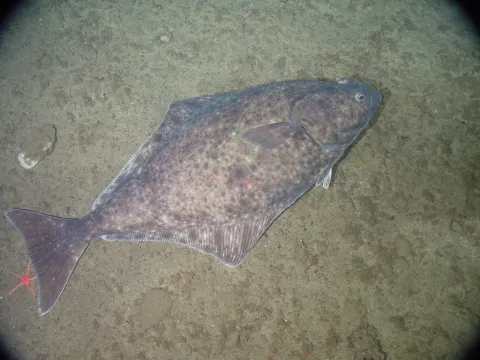
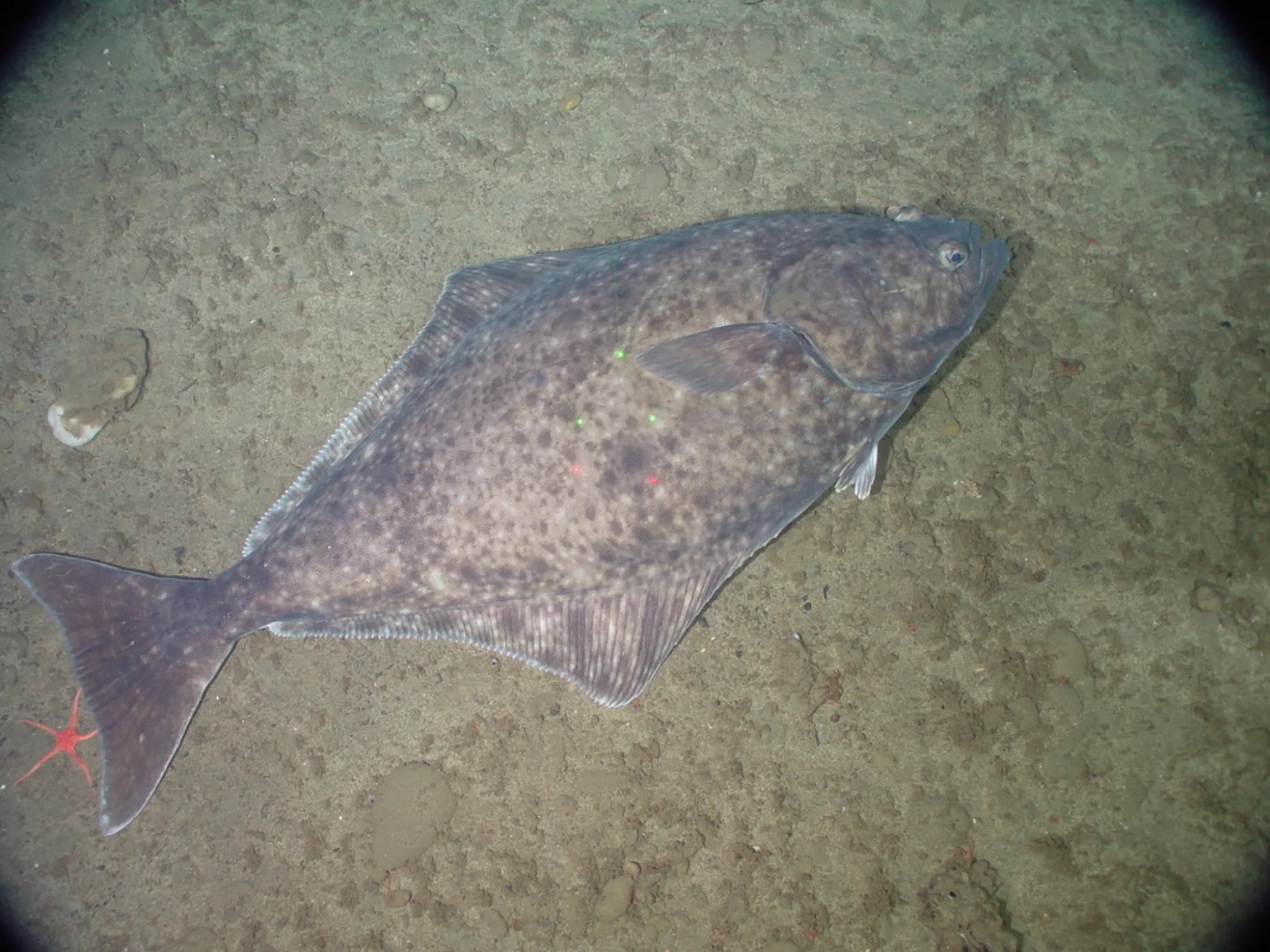
A broad, diamond-shaped body and a crescent-shaped tail distinguish the Pacific Halibut, one of the largest flatfish. More elongated than many of its relatives, it has both eyes on its dark upper side. That surface tends to match the colour of the seabed, while the lighter underside resembles the sky when seen from below. This colouring helps conceal the fish from both predators and prey. Females can reach 230 kg and grow longer than 2.4 m.
Pacific Halibut live on or near the seabed of the North Pacific continental shelf and the Bering Sea, favouring water between 3 and 8 °C. Strong swimmers, they can travel long distances and generally move clockwise from settlement areas in the western Gulf of Alaska and Bering Sea. They eat fish such as cod, turbot and pollock, as well as octopus, crab and shrimp. At times they leave the bottom to feed on fish including salmon and herring.
In summer, mature fish feed in shallower water, then move to deeper spawning grounds in winter. Spawning peaks from December through February, often beyond the continental shelf edge at depths of 183 to 457 m. The larvae drift freely for up to six months before young halibut settle into life near the bottom in shallower water. Most spend five to seven years in shallow nursery grounds, including the Bering Sea. Pacific Halibut are caught by commercial, sport and subsistence fishers, with much of the fishing concentrated in the Gulf of Alaska and Bering Sea.
Written from the English Wikipedia article Pacific halibut (CC BY-SA 4.0).
- Records
- 22,020
- Countries
- 2
- Atlas places
- 1
These are open occurrence records, so they show where people looked for and recorded the Pacific Halibut as much as where it lives. Cells are up to 25 km across, and every location is generalised to its cell.
Generalised encounter areas, not exact locations. Each shape is a grid cell coloured by how likely the species is there.
- Very likelyCanada25 km zone · medium confidence · 17204 records · updated 80 days ago
- Very likelyUnited States25 km zone · medium confidence · 4816 records · updated 80 days ago
Conservation status not assessed here yet, so every location is generalised to its grid cell.