Atlantic Halibut
Hippoglossus hippoglossus
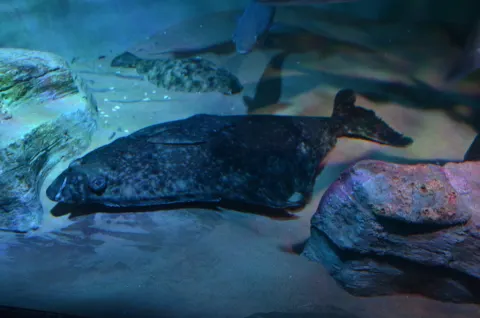
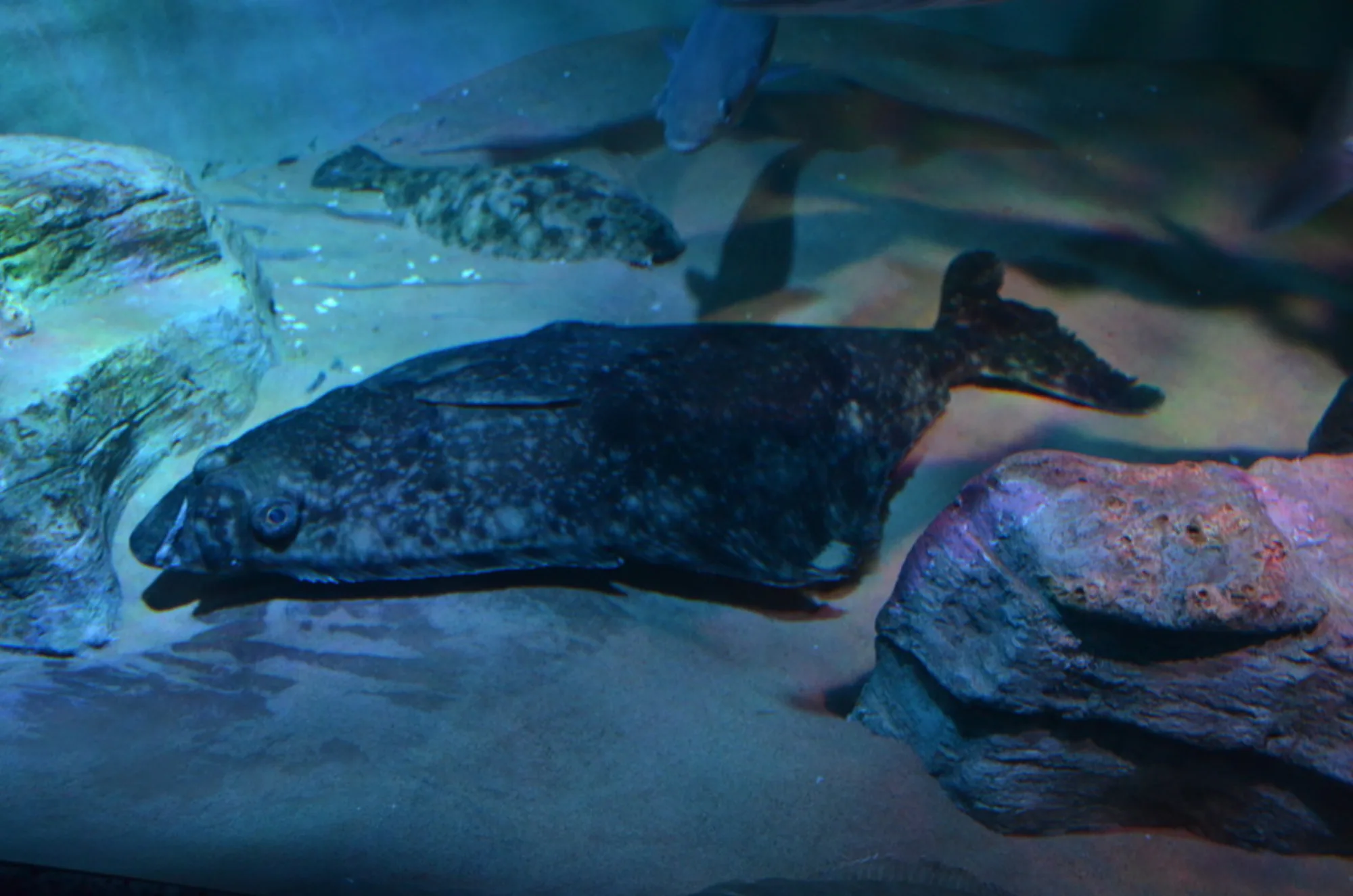
With both eyes on one side of its head, the Atlantic Halibut lies on its left side against the seabed. Its upper side ranges from dark chocolate or olive to slate, sometimes appearing almost black, while the underside is white. Younger fish are paler and more mottled. This is the world's largest flatfish, reaching up to 4.7 m in length and 320 kg in weight. A strong swimmer, it can travel long distances, although it usually stays close to the ocean floor.
Its range spans temperate and Arctic waters on both sides of the North Atlantic, reaching Labrador, Greenland, Iceland, the Barents Sea, Virginia and the Bay of Biscay. Around the eastern Atlantic, it occurs off the United Kingdom, Ireland and northern Europe as far as Russia. It lives over sand, gravel or clay at depths of 50 to 2,000 m, occasionally coming nearer the surface. Young fish spend time close to shore before moving into deeper water as they grow. Adults mainly eat other fish, including cod, herring and smaller halibut, as well as cephalopods and large crustaceans. In their first year, young halibut feed mostly on plankton, then take krill and small fish. Seals, Greenland sharks and killer whales all prey on halibut.
Spawning takes place near the ocean bottom between December and April. Depending on their size and age, females produce anything from a few thousand eggs to four million. Atlantic halibut grow slowly and reach maturity late, leaving their populations slow to recover from overfishing. Once an important food fish, the species has seen its fishery largely collapse.
Written from the English Wikipedia article Atlantic halibut (CC BY-SA 4.0).
- Records
- 16,991
- Countries
- 4
- Atlas places
- 2
These are open occurrence records, so they show where people looked for and recorded the Atlantic Halibut as much as where it lives. Cells are up to 25 km across, and every location is generalised to its cell.
Generalised encounter areas, not exact locations. Each shape is a grid cell coloured by how likely the species is there.
- Very likelyCanada25 km zone · high confidence · 16040 records · updated 81 days ago
- Very likelyNorway25 km zone · medium confidence · 527 records · updated 81 days ago
- Very likelyUnited States25 km zone · high confidence · 424 records · updated 81 days ago
Conservation status not assessed here yet, so every location is generalised to its grid cell.