Bluntnose Sixgill Shark
Hexanchus griseus
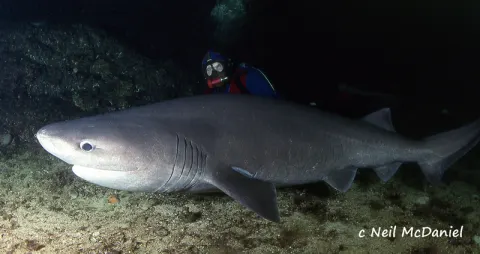
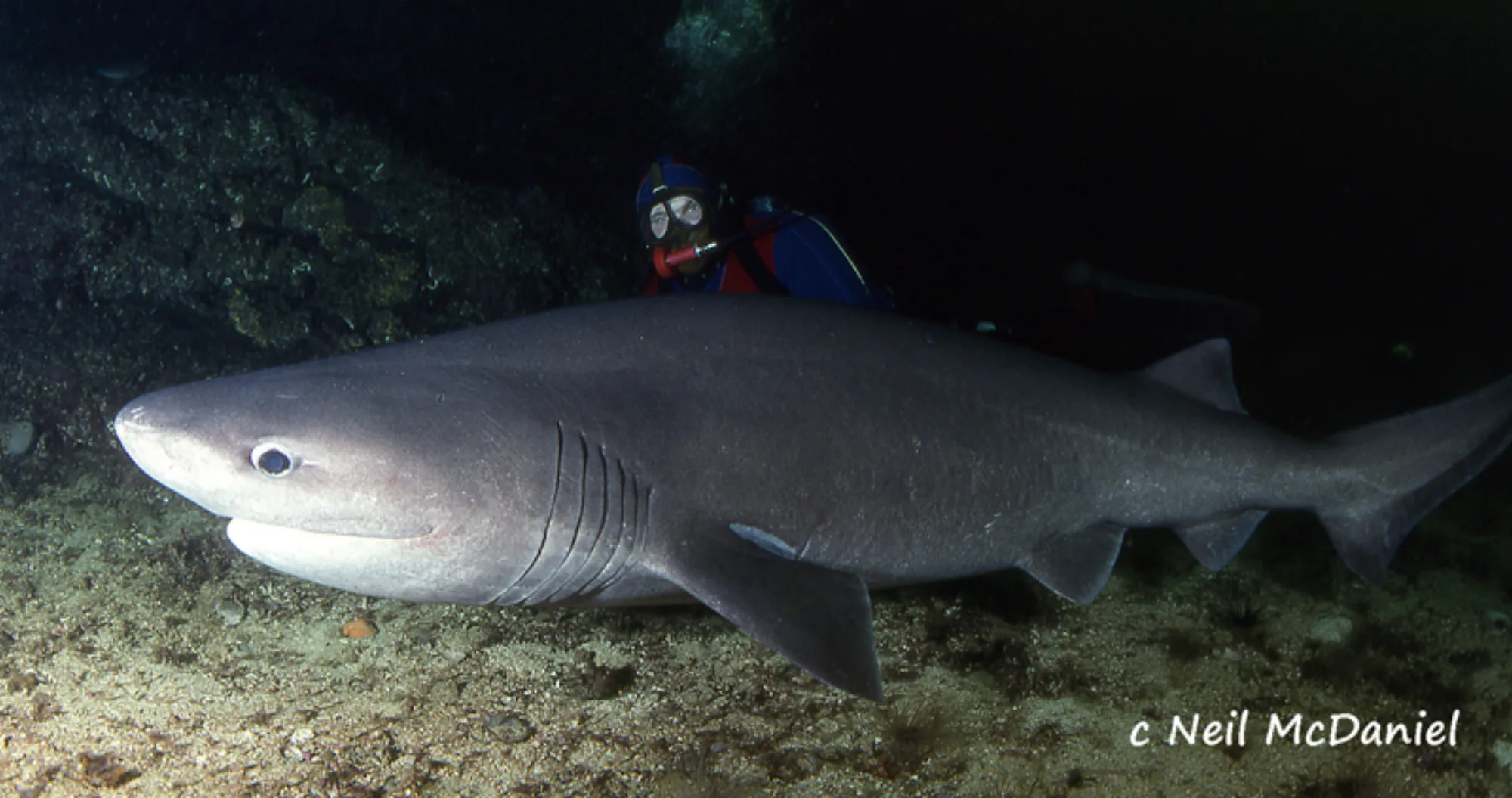
A broad, blunt snout and six gill slits give the Bluntnose Sixgill Shark a distinctive profile. Its large body has a long tail, small blue-green eyes and skin ranging from tan to black. A pale line runs along its sides, with dark spots nearby, and the edges of its fins are pale too. Adults can grow to 5.5 m, though large specimens may reach 6 m.
This shark lives in tropical and temperate waters worldwide, across three oceans: the Atlantic, Indian and Pacific. It usually swims in dim water near the seabed or above the continental shelf, at depths of 180 to 1,100 m. Adults generally remain deeper than 100 m, while youngsters may approach the shore to feed in water as shallow as 12 m. At night, sixgills move upwards to forage, returning to deeper water as morning brings more light and warmth. They can glide upwards with little movement, an ability that may help them approach prey unseen from below. Though generally sluggish, they can use their powerful tails to reach high speeds when pursuing prey. Their varied diet includes fish, smaller sharks, squid, crabs, seals and carrion.
Embryos develop inside the mother, nourished by yolk sacs, and litters typically contain 22 to 108 pups. The Salish Sea, including Puget Sound, is one of the few known places where the species gives birth. Sixgills are often caught accidentally in fisheries, but are also taken for food and sport. Their long lives make them susceptible to exploitation, and some regional populations have been severely depleted.
Written from the English Wikipedia article Bluntnose sixgill shark (CC BY-SA 4.0).
- Records
- 38,132
- Countries
- 12
- Atlas places
- 2
These are open occurrence records, so they show where people looked for and recorded the Bluntnose Sixgill Shark as much as where it lives. Cells are up to 25 km across, and every location is generalised to its cell.
Generalised encounter areas, not exact locations. Each shape is a grid cell coloured by how likely the species is there.
- Very likelyUnited States25 km zone · medium confidence · 37303 records · updated 80 days ago
- Very likelyCanada25 km zone · high confidence · 770 records · updated 80 days ago
- LikelyItaly25 km zone · medium confidence · 23 records · updated 80 days ago
- LikelyIreland25 km zone · medium confidence · 16 records · updated 80 days ago
- LikelyFrance25 km zone · medium confidence · 8 records · updated 80 days ago
- LikelyAustralia25 km zone · medium confidence · 3 records · updated 80 days ago
- LikelyMexico25 km zone · medium confidence · 3 records · updated 80 days ago
- LikelyNew Zealand25 km zone · medium confidence · 3 records · updated 80 days ago
- LikelySri Lanka25 km zone · medium confidence · 3 records · updated 80 days ago
- LikelyChile25 km zone · low confidence · 0 records · updated 80 days ago
Conservation status not assessed here yet, so every location is generalised to its grid cell.