Port Jackson Shark
Heterodontus portusjacksoni
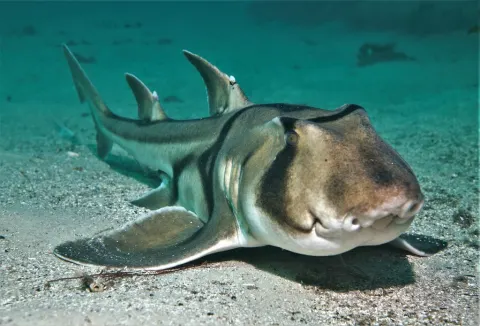
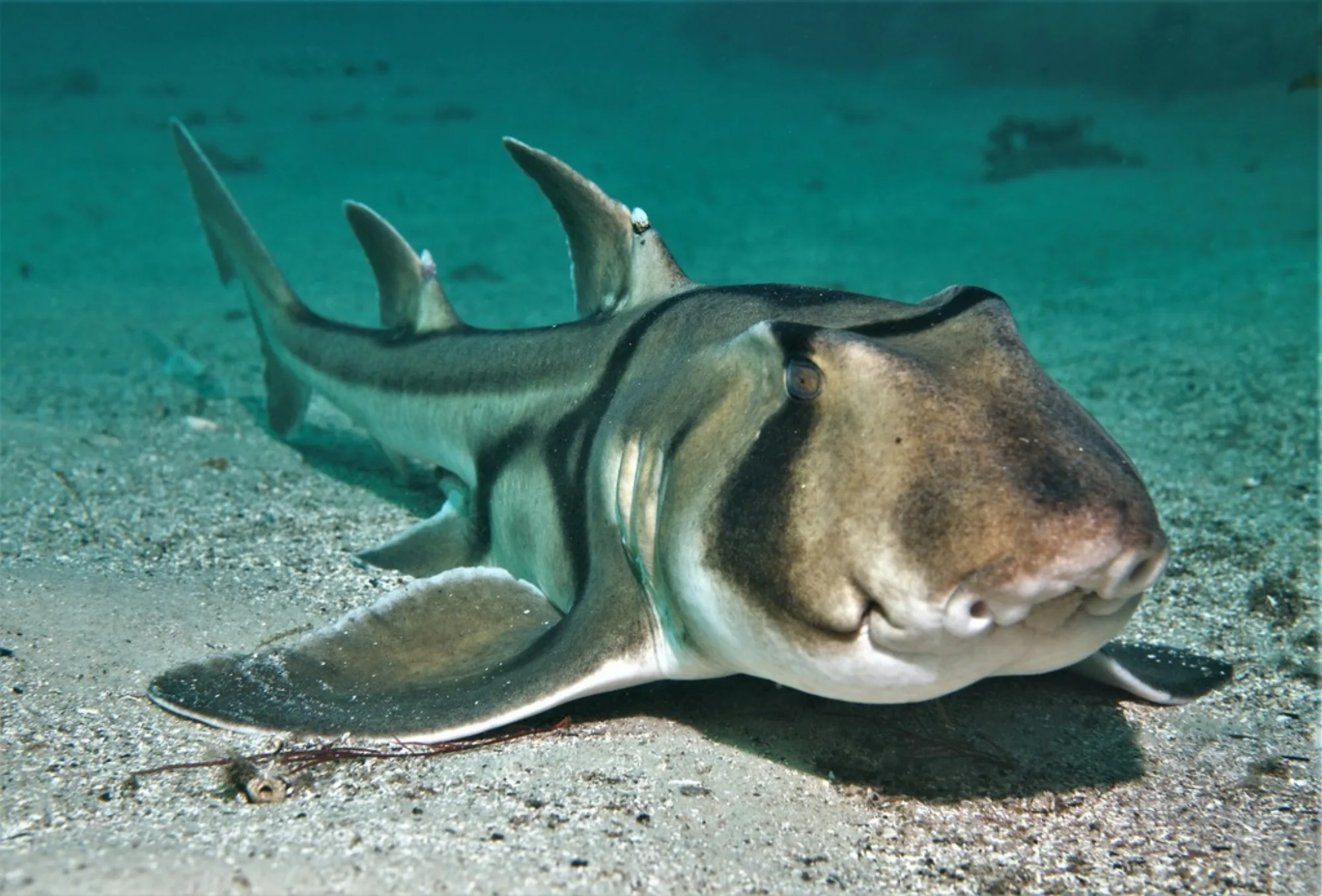
Dark, harness-like bands make the Port Jackson Shark easy to recognise against its grey-brown body. The markings cross its eyes, run along its back and extend across its sides. It has a broad, blunt head with ridges above the eyes, and a spine in front of each dorsal fin. This bullhead shark can grow to 1.65 metres long.
The species lives in temperate coastal waters around southern Australia, ranging from southern Queensland past Tasmania to the central coast of Western Australia. It usually stays shallower than 100 metres, although it has been recorded at 275 metres. It spends its time on or near the seabed, most often in rocky habitats, but also uses sandy and muddy areas and seagrass beds. During the day, it shelters in places such as caves and rocky outcrops, sometimes resting in groups. It is most active in the late evening and forages at night for sea urchins, molluscs, crustaceans and fish. Young sharks eat more soft-bodied prey than adults.
Port Jackson Sharks migrate south in summer and return north to breed in winter. Males reach coastal bays and harbours first, with females arriving later and staying longer. Females lay eggs during an annual breeding season that begins in late August and lasts until mid-November. The eggs take 10 to 11 months to mature before the young emerge. Many eggs are lost to predators, and other sharks probably pose the greatest threat to the species. Port Jackson Sharks can also be caught as bycatch.
Written from the English Wikipedia article Port Jackson shark (CC BY-SA 4.0).
- Records
- 36,649
- Countries
- 1
- Atlas places
- 3
These are open occurrence records, so they show where people looked for and recorded the Port Jackson Shark as much as where it lives. Cells are up to 25 km across, and every location is generalised to its cell.
Generalised encounter areas, not exact locations. Each shape is a grid cell coloured by how likely the species is there.
- Very likelyAustralia25 km zone · medium confidence · 36649 records · updated 80 days ago
Conservation status not assessed here yet, so every location is generalised to its grid cell.