Eastern Hognose Snake
Heterodon platirhinos
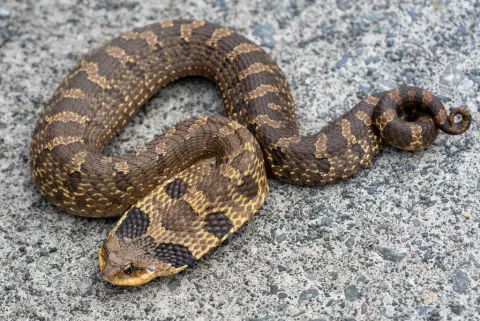
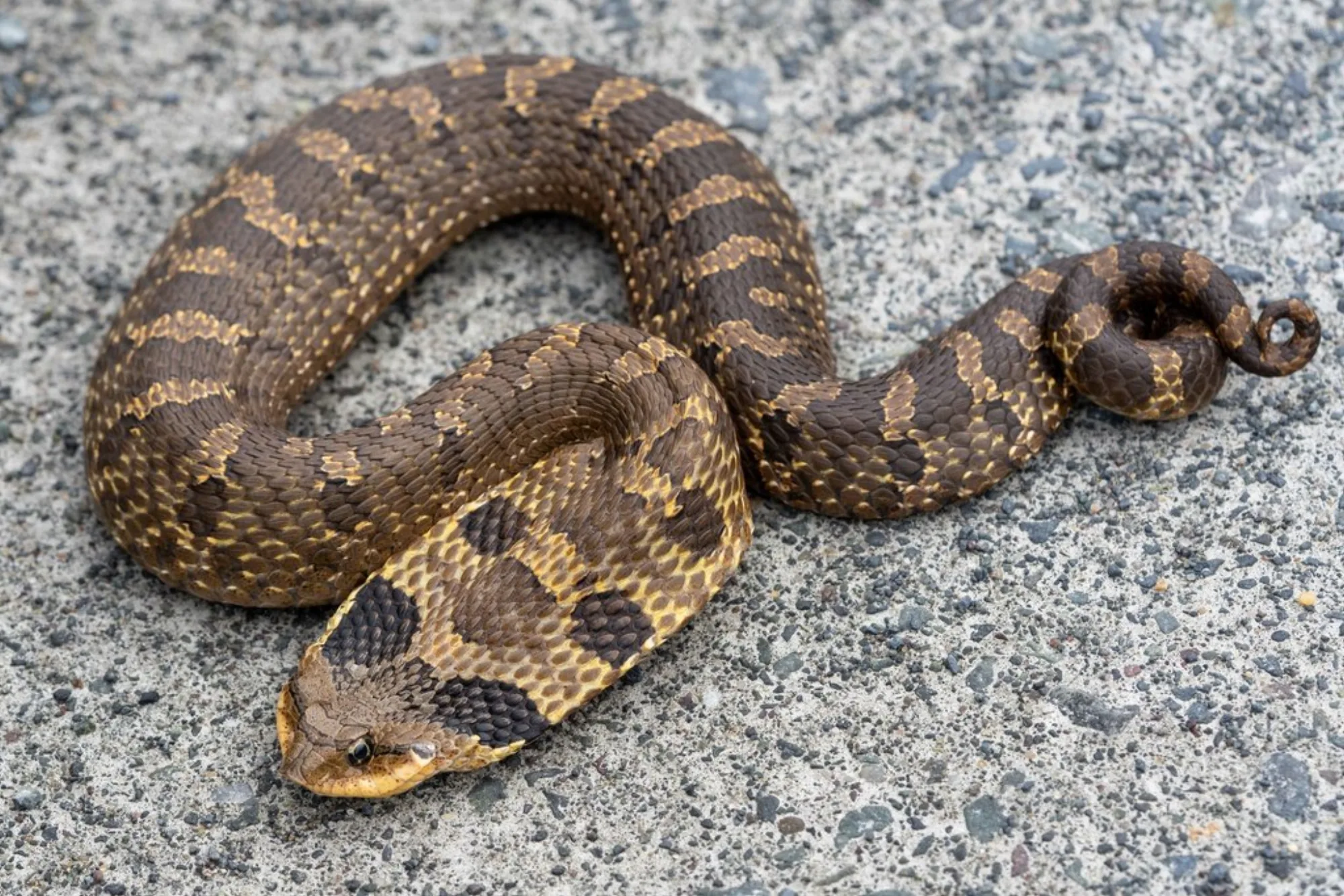
An upturned snout gives the Eastern Hognose Snake a distinctive profile and helps it dig in sandy soil. This stout-bodied North American snake varies widely in colour, from red, green and orange to brown, grey or black. Its back may be blotched, chequered or plain, while the underside of its tail is lighter than its belly. Adults average 71 cm in total length, with females larger than males.
The snake ranges across the central and eastern United States, reaching southern Ontario in the north and southern Florida in the south. It favours pine woods with sandy ground, as well as old fields and woodland margins, especially where dry, loose soil allows it to burrow. It also lives in woodlands, tall-grass prairies and grassy or cultivated fields beside woodland. Barrier beaches and dunes can hold high densities, supported by abundant amphibian prey. Active by day, it tends to stay concealed and is usually most active from April to September, though timing varies with climate. It hibernates alone in burrows it digs itself or those made by mammals.
Toads are a particular favourite, but the snake also eats frogs and salamanders. When threatened, it may flatten its neck, raise its head, hiss and strike with a closed mouth. If that display fails, it may turn belly-up and feign death, sometimes releasing a foul musk. Females lay up to 40 eggs in June or early July, sometimes in burrows, shallow soil depressions or beneath rocks. Habitat destruction, pollution, pesticides, road deaths and deliberate killing all threaten the snake, while its reluctance to cross paved roads can isolate populations.
Written from the English Wikipedia article Eastern hognose snake (CC BY-SA 4.0).
- Records
- 687
- Countries
- 2
- Atlas places
- 1
These are open occurrence records, so they show where people looked for and recorded the Eastern Hognose Snake as much as where it lives. Cells are up to 25 km across, and every location is generalised to its cell.
Generalised encounter areas, not exact locations. Each shape is a grid cell coloured by how likely the species is there.
- Very likelyUnited States25 km zone · medium confidence · 584 records · updated 80 days ago
- Very likelyCanada25 km zone · medium confidence · 103 records · updated 80 days ago
Conservation status not assessed here yet, so every location is generalised to its grid cell.