Western Hognose Snake
Heterodon nasicus
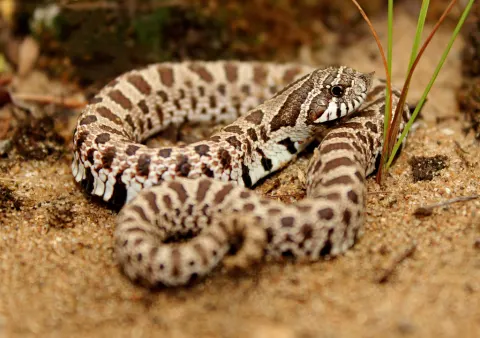
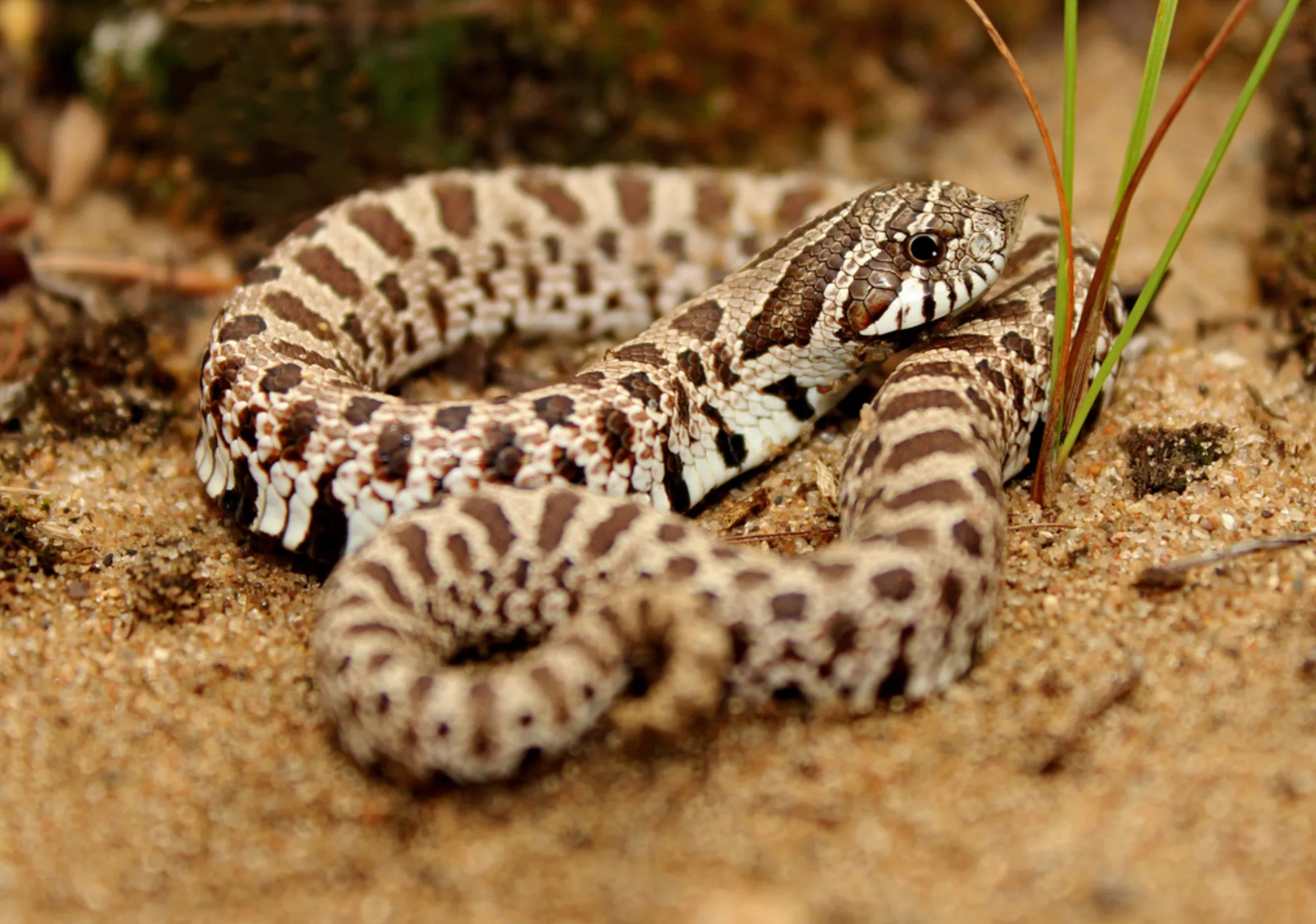
With its upturned snout and stout body, the Western Hognose Snake is a small North American snake built for burrowing. Its colours and patterns vary considerably, and many individuals can look like rattlesnakes to an untrained observer. Males are much smaller than females and rarely exceed 40 to 50 cm in total length, including the tail. The snout gives the snake its hog-like appearance and helps it dig. Its range stretches from southern Canada through the United States to northern Mexico. Look for it in places with sandy or gravelly soil, including prairies, river floodplains, scrub, grasslands, semi-deserts and some partly agricultural areas. It has been found as high as 2,500 m.
Active mainly by day, this snake is usually docile, although some individuals can be highly defensive. When threatened, it may flatten its neck, hiss and make bluff strikes with its mouth closed. If harassment continues, it usually plays dead and almost never bites in self-defence. Some individuals inflate their throats instead of flattening their heads, a response more often seen in adolescent males. In the wild, it eats mainly amphibians, including tree frogs and toads, along with small lizards and the occasional rodent. Its instinct is to spend the winter underground in brumation. Females lay 4 to 23 thin-shelled eggs between June and August, and the young hatch after approximately 60 days. Hatchlings measure 13 to 23 cm in total length and reach sexual maturity after approximately two years. Local declines have been reported, although no causes for them are specified.
Written from the English Wikipedia article Western hognose snake (CC BY-SA 4.0).
- Records
- 75
- Countries
- 2
- Atlas places
- 2
These are open occurrence records, so they show where people looked for and recorded the Western Hognose Snake as much as where it lives. Cells are up to 25 km across, and every location is generalised to its cell.
Generalised encounter areas, not exact locations. Each shape is a grid cell coloured by how likely the species is there.
- Very likelyUnited States25 km zone · medium confidence · 73 records · updated 81 days ago
- LikelyCanada25 km zone · medium confidence · 2 records · updated 81 days ago
Conservation status not assessed here yet, so every location is generalised to its grid cell.