Naked Mole Rat
Heterocephalus glaber
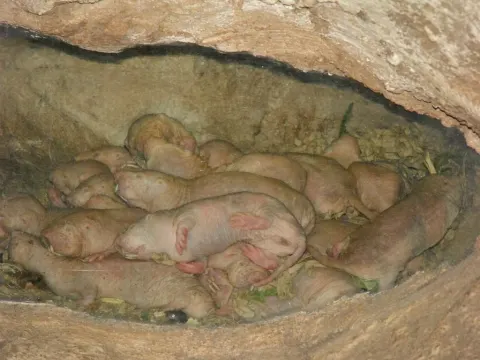
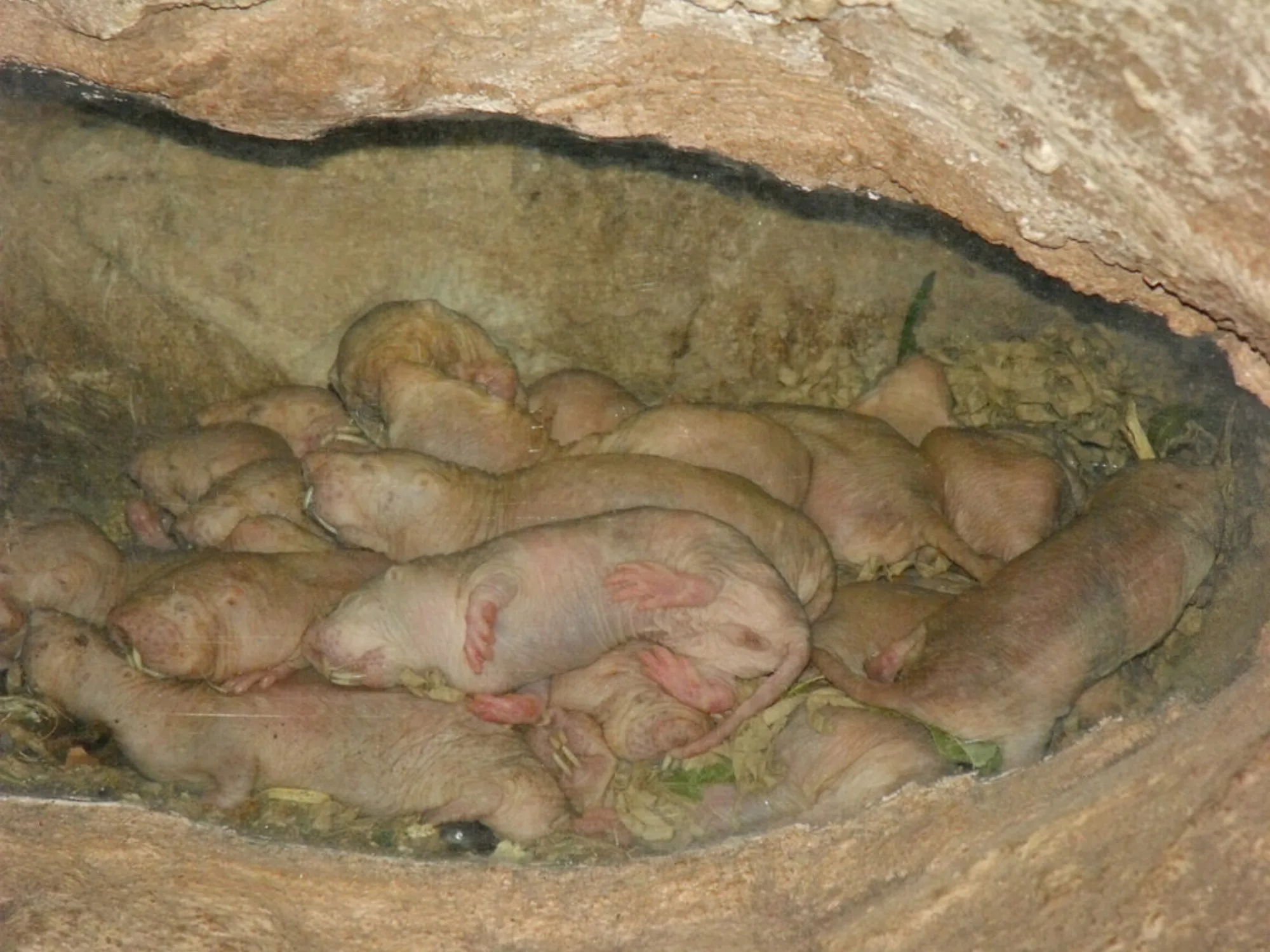
Wrinkled pink or yellowish skin, sparse hair and prominent digging teeth give the Naked Mole Rat a distinctive appearance. This burrowing rodent has tiny eyes and short, thin legs, and can travel as quickly backwards through its tunnels as forwards. Typical individuals measure 8 to 10 cm and weigh 30 to 35 grams, although breeding females can be much heavier. It lives in the dry tropical grasslands of East Africa, mainly in southern Ethiopia, Kenya and Somalia. Travellers are unlikely to notice the animals themselves underground, but may spot small mounds of earth pushed up from their burrows.
Colonies average 75 to 80 animals, sometimes exceeding 300, with tunnels that can extend for a combined 3 to 5 kilometres. Individuals are active by day and night, taking several short sleeps between periods of activity. Smaller workers gather food and maintain the nest, while larger ones dig tunnels and respond to threats. The colony feeds mainly on large underground tubers, eating the inside while leaving the outside intact so that the plant can regenerate. A single tuber can sustain the group for months or even years. When a worker finds food, it calls on the return journey and leaves an odour trail for others to follow.
A colony has a single breeding female, known as the queen, alongside up to three breeding males. In the wild, breeding usually happens once a year if the litter survives, and other colony members help care for the pups. Snakes, honey badgers and various birds of prey hunt naked mole-rats, which are particularly exposed when pushing soil to the surface.
Written from the English Wikipedia article Naked mole-rat (CC BY-SA 4.0).
- Records
- 41
- Countries
- 1
- Atlas places
- 4
These are open occurrence records, so they show where people looked for and recorded the Naked Mole Rat as much as where it lives. Cells are up to 25 km across, and every location is generalised to its cell.
Generalised encounter areas, not exact locations. Each shape is a grid cell coloured by how likely the species is there.
- Very likelyKenya25 km zone · medium confidence · 41 records · updated 80 days ago
Conservation status not assessed here yet, so every location is generalised to its grid cell.