Himalayan Tahr
Hemitragus jemlahicus
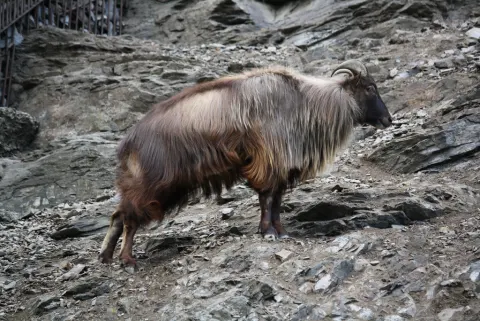
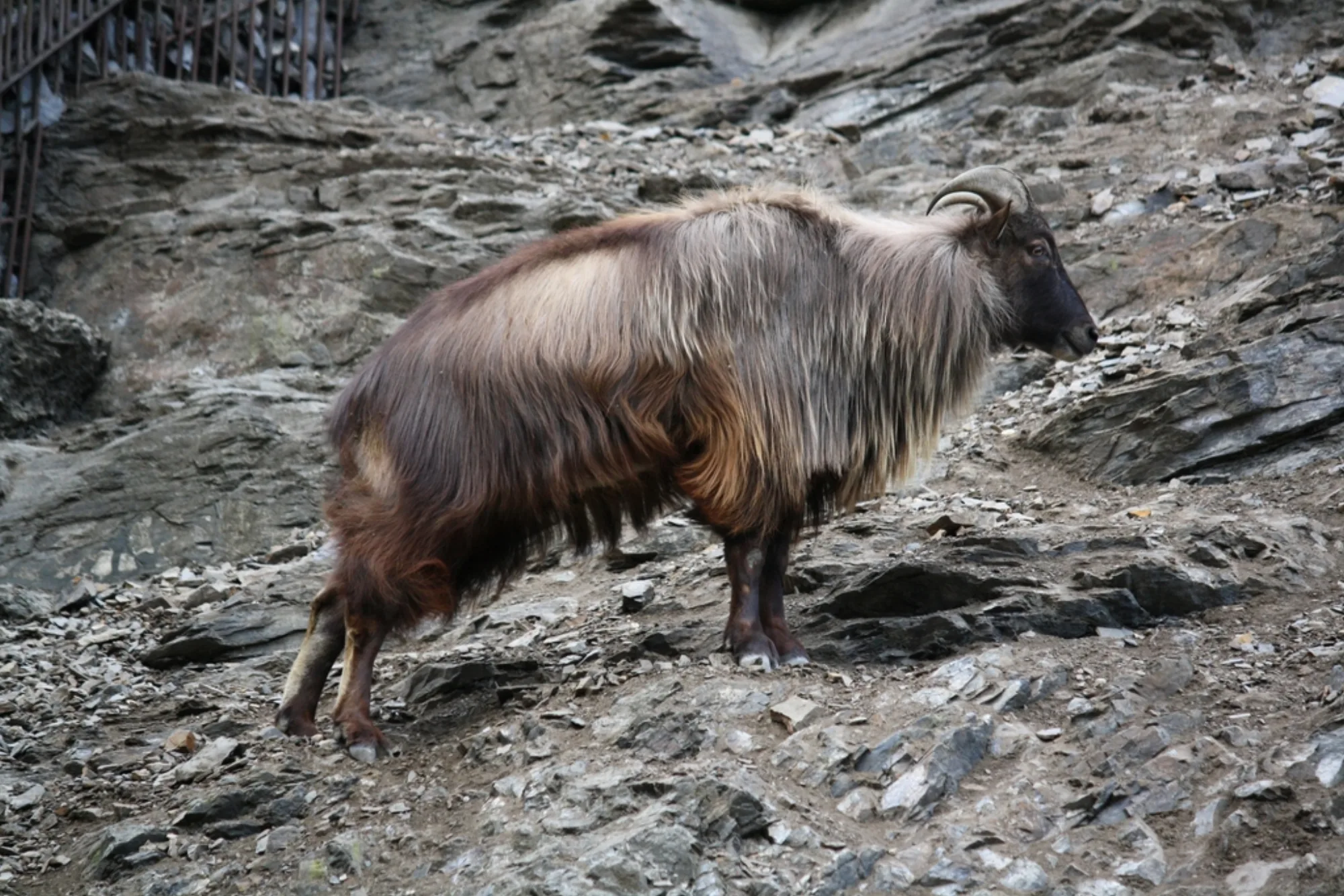
On rocky Himalayan slopes, the Himalayan Tahr is a large wild goat with a small head, pointed ears and large eyes. Its horns curve backwards and can reach 46 cm; females are smaller than males and have smaller horns. A thick reddish coat and a dense undercoat help it cope with the mountain climate. As winter ends, the coat becomes thinner and lighter in colour. Its hooves grip smooth rock, helping it move swiftly and confidently across steep, rough ground.
The tahr is native to Nepal and parts of Tibet, India and Bhutan, and is mainly found between 2,500 and 5,000 m in the Himalayas. It favours cool, rocky mountainsides where plants are exposed for grazing and browsing. When snow covers higher vegetation in winter, it moves to lower slopes. It spends much of its time eating grasses, leaves and some fruit, and can also digest woody shrubs. In areas where it has been introduced, it moves lower at night for food and water, then higher by day to rest and avoid predators. Snow leopards prey on tahr in their native range.
During the breeding season, males compete for females, with larger and more mature males taking part in displays and fights. Females usually give birth to one kid after a gestation of 180 to 242 days, and the young can stand soon after birth. Hunting and habitat loss are driving a decline in the population. In New Zealand, where the tahr was introduced, it is hunted and culled after heavy grazing damaged native vegetation.
Written from the English Wikipedia article Himalayan tahr (CC BY-SA 4.0).
- Records
- 48
- Countries
- 4
- Atlas places
- 3
These are open occurrence records, so they show where people looked for and recorded the Himalayan Tahr as much as where it lives. Cells are up to 25 km across, and every location is generalised to its cell.
Generalised encounter areas, not exact locations. Each shape is a grid cell coloured by how likely the species is there.
- Very likelyIndia25 km zone · medium confidence · 33 records · updated 80 days ago
- LikelySouth Africa25 km zone · medium confidence · 7 records · updated 80 days ago
- LikelyNepal25 km zone · medium confidence · 6 records · updated 80 days ago
- PossibleNew Zealand25 km zone · medium confidence · 2 records · updated 80 days ago
Conservation status not assessed here yet, so every location is generalised to its grid cell.