Epaulette Shark
Hemiscyllium ocellatum
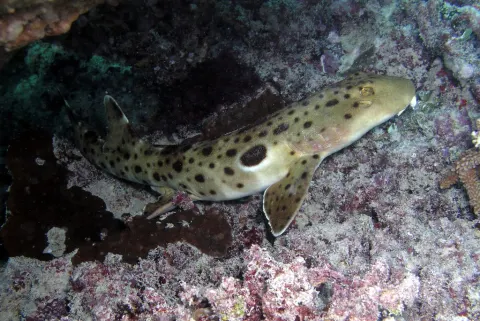
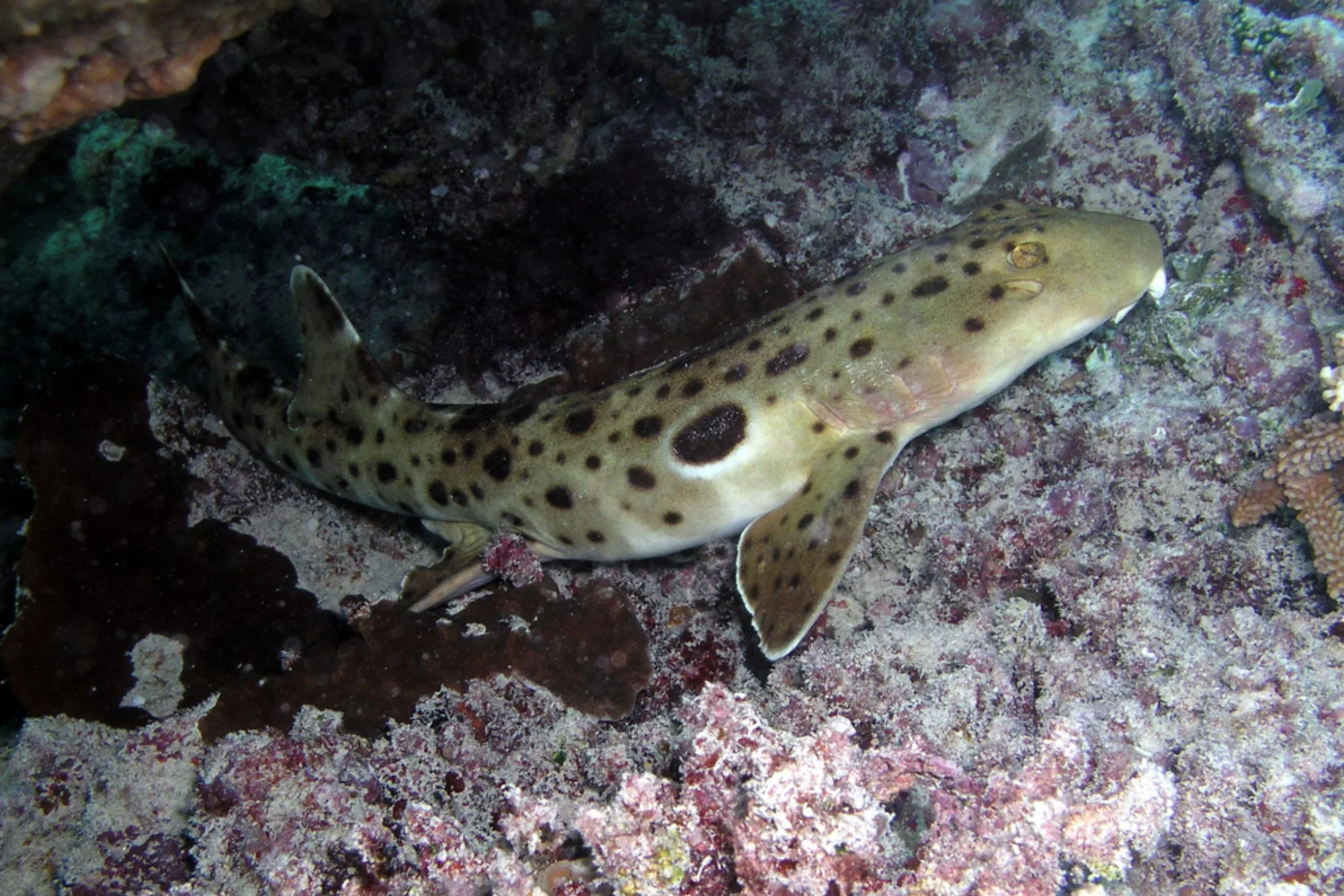
In tropical shallows, the Epaulette Shark can be found in water so shallow that its body is scarcely covered. It usually measures 70 to 90 cm, with a slender body, short head and broad, rounded fins. Adults are beige to brown above, with scattered brown spots and faint darker bands. A large black spot edged in white sits behind each front fin, giving the shark its name. Young sharks have alternating light and dark bands across their bodies and fins.
Its range includes the southern shores of New Guinea and the northern Australian coast, extending south to Sydney. Heron Island's reefs hold a particularly large population, and the shark favours staghorn coral, coral flats and pools left by the tide. Mostly active at night and in low water, it often shelters inside or beneath coral heads. It can swim, but often moves over sand or coral by bending its body and pushing with its fins, even crawling out of the water to reach isolated pools. It can also tolerate the low oxygen levels that develop in pools cut off by the falling tide.
An opportunistic hunter, it eats crustaceans, worms and small bony fish, and searches most actively at dawn and dusk. While looking for food, it may turn over debris with its snout or push its head into the sand. Females lay egg capsules from August to December, usually depositing two every 14 days. Larger fish, including other sharks, prey on it, while rising temperatures can weaken developing young. Off New Guinea, damage to its habitat, destructive fishing and excessive catches by artisan fishers add to the pressures on the shark.
Written from the English Wikipedia article Epaulette shark (CC BY-SA 4.0).
- Records
- 92
- Countries
- 1
- Atlas places
- 1
These are open occurrence records, so they show where people looked for and recorded the Epaulette Shark as much as where it lives. Cells are up to 25 km across, and every location is generalised to its cell.
Generalised encounter areas, not exact locations. Each shape is a grid cell coloured by how likely the species is there.
- Very likelyAustralia25 km zone · medium confidence · 92 records · updated 80 days ago
Conservation status not assessed here yet, so every location is generalised to its grid cell.