Long-eared Hedgehog
Hemiechinus auritus
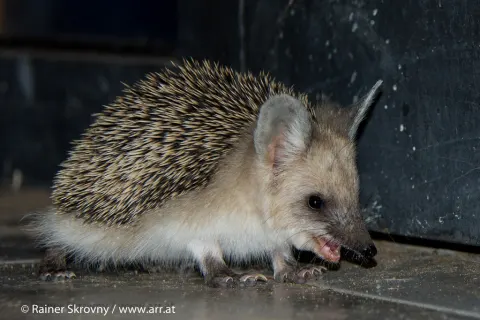
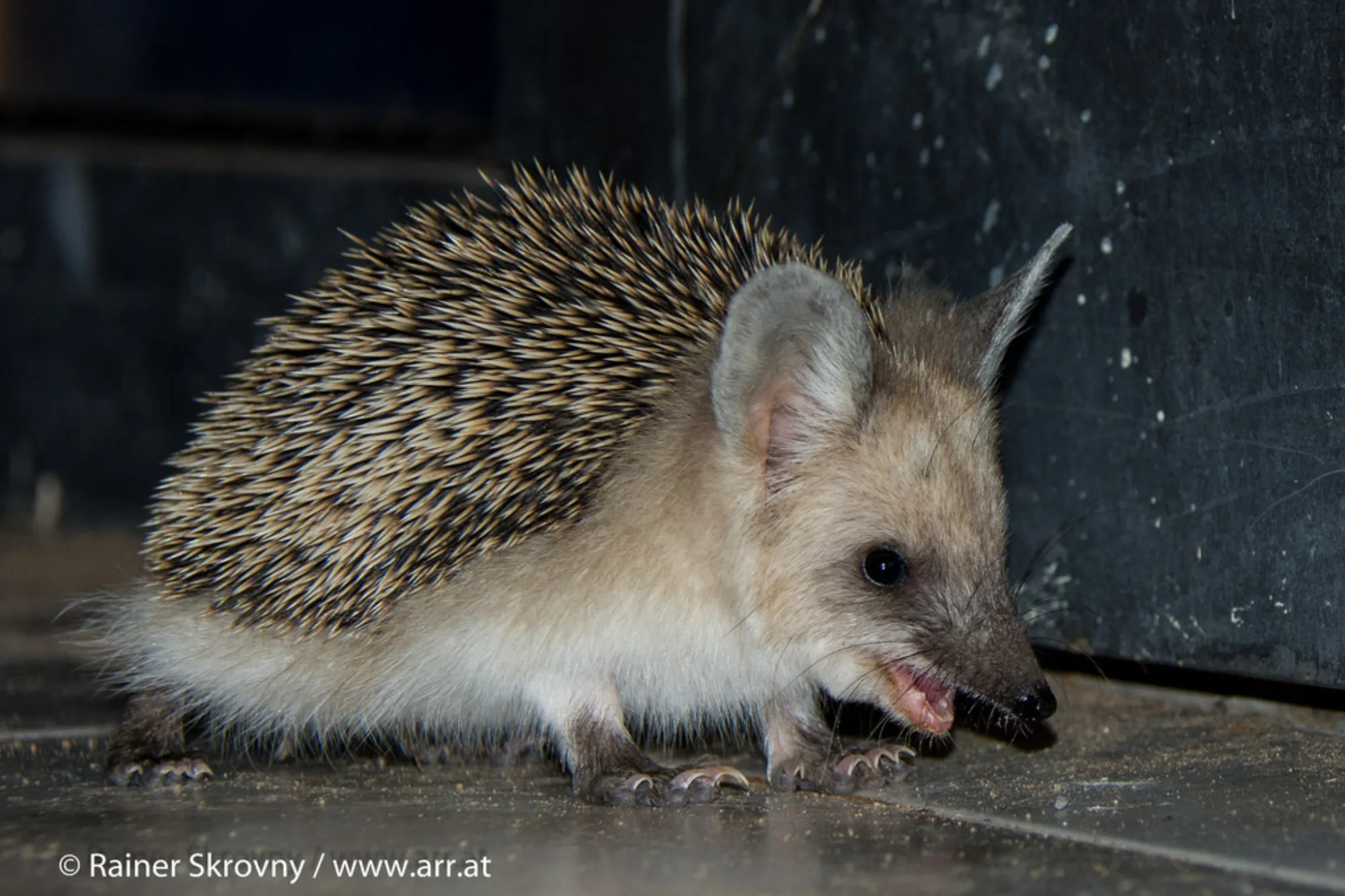
Long ears give the Long-eared Hedgehog its name, and help it release heat in the desert. This small hedgehog has a pale underside, whitish hair at the tips of its ears and white-tipped spines with darker bands below. Its head and body measure approximately 120 to 270 mm, and it weighs 250 to 400 grams.
Its range stretches from the eastern Mediterranean across the arid and steppe regions of Asia to western Pakistan, and from eastern Ukraine through Mongolia to China's Xinjiang region. It lives in dry steppes, semi-deserts and deserts, favouring dry river valleys, gullies, shrubby places and abandoned irrigation ditches. It also settles in oases and near human settlements, sometimes in cultivated areas. By day, it rests beneath rocks, in hollows or among piles of rocks. It lives in a burrow, either digging one beneath a bush or using an abandoned home of another small mammal.
Solitary and nocturnal, it forages from early evening and can travel up to 9 km in a night looking for food. Insects are a major part of its diet, but it also eats creatures such as lizards, along with eggs, fruit and plants. It prefers to live near water, although it can obtain water from its food when a source is unavailable. It remains active for much of the year and may hibernate in summer or winter. Breeding takes place once a year, from July through September, and a female often has 2 to 3 young. Eurasian eagle owls hunt these hedgehogs, and Pharaoh eagle-owls have also been reported taking them as prey in Jordan. When faced with predators, the hedgehog is more likely to run or leap at them than curl into a ball.
Written from the English Wikipedia article Long-eared hedgehog (CC BY-SA 4.0).
- Records
- 367
- Countries
- 11
No atlas park has a record of the Long-eared Hedgehog in or around it yet.
These are open occurrence records, so they show where people looked for and recorded the Long-eared Hedgehog as much as where it lives. Cells are up to 25 km across, and every location is generalised to its cell.
Generalised encounter areas, not exact locations. Each shape is a grid cell coloured by how likely the species is there.
- Very likelyCyprus25 km zone · medium confidence · 338 records · updated 80 days ago
- LikelyUkraine25 km zone · medium confidence · 14 records · updated 80 days ago
- LikelyRussia25 km zone · medium confidence · 11 records · updated 80 days ago
- LikelyKazakhstan25 km zone · medium confidence · 3 records · updated 80 days ago
- PossibleMongolia25 km zone · medium confidence · 1 record · updated 80 days ago
- UncommonIsrael25 km zone · low confidence · 0 records · updated 80 days ago
- UncommonKyrgyzstan25 km zone · low confidence · 0 records · updated 80 days ago
- UncommonUzbekistan25 km zone · low confidence · 0 records · updated 80 days ago
- RareChina25 km zone · low confidence · 0 records · updated 80 days ago
- RareIraq25 km zone · low confidence · 0 records · updated 80 days ago
Conservation status not assessed here yet, so every location is generalised to its grid cell.