Turkish Gecko
Hemidactylus turcicus
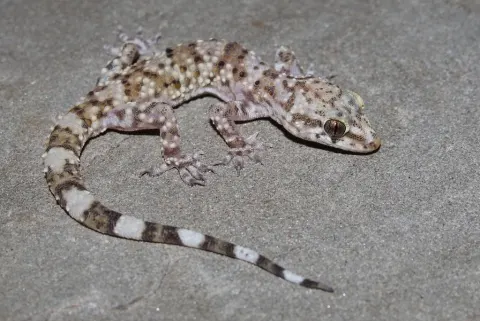
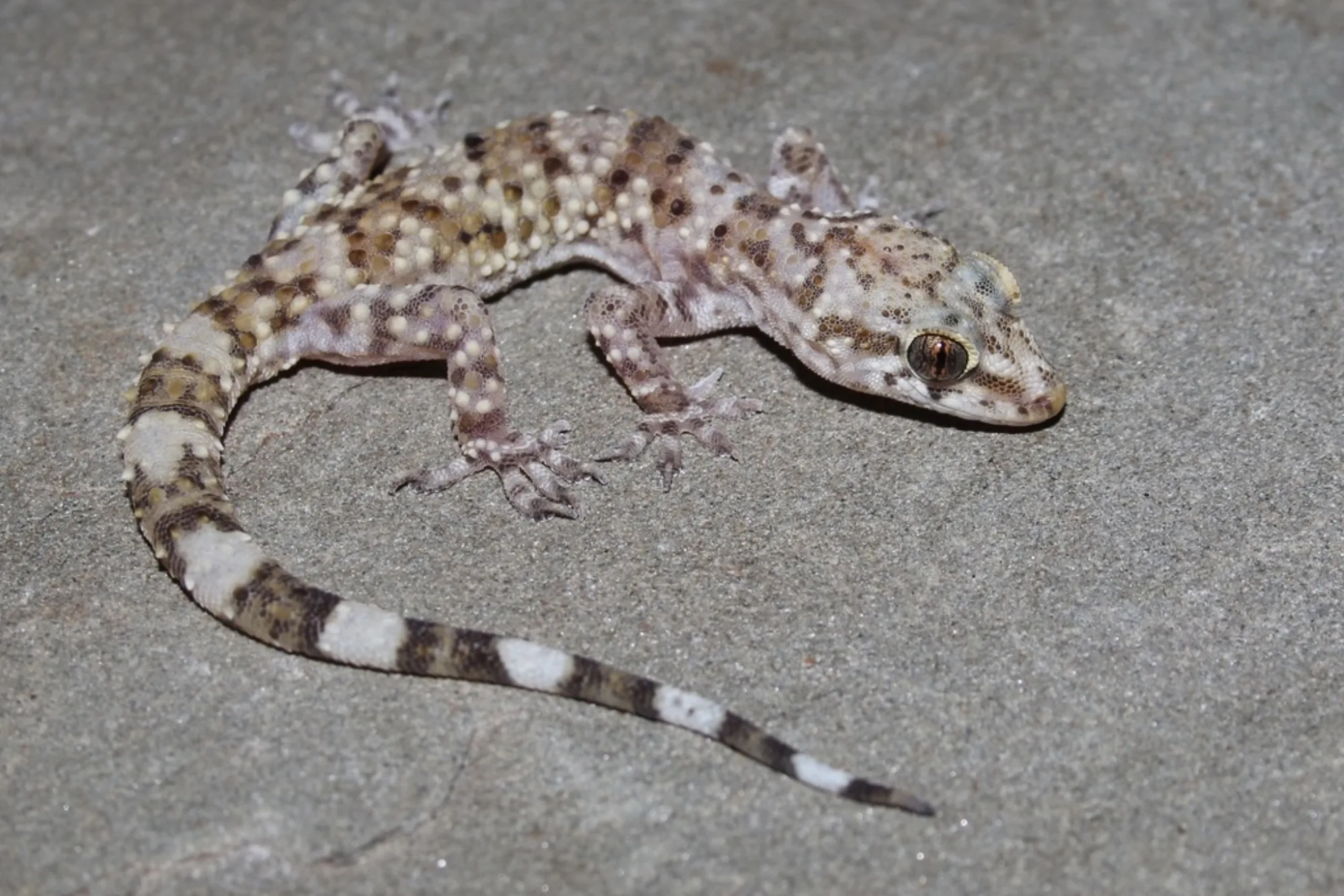
After dark, a small lizard with large, lidless eyes may appear around outdoor lights: the Turkish Gecko, Hemidactylus turcicus. Usually 10 to 13 cm long, it has sticky toe pads and vertical pupils. Its skin can be purple, tan, light brown or greyish, with dark spots and often stripes on the tail. The underside is somewhat translucent, and some individuals are translucent apart from their spots. When they flee, they often seek darkness; they may be seen alone or in groups of five or more.
Native to the Mediterranean region, this gecko has spread widely, reaching parts of East Africa and South America, the Caribbean and areas of the southern United States. It lives near people in places ranging from university campuses and cemeteries to coastal areas and shrublands. Look for it in cracks in old brick buildings, though it also occurs on mountain cliffs and in caves. Nests may be tucked into attics, rubbish piles or spaces beneath building baseboards. A study in Portugal found it active entirely at night, with activity peaking around 02:00. Its high-pitched calls sound rather like squeaks or bird chirps and may have a territorial purpose.
Outdoor lights draw the geckos as they hunt moths and small cockroaches. Their varied prey also includes crickets, grasshoppers, spiders, beetles, ants and snails, and they favour live prey. Breeding usually runs from April to August, with eggs laid from mid-May to August and an average clutch of two. Neither parent has been observed caring for the young. The account does not identify a specific threat to the species; it notes that the gecko appears highly resistant to pesticides and may have few predators where introduced.
Written from the English Wikipedia article Mediterranean house gecko (CC BY-SA 4.0).
- Records
- 5,006
- Countries
- 17
- Atlas places
- 2
These are open occurrence records, so they show where people looked for and recorded the Turkish Gecko as much as where it lives. Cells are up to 25 km across, and every location is generalised to its cell.
Generalised encounter areas, not exact locations. Each shape is a grid cell coloured by how likely the species is there.
- Very likelyUnited States25 km zone · medium confidence · 2497 records · updated 80 days ago
- Very likelyFrance25 km zone · medium confidence · 1158 records · updated 80 days ago
- Very likelyMexico25 km zone · medium confidence · 473 records · updated 80 days ago
- Very likelyGreece25 km zone · medium confidence · 326 records · updated 80 days ago
- Very likelyMonaco25 km zone · high confidence · 188 records · updated 80 days ago
- Very likelySpain25 km zone · medium confidence · 95 records · updated 80 days ago
- Very likelyCroatia25 km zone · medium confidence · 67 records · updated 80 days ago
- Very likelyTürkiye25 km zone · medium confidence · 66 records · updated 80 days ago
- Very likelyIsrael25 km zone · medium confidence · 52 records · updated 80 days ago
- Very likelyItaly25 km zone · medium confidence · 22 records · updated 80 days ago
Conservation status not assessed here yet, so every location is generalised to its grid cell.