Kissing Gourami
Helostoma temminckii
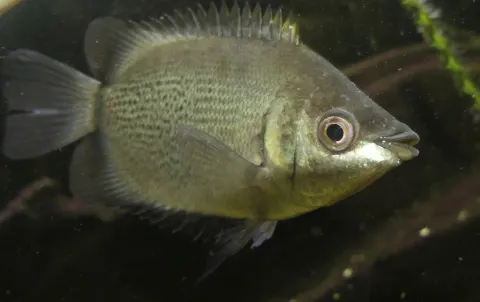
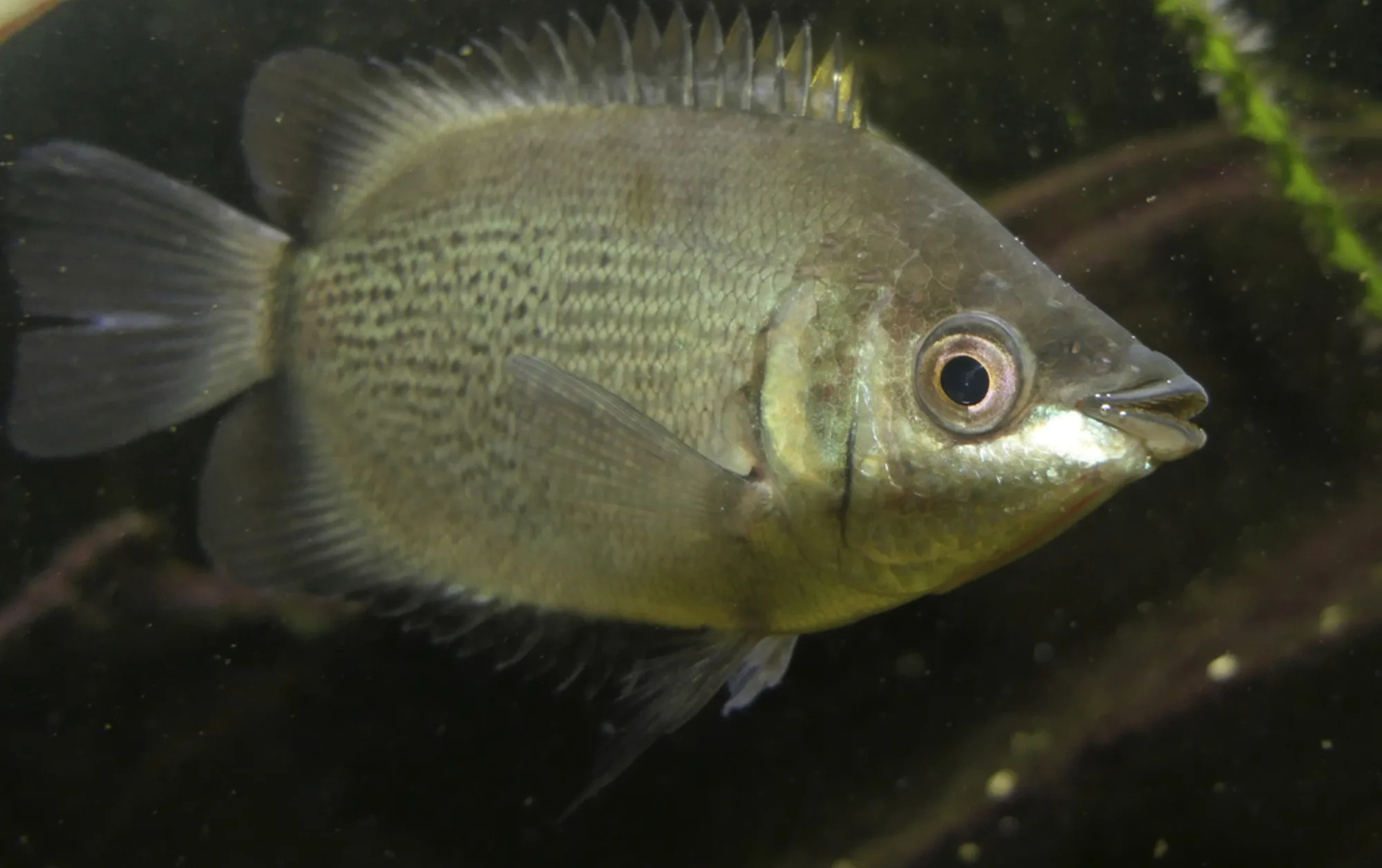
With its deep, flattened body and forward-facing mouth, the Kissing Gourami is a freshwater fish of tropical Southeast Asia. It can reach 30 cm in total length, and males and females are difficult to tell apart by sight. The wild form is greenish-silvery, with spotted stripes running along its body and opaque, dark brown fins. A pink form, ranging from rose to orangey-pink, has silvery scales and transparent pinkish fins; it has been selectively bred in captivity. Native to mainland Southeast Asia, the Greater Sundas and smaller nearby islands, the fish has also been introduced beyond that range. Look for its natural habitat in shallow, slow-moving backwaters thick with vegetation.
These omnivores occupy midwater and graze mainly on algae and aquatic plants, taking insects from the surface and filtering plankton from the water. They use their toothed lips to scrape algae from stones and other surfaces. The mouth also gives the fish its name: two individuals may press their mouths together in a ritualised display of aggression. In Thailand, spawning takes place from May to October, at the start of the rainy season, when adults move along rivers to shallow lagoons or flooded forests. Eggs are scattered beneath floating vegetation, and the adults neither guard them nor care for the young. After a day, the eggs hatch; two days later, the young are free-swimming. Parasitic algae can live beneath the skin and appear as dark spots; fish carrying them are commonly less healthy than unaffected individuals. Kissing gouramis are also caught for food and exported in large quantities for the aquarium trade.
Written from the English Wikipedia article Kissing gourami (CC BY-SA 4.0).
- Records
- 9
- Countries
- 2
No atlas park has a record of the Kissing Gourami in or around it yet.
These are open occurrence records, so they show where people looked for and recorded the Kissing Gourami as much as where it lives. Cells are up to 25 km across, and every location is generalised to its cell.
Generalised encounter areas, not exact locations. Each shape is a grid cell coloured by how likely the species is there.
- Very likelyMalaysia25 km zone · medium confidence · 9 records · updated 80 days ago
- PossibleIndonesia25 km zone · low confidence · 0 records · updated 80 days ago
Conservation status not assessed here yet, so every location is generalised to its grid cell.