Gila Monster
Heloderma suspectum
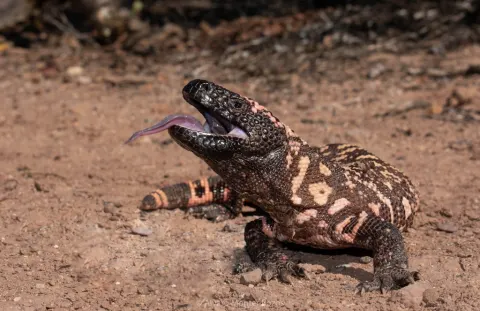
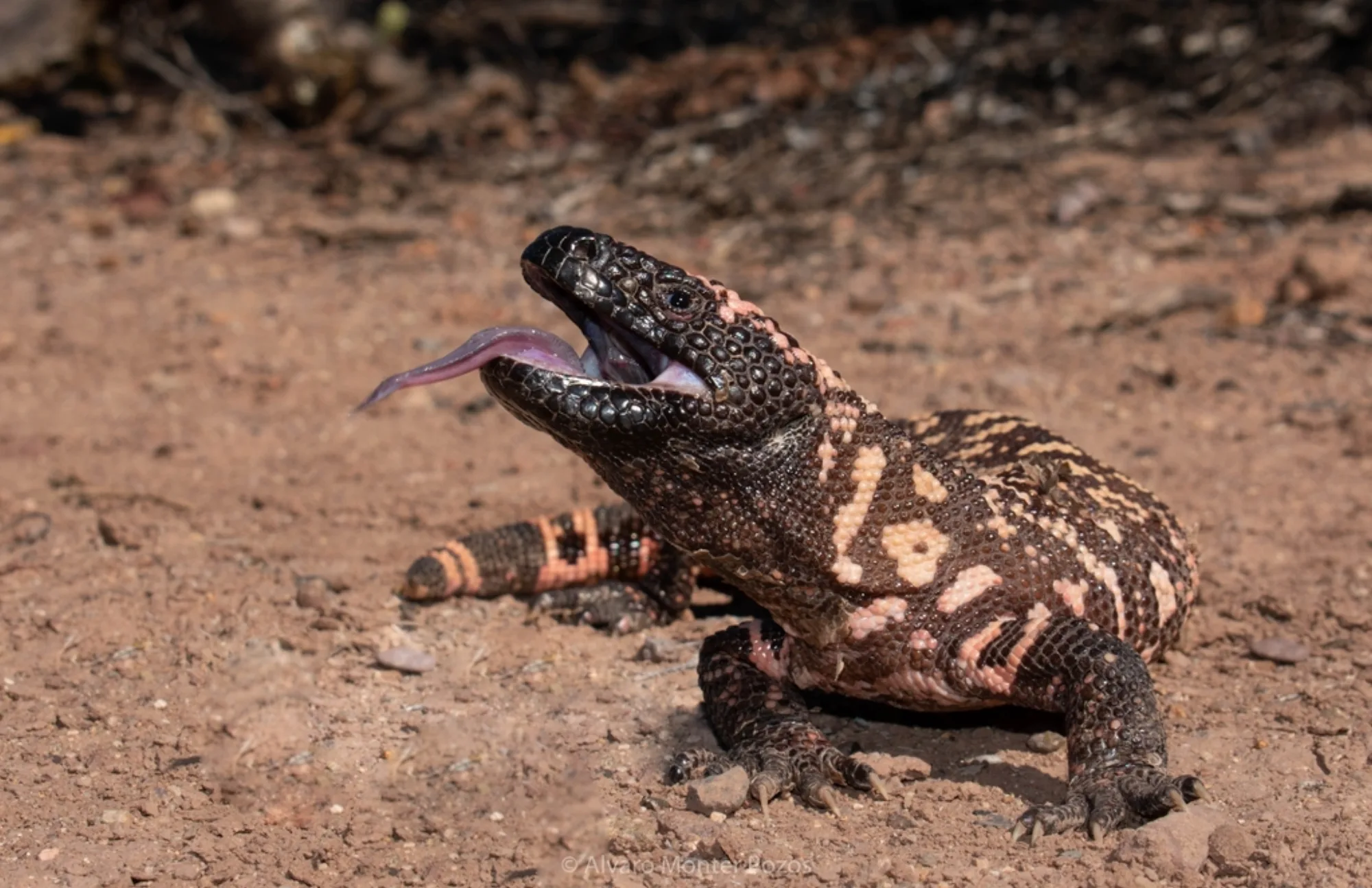
A heavy body, broad head and small-looking eyes give the Gila Monster a distinctive outline. This slow-moving, venomous lizard can reach 56 cm in total length. Adults have yellow to pink colouring against black, while young lizards start with a simpler pattern that changes during their first 6 months. Its range stretches from the southwestern United States into Mexico, with records in Sonora, Arizona and parts of four other US states: California, Nevada, Utah and New Mexico. It lives in scrubland, succulent desert and oak woodland, sheltering in burrows, thickets and beneath rocks where humidity is adequate.
A sighting takes patience: Gila Monsters spend 90% of their lives underground, often sheltering in rocky areas. During the dry season they are active in the morning, while later in summer they may emerge on warm nights or after thunderstorms. They can also be seen in puddles after summer rain. A keen sense of smell helps them find food, and they can climb trees and cacti. Their varied diet includes small mammals, birds, reptiles, insects, carrion and eggs. Fat stored in the tail means they need not eat often, although they feed when suitable prey is available.
Breeding takes place in spring, and females lay their eggs between late May and June. A clutch can contain up to eight eggs, though more than six is rare; the young hatch near the end of October and enter hibernation without coming to the surface. Development for construction and farming destroys habitat, and people sometimes kill the lizards because of their fearsome reputation. Coyotes, badgers and birds of prey also hunt them, with eggs and young especially exposed to predators.
Written from the English Wikipedia article Gila monster (CC BY-SA 4.0).
- Records
- 285
- Countries
- 2
- Atlas places
- 1
These are open occurrence records, so they show where people looked for and recorded the Gila Monster as much as where it lives. Cells are up to 25 km across, and every location is generalised to its cell.
Generalised encounter areas, not exact locations. Each shape is a grid cell coloured by how likely the species is there.
- Very likelyUnited States25 km zone · medium confidence · 262 records · updated 80 days ago
- Very likelyMexico25 km zone · medium confidence · 23 records · updated 80 days ago
Conservation status not assessed here yet, so every location is generalised to its grid cell.