Mexican Beaded Lizard
Heloderma horridum
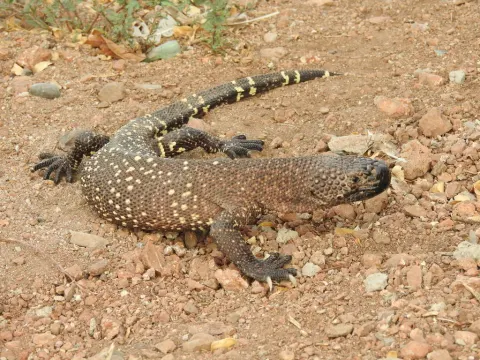
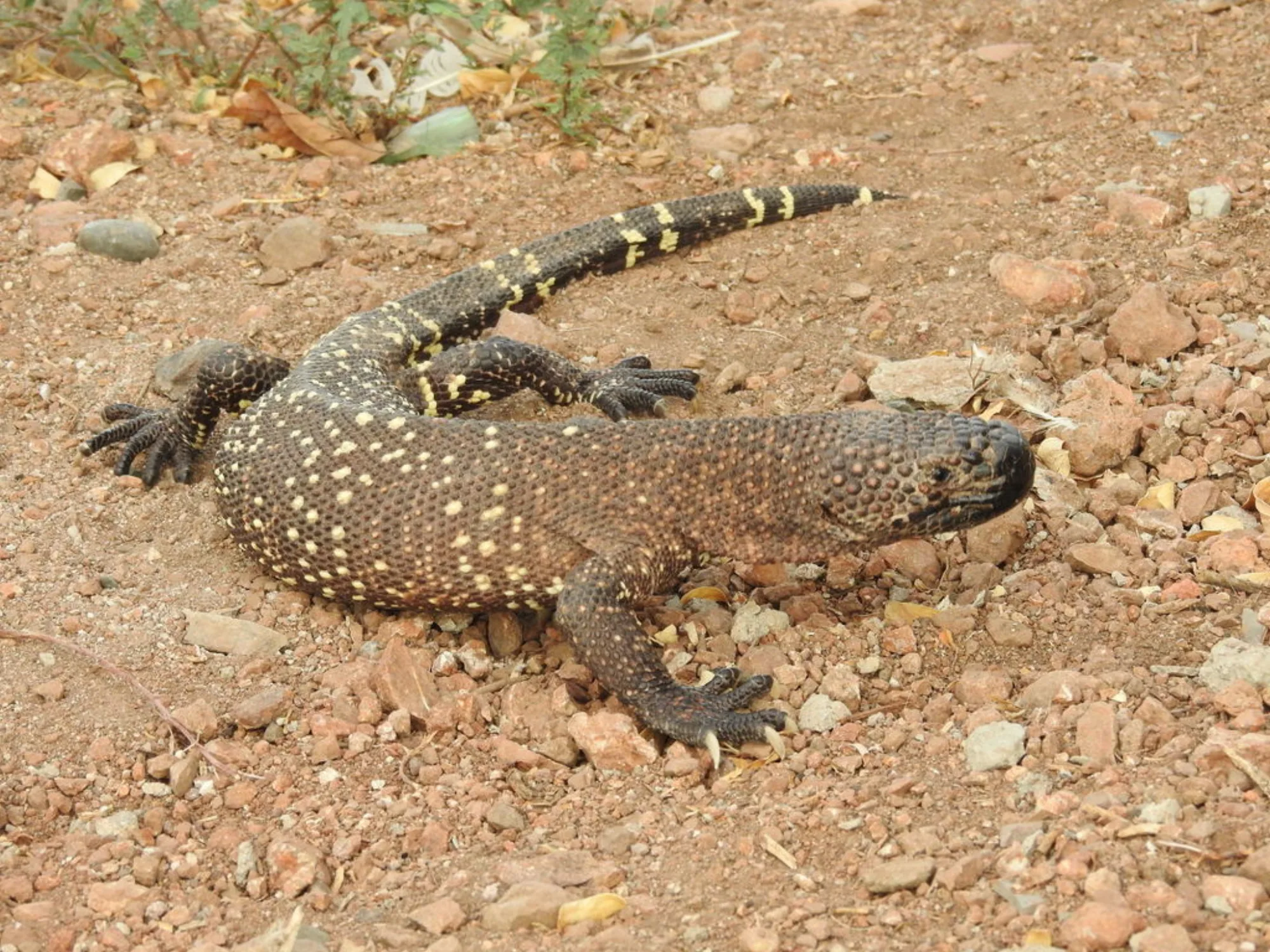
Black skin patterned with yellowish spots or bands makes the Mexican Beaded Lizard distinctive, while its small, beadlike scales give it its name. This venomous lizard has a stocky body, a broad head and a short tail that stores fat. Adults measure 57 to 91 cm in length, and the largest specimens can weigh more than 2,000 g.
In Mexico, it occurs from Sonora to Oaxaca, in a landscape that includes desert, tropical deciduous forest and thorn scrub. Beaded lizards are also found in pine-oak forest, from sea level up to 1500 m. A sighting takes some luck: in the wild, these lizards are active only from April to mid-November and spend about an hour a day above ground. They climb deciduous trees in search of food, using their forked pink tongues to gather scents. Bird and reptile eggs make up much of their diet, though they sometimes eat small birds, mammals, frogs, lizards and insects.
Beaded lizards usually mate in summer, and females generally lay clutches of two to 30 eggs in late summer or early autumn. The eggs hatch the following spring or summer, but sightings of the young are rare. The young are thought to spend much of their early life underground, coming out at 2 to 3 years old. Across its range, the Mexican Beaded Lizard faces habitat loss and collection in excessive numbers. Local people also sometimes kill beaded lizards on sight because of superstitions, including the false belief that a glance from one can cause a pregnant woman to miscarry.
Written from the English Wikipedia article Mexican beaded lizard (CC BY-SA 4.0).
- Records
- 101
- Countries
- 1
No atlas park has a record of the Mexican Beaded Lizard in or around it yet.
These are open occurrence records, so they show where people looked for and recorded the Mexican Beaded Lizard as much as where it lives. Cells are up to 25 km across, and every location is generalised to its cell.
Generalised encounter areas, not exact locations. Each shape is a grid cell coloured by how likely the species is there.
- Very likelyMexico25 km zone · medium confidence · 101 records · updated 80 days ago
Conservation status not assessed here yet, so every location is generalised to its grid cell.