Sun Bear
Helarctos malayanus
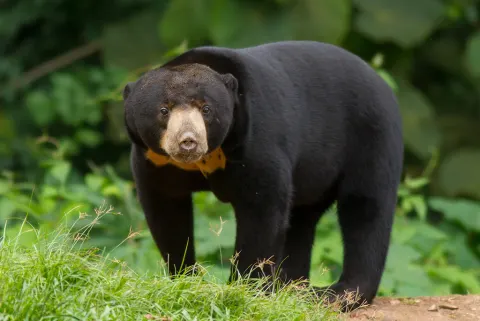
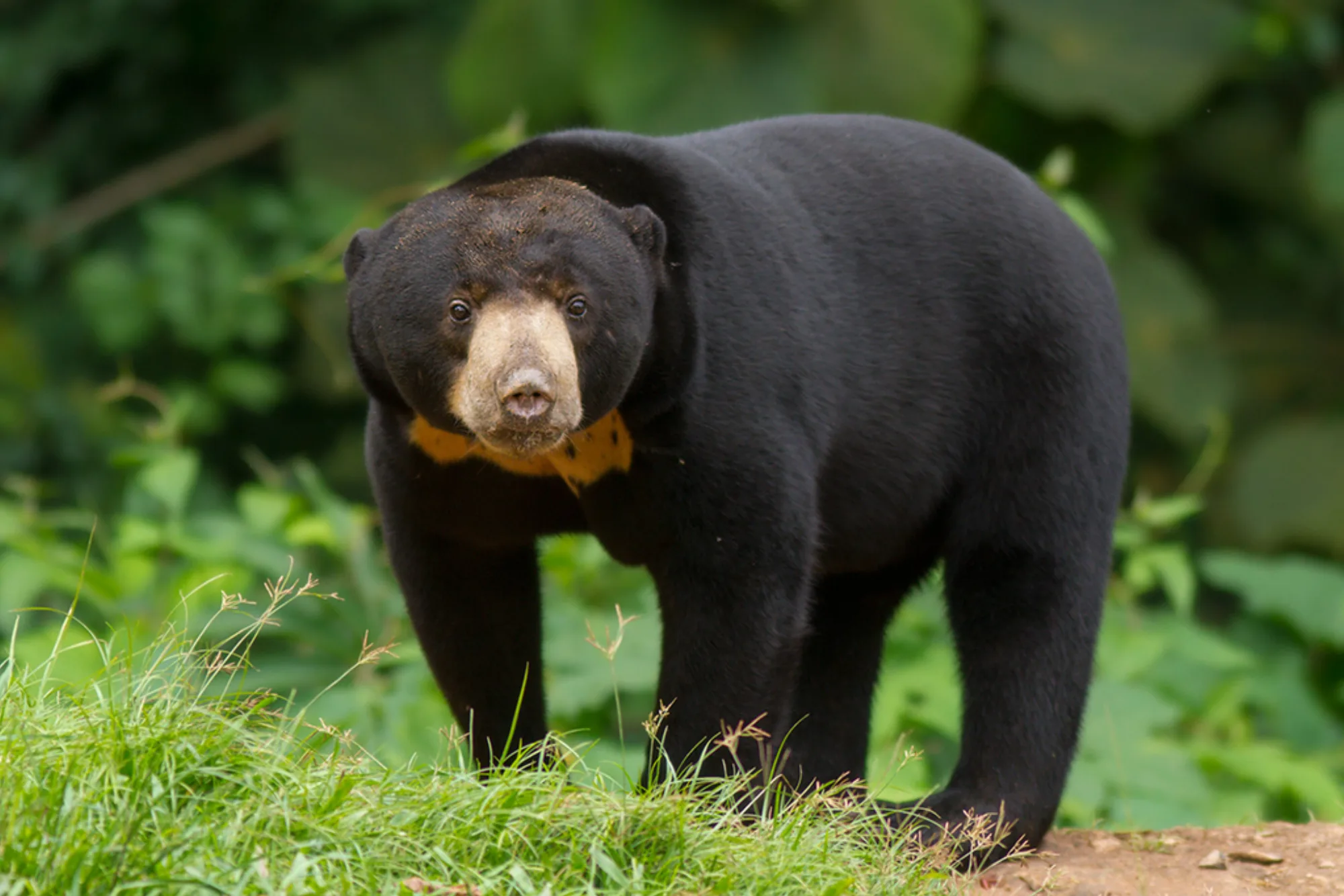
Small, stocky and built for climbing, the Sun Bear weighs 25 to 65 kg and reaches nearly 70 cm at the shoulder, making it the smallest of the bears. Its large paws carry strongly curved claws, while its ears are small and rounded and its snout is short. The short coat is usually jet black, though it can range from grey to red. A chest patch, often crescent-shaped and ranging from orange to cream, gives the bear its name, although some individuals have no patch.
Sun Bears live in the tropical forests of Southeast Asia, with a range extending from northeastern India through mainland Southeast Asia to Brunei, Indonesia and Malaysia. They inhabit deciduous and evergreen forests, generally at low altitudes, although they also occur in montane areas. Skilled climbers, they sleep or sunbathe in trees 2 to 7 m above the ground and also rest in hollow logs and tree cavities. They are mainly active by day, though they may be more nocturnal where people are often present. Usually solitary, a bear may sometimes be seen with another, as when a mother travels with her cub. Their varied diet includes ants, bees, beetles, termites, honey, seeds and fruit, with birds and deer eaten occasionally. Bears breed throughout the year, and mothers have one or two cubs that stay with them for around three years.
Heavy deforestation for agriculture and logging, along with forest fires, has reduced their habitat. Poaching for food and the wildlife trade is another serious threat, while bears can also be harmed in conflicts with people when they enter farmland, plantations and orchards.
Written from the English Wikipedia article Sun bear (CC BY-SA 4.0).
- Records
- 2
- Countries
- 2
No atlas park has a record of the Sun Bear in or around it yet.
These are open occurrence records, so they show where people looked for and recorded the Sun Bear as much as where it lives. Cells are up to 25 km across, and every location is generalised to its cell.
Generalised encounter areas, not exact locations. Each shape is a grid cell coloured by how likely the species is there.
- Very likelyThailand25 km zone · medium confidence · 2 records · updated 80 days ago
- LikelyCambodia25 km zone · low confidence · 0 records · updated 80 days ago
Conservation status not assessed here yet, so every location is generalised to its grid cell.